
- Private Label Toys
Annals of the Parish, by John Galt
Time: 2010-12-5 17:23:32 Author: Mother Day Gifts Kids Source: Our Team Views: Comments:0Summary: Transcribed from the 1910 T. N. Foulis edition by David Price,email [email protected] OFTHE PAR best weighted stuffed animals for the whole familyTranscribed from the 1910 T. N. Foulis edition by David Price,best weighted stuffed animals for the whole familyemail [email protected]
ANNALS OF
THE PARISHOR THE CHRONICLE OF DAL-
MAILING DURING THE MINISTRY
OF THE REV. MICAH BALWHID-
DER. WRITTEN BY HIMSELF
AND ARRANGED AND EDITED BY
JOHN GALT
ILLUSTRATED IN COLOUR BY
HENRY W. KERR, R.S.A.
T.N.FOULIS
London & Edinburgh
1 9 1 0September1910
Printed by Turnbull &Spears, Edinburgh
p.1INTRODUCTION
In the same year, and on the sameday of the same month, that his Sacred Majesty King George, thethird of the name, came to his crown and kingdom, I was placedand settled as the minister of Dalmailing. [1] When about a week thereafter thiswas known in the parish, it was thought a wonderful thing, andeverybody spoke of me and the new king as united in our trustsand temporalities, marvelling how the same should come to pass,and thinking the hand of Providence was in it, and that surely wewere preordained to fade and flourish in fellowship together;which has really been the case: for in the same season that hisMost Excellent Majesty, as he was very properly styled in theproclamations for the general fasts and thanksgivings, was set byas a precious vessel which had received a crack or a flaw, andcould only be serviceable in the way of an ornament, I wasobliged, by reason of age and the growing infirmities of myrecollection, to consent to the earnest entreaties of theSession, and to accept of Mr. Amos to be my helper. I waslong reluctant to do so; but the great respect that my people hadfor me, and the love that I bore towards them, over and above thesign that was given to me in the removal of the royalcandle-stick from its place, worked upon my heart andunderstanding, and I could not stand out. So, on the lastSabbath of the year 1810, I preached my last sermon, and it was amoving discourse. There were few dry eyes in the kirk thatday; for I had been with the aged from the beginning—theyoung considered me as their natural pastor—and my biddingthem all farewell was, as when of old among the heathen, an idolwas taken away by the hands of the enemy.
At the close of the worship, and before the blessing, Iaddressed them in a fatherly manner; and, although the kirk wasfuller than ever I saw it before, the fall of a pin might havebeen heard—at the conclusion there was a sobbing and muchsorrow. I said,
“My dear friends, I have now finished my work among youfor ever. I have often spoken to you from this place thewords of truth and holiness; and, had it been in poor frail humannature to practise the advice and counselling that I have givenin this pulpit to you, there would not need to be any cause forsorrow on this occasion—the close and latter end of myministry. But, nevertheless, I have no reason to complain;and it will be my duty to testify, in that place where I hope weare all one day to meet again, that I found you a docile and atractable flock, far more than at first I could haveexpected. There are among you still a few, but with greyheads and feeble hands now, that can remember the greatopposition that was made to my placing, and the stout part theythemselves took in the burly, because I was appointed by thepatron; but they have lived to see the error of their way, and toknow that preaching is the smallest portion of the duties of afaithful minister. I may not, my dear friends, have appliedmy talent in the pulpit so effectually as perhaps I might havedone, considering the gifts that it pleased God to give me inthat way, and the education that I had in the Orthodox Universityof Glasgow, as it was in the time of my youth; nor can I saythat, in the works of peace-making and charity, I have done allthat I should have done. But I have done my best, studyingno interest but the good that was to rise according to the faithin Christ Jesus.
“To my young friends I would, as a parting word, say,look to the lives and conversation of your parents—theywere plain, honest, and devout Christians, fearing God andhonouring the King. They believed the Bible was the word ofGod; and, when they practised its precepts, they found, by thegood that came from them, that it was truly so. They borein mind the tribulation and persecution of their forefathers forrighteousness’ sake, and were thankful for the quiet andprotection of the government in their day and generation. Their land was tilled with industry, and they ate the bread ofcarefulness with a contented spirit, and, verily, they had thereward of well-doing even in this world; for they beheld on allsides the blessing of God upon the nation, and the tree growing,and the plough going where the banner of the oppressor wasplanted of old, and the war-horse trampled in the blood ofmartyrs. Reflect on this, my young friends, and know, thatthe best part of a Christian’s duty in this world of muchevil, is to thole and suffer with resignation, as lang as it ispossible for human nature to do. I do not counsel passiveobedience: that is a doctrine that the Church of Scotland cannever abide; but the divine right of resistance, which, in thedays of her trouble, she so bravely asserted against popish andprelatic usurpations, was never resorted to till the attempt wasmade to remove the ark of the tabernacle from her. Itherefore counsel you, my young friends, not to lend your ears tothose that trumpet forth their hypothetical politics; but tobelieve that the laws of the land are administered with a goodintent, till in your own homes and dwellings ye feel the presenceof the oppressor—then, and not till then, are ye free togird your loins for battle—and woe to him, and woe to theland where that is come to, if the sword be sheathed till thewrong be redressed.
“As for you, my old companions, many changes have weseen in our day; but the change that we ourselves are soon toundergo will be the greatest of all. We have seen ourbairns grow to manhood—we have seen the beauty of youthpass away—we have felt our backs become unable for theburthen, and our right hand forget its cunning.—Our eyeshave become dim, and our heads grey—we are now totteringwith short and feckless steps towards the grave; and some, thatshould have been here this day, are bed-rid, lying, as it were,at the gates of death, like Lazarus at the threshold of the richman’s door, full of ails and sores, and having no enjoymentbut in the hope that is in hereafter. What can I say to youbut farewell! Our work is done—we are weary and wornout, and in need of rest—may the rest of the blessed be ourportion!—and in the sleep that all must sleep, beneath thecold blanket of the kirkyard grass, and on that clay pillow wherewe must shortly lay our heads, may we have pleasant dreams, tillwe are awakened to partake of the everlasting banquet of thesaints in glory!”
When I had finished, there was for some time a great solemnitythroughout the kirk; and, before giving the blessing, I sat downto compose myself, for my heart was big, and my spirit oppressedwith sadness.
As I left the pulpit, all the elders stood on the steps tohand me down, and the tear was in every eye, and they helped meinto the session-house; but I could not speak to them, nor themto me. Then Mr. Dalziel, who was always a composed andsedate man, said a few words of prayer, and I was comfortedtherewith, and rose to go home to the manse; but in thechurchyard all the congregation was assembled, young and old, andthey made a lane for me to the back-yett that opened into themanse-garden—Some of them put out their hands and touchedme as I passed, followed by the elders, and some of themwept. It was as if I was passing away, and to be nomore—verily, it was the reward of my ministry—afaithful account of which, year by year, I now sit down, in theevening of my days, to make up, to the end that I may bearwitness to the work of a beneficent Providence, even in thenarrow sphere of my parish, and the concerns of that flock ofwhich it was His most gracious pleasure to make me the unworthyshepherd.
p. 7CHAPTERI
YEAR 1760The Anno Domini one thousand sevenhundred and sixty, was remarkable for three things in the parishof Dalmailing.—First and foremost, there was my placing;then the coming of Mrs. Malcolm with her five children to settleamong us; and next, my marriage upon my own cousin, Miss BettyLanshaw, by which the account of this year naturally dividesitself into three heads or portions.
First, of the placing.—It was a great affair; for I wasput in by the patron, and the people knew nothing whatsoever ofme, and their hearts were stirred into strife on the occasion,and they did all that lay within the compass of their power tokeep me out, insomuch, that there was obliged to be a guard ofsoldiers to protect the presbytery; and it was a thing that mademy heart grieve when I heard the drum beating and the fifeplaying as we were going to the kirk. The people werereally mad and vicious, and flung dirt upon us as we passed, andreviled us all, and held out the finger of scorn at me; but Iendured it with a resigned spirit, compassionating theirwilfulness and blindness. Poor old Mr. Kilfuddy of theBraehill got such a clash of glar on the side of his face, thathis eye was almost extinguished.
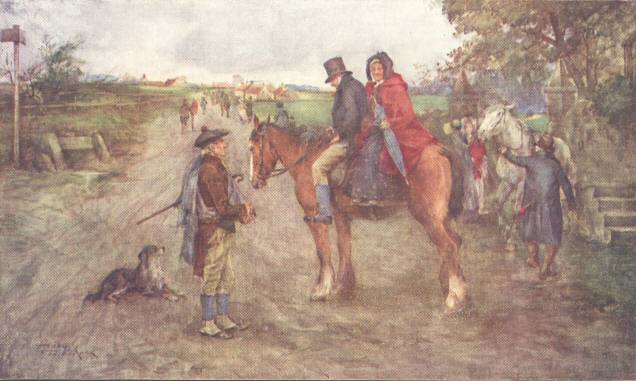
When we got to the kirk door, it was found to be nailed up, soas by no possibility to be opened. The sergeant of thesoldiers wanted to break it, but I was afraid that the heritorswould grudge and complain of the expense of a new door, and Isupplicated him to let it be as it was: we were, therefore,obligated to go in by a window, and the crowd followed us in themost unreverent manner, making the Lord’s house like an innon a fair day, with their grievous yellyhooing. During thetime of the psalm and the sermon, they behaved themselves better,but when the induction came on, their clamour was dreadful; andThomas Thorl, the weaver, a pious zealot in that time, he got upand protested, and said, “Verily, verily, I say unto you,he that entereth not by the door into the sheepfold, but climbethup some other way, the same is a thief and a robber.” And I thought I would have a hard and sore time of it with suchan outstrapolous people. Mr. Given, that was then theminister of Lugton, was a jocose man, and would have his jokeeven at a solemnity. When the laying of the hands upon mewas adoing, he could not get near enough to put on his, but hestretched out his staff and touched my head, and said, to thegreat diversion of the rest, “This will do well enough,timber to timber;” but it was an unfriendly saying of Mr.Given, considering the time and the place, and the temper of mypeople.
After the ceremony, we then got out at the window, and it wasa heavy day to me; but we went to the manse, and there we had anexcellent dinner, which Mrs. Watts of the new inns of Irville [9] prepared at my request, and sent herchaise-driver to serve, for he was likewise her waiter, shehaving then but one chaise, and that no often called for.
But, although my people received me in this unruly manner, Iwas resolved to cultivate civility among them, and therefore, thevery next morning I began a round of visitations; but, oh! it wasa steep brae that I had to climb, and it needed a stoutheart. For I found the doors in some places barred againstme; in others, the bairns, when they saw me coming, ran crying totheir mothers, “Here’s the feckless Mess-John!”and then, when I went into the houses, their parents wouldna askme to sit down, but with a scornful way, said, “Honest man,what’s your pleasure here?” Nevertheless, Iwalked about from door to door like a dejected beggar, till I gotthe almous deed of a civil reception—and who would havethought it?—from no less a person than the same ThomasThorl that was so bitter against me in the kirk on the foregoingday.
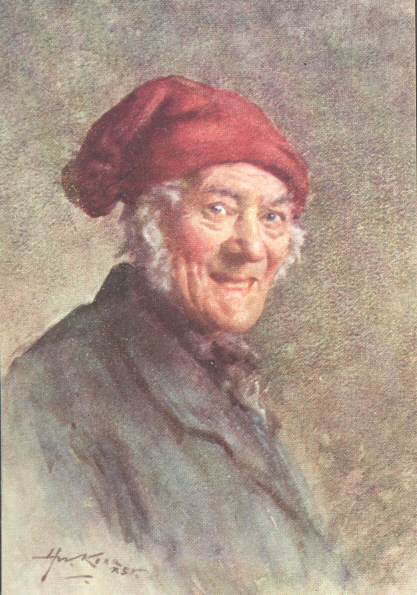
Thomas was standing at the door with his green duffle apron,and his red Kilmarnock nightcap—I mind him as well as if itwas but yesterday—and he had seen me going from house tohouse, and in what manner I was rejected, and his bowels weremoved, and he said to me in a kind manner, “Come in, sir,and ease yoursel’: this will never do, the clergy areGod’s gorbies, and for their Master’s sake it behovesus to respect them. There was no ane in the whole parishmair against you than mysel’; but this early visitation isa symptom of grace that I couldna have expectit from a bird outthe nest of patronage.” I thanked Thomas, and went inwith him, and we had some solid conversation together, and I toldhim that it was not so much the pastor’s duty to feed theflock, as to herd them well; and that, although there might besome abler with the head than me, there wasna a he within thebounds of Scotland more willing to watch the fold by night and byday. And Thomas said he had not heard a mair sound observefor some time, and that, if I held to that doctrine in thepoopit, it wouldna be lang till I would work achange.—“I was mindit,” quoth he, “neverto set my foot within the kirk door while you were there; but totestify, and no to condemn without a trial, I’ll be therenext Lord’s day, and egg my neighbours to be likewise, soye’ll no have to preach just to the bare walls and thelaird’s family.”
I have now to speak of the coming of Mrs. Malcolm.—Shewas the widow of a Clyde shipmaster, that was lost at sea withhis vessel. She was a genty body, calm andmethodical. From morning to night she sat at her wheel,spinning the finest lint, which suited well with her palehands. She never changed her widow’s weeds, and shewas aye as if she had just been ta’en out of abandbox. The tear was aften in her e’e when thebairns were at the school; but when they came home, her spiritwas lighted up with gladness, although, poor woman, she had manya time very little to give them. They were, however,wonderful well-bred things, and took with thankfulness whatevershe set before them; for they knew that their father, thebreadwinner, was away, and that she had to work sore for theirbit and drap. I dare say, the only vexation that ever shehad from any of them, on their own account, was when Charlie, theeldest laddie, had won fourpence at pitch-and-toss at the school,which he brought home with a proud heart to his mother. Ihappened to be daunrin’ by at the time, and just looked inat the door to say gude-night: it was a sad sight. Therewas she sitting with the silent tear on her cheek, and Charliegreeting as if he had done a great fault, and the other fourlooking on with sorrowful faces. Never, I am sure, didCharlie Malcolm gamble after that night.
I often wondered what brought Mrs. Malcolm to our clachan,instead of going to a populous town, where she might have takenup a huxtry-shop, as she was but of a silly constitution, thewhich would have been better for her than spinning from morningto far in the night, as if she was in verity drawing the threadof life. But it was, no doubt, from an honest pride to hideher poverty; for when her daughter Effie was ill with themeasles—the poor lassie was very ill—nobody thoughtshe could come through, and when she did get the turn, she wasfor many a day a heavy handful;—our session being rich, andnobody on it but cripple Tammy Daidles, that was at that timeknown through all the country side for begging on a horse, Ithought it my duty to call upon Mrs. Malcolm in a sympathisingway, and offer her some assistance, but she refused it.
“No, sir,” said she, “I canna take help fromthe poor’s-box, although it’s very true that I am ingreat need; for it might hereafter be cast up to my bairns, whomit may please God to restore to better circumstances when I am noto see’t; but I would fain borrow five pounds, and if, sir,you will write to Mr. Maitland, that is now the Lord Provost ofGlasgow, and tell him that Marion Shaw would be obliged to himfor the lend of that soom, I think he will not fail to sendit.”
I wrote the letter that night to Provost Maitland, and, by theretour of the post, I got an answer, with twenty pounds for Mrs.Malcolm, saying, “That it was with sorrow he heard so smalla trifle could be serviceable.” When I took theletter and the money, which was in a bank-bill, she said,“This is just like himsel’.” She thentold me that Mr. Maitland had been a gentleman’s son of theeast country, but driven out of his father’s house, when aladdie, by his stepmother; and that he had served as a servantlad with her father, who was the Laird of Yillcogie, but ranthrough his estate, and left her, his only daughter, in littlebetter than beggary with her auntie, the mother of CaptainMalcolm, her husband that was. Provost Maitland in hisservitude had ta’en a notion of her; and when he recoveredhis patrimony, and had become a great Glasgow merchant, onhearing how she was left by her father, he offered to marry her,but she had promised herself to her cousin the captain, whosewidow she was. He then married a rich lady, and in timegrew, as he was, Lord Provost of the city; but his letter withthe twenty pounds to me, showed that he had not forgotten hisfirst love. It was a short, but a well-written letter, in afair hand of write, containing much of the true gentleman; andMrs. Malcolm said, “Who knows but out of the regard he oncehad for their mother, he may do something for my five helplessorphans.”
Thirdly, Upon the subject of taking my cousin, Miss BettyLanshaw, for my first wife, I have little to say.—It wasmore out of a compassionate habitual affection, than the passionof love. We were brought up by our grandmother in the samehouse, and it was a thing spoken of from the beginning, thatBetty and me were to be married. So, when she heard thatthe Laird of Breadland had given me the presentation ofDalmailing, she began to prepare for the wedding; and as soon asthe placing was well over, and the manse in order, I gaed to Ayr,where she was, and we were quietly married, and came home in achaise, bringing with us her little brother Andrew, that died inthe East Indies, and he lived and was brought up by us.
Now, this is all, I think, thathappened in that year worthy of being mentioned, except that atthe sacrament, when old Mr. Kilfuddy was preaching in the tent,it came on such a thunder-plump, that there was not a single soulstayed in the kirkyard to hear him; for the which he was greatlymortified, and never after came to our preachings.
p.15CHAPTER II
YEAR 1761It was in this year that the greatsmuggling trade corrupted all the west coast, especially thelaigh lands about the Troon and the Loans. The tea wasgoing like the chaff, the brandy like well-water, and the wastrieof all things was terrible. There was nothing minded butthe riding of cadgers by day, and excisemen by night—andbattles between the smugglers and the king’s men, both bysea and land. There was a continual drunkenness anddebauchery; and our session, that was but on the lip of thiswhirlpool of iniquity, had an awful time o’t. I didall that was in the power of nature to keep my people from thecontagion: I preached sixteen times from the text, “Renderto Cæsar the things that areCæsar’s.” I visited, and I exhorted; Iwarned, and I prophesied; I told them that, although the moneycame in like sclate stones, it would go like the snow off thedyke. But for all I could do, the evil got in among us, andwe had no less than three contested bastard bairns upon our handsat one time, which was a thing never heard of in a parish of theshire of Ayr since the Reformation. Two of the bairns,after no small sifting and searching, we got fathered at last;but the third, that was by Meg Glaiks, and given to one RabRickerton, was utterly refused, though the fact was not denied;but he was a termagant fellow, and snappit his fingers at theelders. The next day he listed in the Scotch Greys, whowere then quartered at Ayr, and we never heard more of him, butthought he had been slain in battle, till one of the parish,about three years since, went up to London to lift a legacy froma cousin that died among the Hindoos. When he was walkingabout, seeing the curiosities, and among others Chelsea Hospital,he happened to speak to some of the invalids, who found out fromhis tongue that he was a Scotchman; and speaking to the invalids,one of them, a very old man, with a grey head and a leg oftimber, inquired what part of Scotland he was come from; and whenhe mentioned my parish, the invalid gave a great shout, and saidhe was from the same place himself; and who should this old manbe, but the very identical Rab Rickerton, that was art and partin Meg Glaiks’ disowned bairn. Then they had a longconverse together, and he had come through many hardships, buthad turned out a good soldier; and so, in his old days, was anindoor pensioner, and very comfortable; and he said that he had,to be sure, spent his youth in the devil’s service, and hismanhood in the king’s, but his old age was given to that ofhis Maker, which I was blithe and thankful to hear; and heenquired about many a one in the parish, the blooming and thegreen of his time, but they were all dead and buried; and he hada contrite and penitent spirit, and read his Bible every day,delighting most in the Book of Joshua, the Chronicles, and theKings.
Before this year, the drinking of tea was little known in theparish, saving among a few of the heritors’ houses on aSabbath evening; but now it became very rife: yet the commonersort did not like to let it be known that they were taking to thenew luxury, especially the elderly women, who, for that reason,had their ploys in out-houses and by-places, just as the witcheslang syne had their sinful possets and galravitchings; and theymade their tea for common in the pint-stoup, and drank it out ofcaps and luggies, for there were but few among them that had cupsand saucers. Well do I remember one night in harvest, inthis very year, as I was taking my twilight dauner aneath thehedge along the back side of Thomas Thorl’s yard,meditating on the goodness of Providence, and looking at thesheaves of victual on the field, that I heard his wife, and twothree other carlins, with their Bohea in the inside of the hedge,and no doubt but it had a lacing of the conek, [17] for they were all cracking likepen-guns. But I gave them a sign, by a loud host, thatProvidence sees all, and it skailed the bike; for I heard them,like guilty creatures, whispering, and gathering up theirtruck-pots and trenchers, and cowering away home.
It was in this year that Patrick Dilworth (he had beenschoolmaster of the parish from the time, as his wife said, ofAnna Regina, and before the Rexes came to the crown), wasdisabled by a paralytic, and the heritors, grudging the cost ofanother schoolmaster as long as he lived, would not allow thesession to get his place supplied, which was a wrong thing, Imust say, of them; for the children of the parishioners wereobliged, therefore, to go to the neighbouring towns for theirschooling, and the custom was to take a piece of bread and cheesein their pockets for dinner, and to return in the evening alwaysvoracious for more, the long walk helping the natural crave oftheir young appetites. In this way Mrs. Malcolm’s twoeldest laddies, Charlie and Robert, were wont to go to Irville,and it was soon seen that they kept themselves aloof from theother callans in the clachan, and had a genteeler turn than thegrulshy bairns of the cottars. Her bit lassies, Kate andEffie, were better off; for some years before, Nanse Banks hadtaken up a teaching in a garret-room of a house, at the cornerwhere John Bayne has biggit the sclate-house for hisgrocery-shop. Nanse learnt them reading and workingstockings, and how to sew the semplar, for twal-penniesa-week. She was a patient creature, well cut out for hercalling, with blear een, a pale face, and a long neck, but meekand contented withal, tholing the dule of this world with aChristian submission of the spirit; and her garret-room was acordial of cleanliness, for she made the scholars set the housein order, time and time about, every morning; and it was a commonremark for many a day, that the lassies, who had been at NanseBanks’s school, were always well spoken of, both for theircivility, and the trigness of their houses when they wereafterwards married. In short, I do not know, that in allthe long epoch of my ministry, any individual body did more toimprove the ways of the parishioners, in their domestic concerns,than did that worthy and innocent creature, Nanse Banks, theschoolmistress; and she was a great loss when she was removed, asit is to be hoped, to a better world; but anent this I shall haveto speak more at large hereafter.
It was in this year that my patron, the Laird of Breadland,departed this life, and I preached his funeral sermon; but he wasnon-beloved in the parish; for my people never forgave him forputting me upon them, although they began to be more on afamiliar footing with myself. This was partly owing to myfirst wife, Betty Lanshaw, who was an active throughgoing woman,and wonderfu’ useful to many of the cottars’ wives attheir lying-in; and when a death happened among them, her helpinghand, and any thing we had at the manse, was never wanting; and Iwent about myself to the bedsides of the frail, leaving no stoneunturned to win the affections of my people, which, by theblessing of the Lord, in process of time, was brought to abearing.
But a thing happened in this year, which deserves to berecorded, as manifesting what effect the smuggling was beginningto take in the morals of the country side. One Mr.Macskipnish, of Highland parentage, who had been avalet-de-chambre with a major in the campaigns, and taken aprisoner with him by the French, he having come home in a cartel,took up a dancing-school at Irville, the which art he had learntin the genteelest fashion, in the mode of Paris, at the Frenchcourt. Such a thing as a dancing-school had never, in thememory of man, been known in our country side; and there was sucha sound about the steps and cottillions of Mr. Macskipnish, thatevery lad and lass, that could spare time and siller, went tohim, to the great neglect of their work. The very bairns onthe loan, instead of their wonted play, gaed linking and loupingin the steps of Mr. Macskipnish, who was, to be sure, a greatcuriosity, with long spindle legs, his breast shot out like aduck’s, and his head powdered and frizzled up like atappit-hen. He was, indeed, the proudest peacock that couldbe seen, and he had a ring on his finger, and when he came todrink his tea at the Breadland, he brought no hat on his head,but a droll cockit thing under his arm, which, he said, was afterthe manner of the courtiers at the petty suppers of one MadamPompadour, who was at that time the concubine of the Frenchking.
I do not recollect any other remarkable thing that happened inthis year. The harvest was very abundant, and the meal socheap, that it caused a great defect in my stipend; so that I wasobligated to postpone the purchase of a mahogany scrutoire for mystudy, as I had intended. But I had not the heart tocomplain of this: on the contrary, I rejoiced thereat; for whatmade me want my scrutoire till another year, had carriedblitheness into the hearth of the cottar, and made thewidow’s heart sing with joy; and I would have been anunnatural creature, had I not joined in the universal gladness,because plenty did abound.
p.22CHAPTER III
YEAR 1762The third year of my ministry waslong held in remembrance for several very memorable things. William Byres of the Loanhead had a cow that calved two calves atone calving; Mrs. Byres, the same year, had twins, male andfemale; and there was such a crop on his fields, testifying thatthe Lord never sends a mouth into the world without providingmeat for it. But what was thought a very daunting sign ofsomething, happened on the Sacrament Sabbath at the conclusion ofthe action sermon, when I had made a very suitablediscourse. The day was tempestuous, and the wind blew withsuch a pith and birr, that I thought it would have twirled thetrees in the kirkyard out by the roots, and, blowing in thismanner, it tirled the thack from the rigging of the manse stable;and the same blast that did that, took down the lead that was onthe kirk-roof, which hurled off, as I was saying, at theconclusion of the action sermon, with such a dreadful sound, asthe like was never heard, and all the congregation thought thatit betokened a mutation to me. However, nothing particularhappened to me; but the smallpox came in among the weans of theparish, and the smashing that it made of the poor bits o’bairns was indeed woeful.
One Sabbath, when the pestilence was raging, I preached asermon about Rachel weeping for her children, which Thomas Thorl,who was surely a great judge of good preaching, said, “wasa monument of divinity whilk searched the heart of many a parentthat day;” a thing I was well pleased to hear, for Thomas,as I have related at length, was the most zealous championagainst my getting the parish; but, from this time, I set himdown in my mind for the next vacancy among the elders. Worthy man! it was not permitted him to arrive at thathonour. In the fall of that year he took an income in hislegs, and couldna go about, and was laid up for the remainder ofhis days, a perfect Lazarus, by the fire-side. But he waswell supported in his affliction. In due season, when itpleased Him that alone can give and take, to pluck him from thislife, as the fruit ripened and ready for the gathering, hisdeath, to all that knew him, was a gentle dispensation, for trulyhe had been in sore trouble.
It was in this year that Charlie Malcolm, Mrs. Malcolm’seldest son, was sent to be a cabin-boy in the Tobacco trader, athree-masted ship, that sailed between Port-Glasgow and Virginiain America. She was commanded by Captain Dickie, an Irvilleman; for at that time the Clyde was supplied with the bestsailors from our coast, the coal-trade with Ireland being abetter trade for bringing up good mariners than the long voyagesin the open sea; which was the reason, as I often heard said, whythe Clyde shipping got so many of their men from our countryside. The going to sea of Charlie Malcolm was, on diversaccounts, a very remarkable thing to us all; for he was the firstthat ever went from our parish, in the memory of man, to be asailor, and everybody was concerned at it, and some thought itwas a great venture of his mother to let him, his father havingbeen lost at sea. But what could the forlorn widowdo? She had five weans, and little to give them; and, asshe herself said, he was aye in the hand of his Maker, go wherehe might; and the will of God would be done, in spite of allearthly wiles and devices to the contrary.
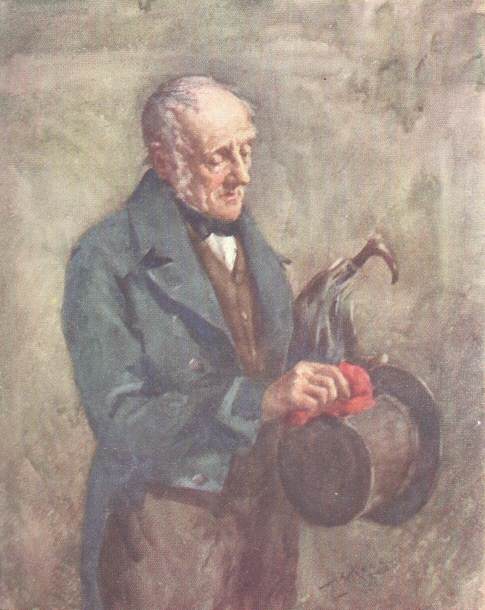
On the Monday morning, when Charlie was to go away to meet theIrville carrier on the road, we were all up, and I walked bymyself from the manse into the clachan to bid him farewell, and Imet him just coming from his mother’s door, as blithe as abee, in his sailor’s dress, with a stick, and a bundle tiedin a Barcelona silk handkerchief hanging o’er his shoulder,and his two little brothers were with him, and his sisters, Kateand Effie, looking out from the door all begreeten; but hismother was in the house, praying to the Lord to protect herorphan, as she afterwards told me. All the weans of theclachan were gathered at the kirkyard yett to see him pass, andthey gave him three great shouts as he was going by; andeverybody was at their doors, and said something encouraging tohim; but there was a great laugh when auld Mizy Spaewell camehirpling with her bauchle in her hand, and flung it after him forgood-luck. Mizy had a wonderful faith in freats, and wasjust an oracle of sagacity at expounding dreams, and bodes ofevery sort and description—besides, she was reckoned one ofthe best howdies in her day; but by this time she was grown frailand feckless, and she died the same year on Hallowe’en,which made everybody wonder that it should have so fallen out forher to die on Hallowe’en.
Shortly after the departure of Charlie Malcolm, the Lady ofBreadland, with her three daughters, removed to Edinburgh, wherethe young laird, that had been my pupil, was learning to be anadvocate, and the Breadland-house was set to Major Gilchrist, anabob from India; but he was a narrow ailing man, and hismaiden-sister, Miss Girzie, was the scrimpetest creature thatcould be; so that, in their hands, all the pretty policy of theBreadlands, that had cost a power of money to the old laird thatwas my patron, fell into decay and disorder; and the bonnyyew-trees that were cut into the shape of peacocks, soon grew outof all shape, and are now doleful monuments of the major’stack, and that of Lady Skimmilk, as Miss Girzie Gilchrist, hissister, was nick-named by every ane that kent her.
But it was not so much on account of the neglect of theBreadland, that the incoming of Major Gilchrist was to bedeplored. The old men that had a light labour in keepingthe policy in order, were thrown out of bread, and could dolittle; and the poor women that whiles got a bit and a drap fromthe kitchen of the family, soon felt the change, so that bylittle and little we were obligated to give help from thesession; insomuch that, before the end of the year, I wasnecessitated to preach a discourse on almsgiving, specially forthe benefit of our own poor, a thing never before known in theparish.
But one good thing came from the Gilchrists to Mrs.Malcolm. Miss Girzie, whom they called Lady Skimmilk, hadbeen in a very penurious way as a seamstress, in the Gorbals ofGlasgow, while her brother was making the fortune in India, andshe was a clever needle-woman—none better, as it was said;and she, having some things to make, took Kate Malcolm to helpher in the coarse work; and Kate, being a nimble and birky thing,was so useful to the lady, and the complaining man the major,that they invited her to stay with them at the Breadland for thewinter, where, although she was holden to her seam from morningto night, her food lightened the hand of her mother, who, for thefirst time since her coming into the parish, found the penny forthe day’s darg more than was needed for the meal-basin; andthe tea-drinking was beginning to spread more openly, insomuchthat, by the advice of the first Mrs. Balwhidder, Mrs. Malcolmtook in tea to sell, and in this way was enabled to eke somethingto the small profits of her wheel. Thus the tide that hadbeen so long ebbing to her, began to turn; and here I am bound intruth to say, that although I never could abide the smuggling,both on its own account, and the evils that grew therefrom to thecountry side, I lost some of my dislike to the tea after Mrs.Malcolm began to traffic in it, and we then had it for ourbreakfast in the morning at the manse, as well as in theafternoon. But what I thought most of it for was, that itdid no harm to the head of the drinkers, which was not always thecase with the possets that were in fashion before. There isno meeting now in the summer evenings, as I remember oftenhappened in my younger days, with decent ladies coming home withred faces, tosy and cosh, from a posset-masking; so, both for itstemperance and on account of Mrs. Malcolm’s sale, Irefrained from the November in this year to preach against tea;but I never lifted the weight of my displeasure from off thesmuggling trade, until it was utterly put down by the strong handof government.
There was no other thing of note in this year, saving onlythat I planted in the garden the big pear-tree, which had the twogreat branches that we call the Adam and Eve. I got theplant, then a sapling, from Mr. Graft, that was LordEaglesham’s head-gardener; and he said it was, as indeedall the parish now knows well, a most juicy sweet pear, such aswas not known in Scotland till my lord brought down the fatherplant from the king’s garden in London, in the forty-fivewhen he went up to testify his loyalty to the House ofHanover.
p.29CHAPTER IV
YEAR 1763The An. Dom. 1763, was, in many arespect, a memorable year, both in public and in private. The King granted peace to the French, and Charlie Malcolm, thatwent to sea in the Tobacco trader, came home to see hismother. The ship, after being at America, had gone down toJamaica, an island in the West Indies, with a cargo of livelumber, as Charlie told me himself, and had come home with morethan a hundred and fifty hoggits of sugar, and sixty-threepuncheons full of rum; for she was, by all accounts, a statelygalley, and almost two hundred tons in the burthen, being thelargest vessel then sailing from the creditable town ofPort-Glasgow. Charlie was not expected; and his coming wasa great thing to us all, so I will mention the wholeparticulars.
One evening, towards the gloaming, as I was taking my walk ofmeditation, I saw a brisk sailor laddie coming towards me. He had a pretty green parrot sitting on a bundle, tied in aBarcelona silk handkerchief, which he carried with a stick overhis shoulder, and in this bundle was a wonderful big nut, such asno one in our parish had ever seen. It was called acocker-nut. This blithe callant was Charlie Malcolm, whohad come all the way that day his leeful lane, on his own legsfrom Greenock, where the Tobacco trader was then ’liveringher cargo. I told him how his mother, and his brothers, andhis sisters were all in good health, and went to convoy him home;and as we were going along, he told me many curious things, andhe gave me six beautiful yellow limes, that he had brought in hispouch all the way across the seas, for me to make a bowl of punchwith, and I thought more of them than if they had been goldenguineas, it was so mindful of the laddie.
When we got to the door of his mother’s house, she wassitting at the fireside, with her three other bairns at theirbread and milk, Kate being then with Lady Skimmilk, at theBreadland, sewing. It was between the day and dark, whenthe shuttle stands still till the lamp is lighted. But sucha shout of joy and thankfulness as rose from that hearth, whenCharlie went in! The very parrot, ye would have thought,was a participator, for the beast gied a skraik that made mywhole head dirl; and the neighbours came flying and flocking tosee what was the matter, for it was the first parrot ever seenwithin the bounds of the parish, and some thought it was but aforeign hawk, with a yellow head and green feathers.
In the midst of all this, Effie Malcolm had run off to theBreadland for her sister Kate, and the two lassies came flyingbreathless, with Miss Girzie Gilchrist, the Lady Skimmilk,pursuing them like desperation, or a griffin, down the avenue;for Kate, in her hurry, had flung down her seam, a new printedgown, that she was helping to make, and it had fallen into aboyne of milk that was ready for the creaming, by which issued adouble misfortune to Miss Girzie, the gown being not only ruined,but licking up the cream. For this, poor Kate was notallowed ever to set her face in the Breadland again.
When Charlie Malcolm had stayed about a week with his mother,he returned to his berth in the Tobacco trader, and shortly afterhis brother Robert was likewise sent to serve his time to thesea, with an owner that was master of his own bark, in the coaltrade at Irville. Kate, who was really a surprising lassiefor her years, was taken off her mother’s hands by the oldLady Macadam, that lived in her jointure house, which is now theCross Keys Inn. Her ladyship was a woman of high breeding,her husband having been a great general, and knighted by the kingfor his exploits; but she was lame, and could not move about inher dining-room without help; so hearing from the first Mrs.Balwhidder how Kate had done such an unatonable deed to MissGirzie Gilchrist, she sent for Kate, and, finding her sharp andapt, she took her to live with her as a companion. This wasa vast advantage, for the lady was versed in all manner ofaccomplishments, and could read and speak French with more easethan any professor at that time in the College of Glasgow; andshe had learnt to sew flowers on satin, either in a nunneryabroad, or in a boarding-school in England, and took pleasure inteaching Kate all she knew, and how to behave herself like alady.
In the summer of this year, old Mr. Patrick Dilworth, that hadso long been doited with the paralytics, died, and it was a greatrelief to my people, for the heritors could no longer refuse toget a proper schoolmaster; so we took on trial Mr. Lorimore, whohas ever since the year after, with so much credit to himself,and usefulness to the parish, been schoolmaster, session clerk,and precentor—a man of great mildness and extraordinaryparticularity. He was then a very young man, and someobjection was made, on account of his youth, to his beingsession-clerk, especially as the smuggling immorality still gaveus much trouble in the making up of irregular marriages; but hisdiscretion was greater than could have been hoped for from hisyears; and, after a twelvemonth’s probation in the capacityof schoolmaster, he was installed in all the offices that hadbelonged to his predecessor, old Mr. Patrick Dilworth thatwas.
But the most memorable thing that befell among my people thisyear, was the burning of the lint-mill on the Lugton water, whichhappened, of all the days of the year, on the very selfsame daythat Miss Girzie Gilchrist, better known as Lady Skimmilk, hiredthe chaise from Mrs. Watts of the New Inns of Irville, to go withher brother, the major, to consult the faculty in Edinburghconcerning his complaints. For, as the chaise was coming bythe mill, William Huckle, the miller that was, came flying out ofthe mill like a demented man, crying fire!—and it was thedriver that brought the melancholy tidings to theclachan—and melancholy they were; for the mill was utterlydestroyed, and in it not a little of all that year’s cropof lint in our parish. The first Mrs. Balwhidder lostupwards of twelve stone, which we had raised on the glebe with nosmall pains, watering it in the drouth, as it was intended forsarking to ourselves, and sheets and napery. A great lossindeed it was, and the vexation thereof had a visible effect onMrs. Balwhidder’s health, which from the spring had been ina dwining way. But for it, I think she might have wrestledthrough the winter: however, it was ordered otherwise, and shewas removed from mine to Abraham’s bosom on Christmas-day,and buried on Hogmanay, for it was thought uncanny to have a deadcorpse in the house on the new-year’s day. She was aworthy woman, studying with all her capacity to win the hearts ofmy people towards me—in the which good work she prosperedgreatly; so that, when she died, there was not a single soul inthe parish that was not contented with both my walk andconversation. Nothing could be more peaceable than the waywe lived together. Her brother Andrew, a fine lad, I hadsent to the college at Glasgow, at my own cost; and when he cameout to the burial, he stayed with me a month, for the manse afterher decease was very dull, and it was during this visit that hegave me an inkling of his wish to go out to India as a cadet, butthe transactions anent that fall within the scope of anotheryear—as well as what relates to her headstone, and theepitaph in metre, which I indicated myself thereon; John Truelthe mason carving the same, as may be seen in the kirkyard, whereit wants a little reparation and setting upright, having settledthe wrong way when the second Mrs. Balwhidder was laid by herside.—But I must not here enter upon an anticipation.
p.35CHAPTER V
YEAR 1764This year well deserved the name ofthe monumental year in our parish; for the young laird of theBreadland, that had been my pupil, being learning to be anadvocate among the faculty in Edinburgh, with his lady mother,who had removed thither with the young ladies her daughters, forthe benefit of education, sent out to be put up in the kirk,under the loft over the family vault, an elegant marbleheadstone, with an epitaph engraven thereon, in fair Latin,setting forth many excellent qualities which the old laird, mypatron that was, the inditer thereof said he possessed. Isay the inditer, because it couldna have been the young lairdhimself, although he got the credit o’t on the stone, forhe was nae daub in my aught at the Latin or any otherlanguage. However, he might improve himself at Edinburgh,where a’ manner of genteel things were then to be got at aneasy rate, and doubtless the young laird got a probationer at theCollege to write the epitaph; but I have often wonderedsin’ syne, how he came to make it in Latin, for assuredlyhis dead parent, if he could have seen it, could not have read asingle word o’t, notwithstanding it was so vaunty about hisvirtues, and other civil and hospitable qualifications.
The coming of the laird’s monumental stone had a greateffect on me, then in a state of deep despondency for the loss ofthe first Mrs. Balwhidder; and I thought I could not do a betterthing, just by way of diversion in my heavy sorrow, than to get awell-shapen headstone made for her—which, as I have hintedat in the record of the last year, was done and set up. Buta headstone without an epitaph, is no better than a body withoutthe breath of life in’t; and so it behoved me to make apoesy for the monument, the which I conned and pondered upon formany days. I thought as Mrs. Balwhidder, worthy woman asshe was, did not understand the Latin tongue, it would not do toput on what I had to say in that language, as the laird haddone—nor indeed would it have been easy, as I found uponthe experimenting, to tell what I had to tell in Latin, which isnaturally a crabbed language, and very difficult to writeproperly. I therefore, after mentioning her age and thedates of her birth and departure, composed in sedate poetry thefollowing epitaph, which may yet be seen on the tombstone.
EPITAPH
A lovely Christian, spouse, and friend,
Pleasant in life, and at her end.—
A pale consumption dealt the blow
That laid her here, with dust below.
Sore was the cough that shook her frame;
That cough her patience did proclaim—
And as she drew her latest breath,
She said, “The Lord is sweet in death.”
O pious reader! standing by,
Learn like this gentle one to die.
The grass doth grow and fade away,
And time runs out by night and day;
The King of Terrors has command
To strike us with his dart in hand.
Go where we will by flood or field,
He will pursue and make us yield.
But though to him we must resign
The vesture of our part divine,
There is a jewel in our trust,
That will not perish in the dust,
A pearl of price, a precious gem,
Ordained for Jesus’ diadem;
Therefore, be holy while you can,
And think upon the doom of man.
Repent in time and sin no more,
That when the strife of life is o’er,
On wings of love your soul may rise,
To dwell with angels in the skies,
Where psalms are sung eternally,
And martyrs ne’er again shall die;
But with the saints still bask in bliss,
And drink the cup of blessedness.This was greatly thought of at the time, and Mr. Lorimore, whohad a nerve for poesy himself in his younger years, was ofopinion that it was so much to the purpose, and suitable withal,that he made his scholars write it out for their examinationcopies, at the reading whereof before the heritors, when theexamination of the school came round, the tear came into my eye,and every one present sympathized with me in my great afflictionfor the loss of the first Mrs. Balwhidder.
Andrew Langshaw, as I have recorded, having come from theGlasgow College to the burial of his sister, my wife that was,stayed with me a month to keep me company; and staying with me,he was a great cordial, for the weather was wet and sleety, andthe nights were stormy, so that I could go little out, and few ofthe elders came in, they being at that time old men in a fecklesscondition, not at all qualified to warsle with the blasts ofwinter. But when Andrew left me to go back to his classes,I was eerie and lonesome; and but for the getting of the monumentready, which was a blessed entertainment to me in those drearynights, with consulting anent the shape of it with John Truel,and meditating on the verse for the epitaph, I might have gonealtogether demented. However, it pleased Him, who is thesurety of the sinner, to help me through the Slough of Despond,and to set my feet on firm land, establishing my way thereon.
But the work of the monument, and the epitaph, could notendure for a constancy, and after it was done, I was again ingreat danger of sinking into the hypochonderies a secondtime. However, I was enabled to fight with my affliction,and by-and-by, as the spring began to open her green lattice, andto set out her flower-pots to the sunshine, and the time of thesinging of birds was come, I became more composed, and likemyself, so I often walked in the fields, and held communion withnature, and wondered at the mysteries thereof.
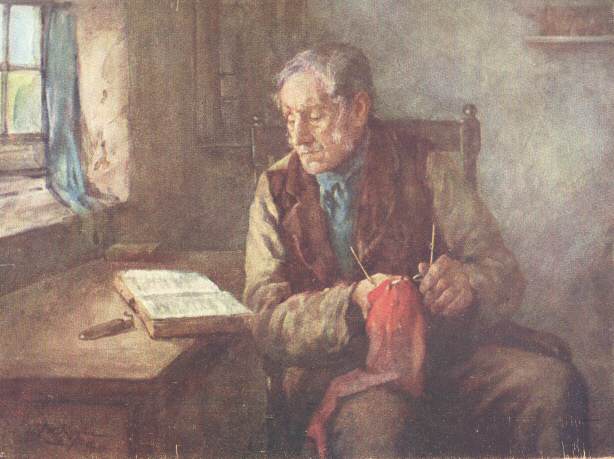
On one of these occasions, as I was sauntering along the edgeof Eaglesham-wood, looking at the industrious bee going fromflower to flower, and the idle butterfly, that layeth up nostore, but perisheth ere it is winter, I felt as it were a spiritfrom on high descending upon me, a throb at my heart, and athrill in my brain, and I was transported out of myself, andseized with the notion of writing a book—but what it shouldbe about, I could not settle to my satisfaction. SometimesI thought of an orthodox poem, like Paradise Lost, by JohnMilton, wherein I proposed to treat more at large of OriginalSin, and the great mystery of Redemption; at others, I fanciedthat a connect treatise on the efficacy of Free Grace would bemore taking; but although I made divers beginnings in bothsubjects, some new thought ever came into my head, and the wholesummer passed away and nothing was done. I thereforepostponed my design of writing a book till the winter, when Iwould have the benefit of the long nights. Before that,however, I had other things of more importance to thinkabout. My servant lasses, having no eye of a mistress overthem, wastered every thing at such a rate, and made such agalravitching in the house, that, long before the end of theyear, the year’s stipend was all spent, and I did not knowwhat to do. At lang and length I mustered courage to sendfor Mr. Auld, who was then living, and an elder. He was adouce and discreet man, fair and well-doing in the world, and hada better handful of strong common sense than many even of theheritors. So I told him how I was situated, and conferredwith him; and he advised me, for my own sake, to look out foranother wife as soon as decency would allow, which he thoughtmight very properly be after the turn of the year, by which timethe first Mrs. Balwhidder would be dead more than twelve months;and when I mentioned my design to write a book, he said, (and hewas a man of good discretion), that the doing of the book was athing that would keep, but masterful servants were a growingevil; so, upon his counselling, I resolved not to meddle with thebook till I was married again, but employ the interim, betweenthen and the turn of the year, in looking out for a prudent womanto be my second wife, strictly intending, as I did perform, notto mint a word about my choice, if I made one, till the wholetwelve months and a day, from the date of the first Mrs.Balwhidder’s interment, had run out.
In this the hand of Providence was very visible, and lucky forme it was that I had sent for Mr. Auld when I did send, as thevery week following, a sound began to spread in the parish, thatone of my lassies had got herself with bairn, which was an awfulthing to think had happened in the house of her master, and thatmaster a minister of the gospel. Some there were, forbackbiting appertaineth to all conditions, that jealoused andwondered if I had not a finger in the pie; which, when Mr. Auldheard, he bestirred himself in such a manful and godly way in mydefence, as silenced the clash, telling that I was utterlyincapable of any such thing, being a man of a guileless heart,and a spiritual simplicity, that would be ornamental in achild. We then had the latheron summoned before thesession, and was not long of making her confess that the fatherwas Nichol Snipe, Lord Glencairn’s gamekeeper; and both herand Nichol were obligated to stand in the kirk: but Nichol was agraceless reprobate, for he came with two coats, one buttonedbehind him, and another buttoned before him, and two wigs of mylord’s, lent him by the valet-de-chamer; the one over hisface, and the other in the right way; and he stood with his faceto the church-wall. When I saw him from the poopit, I saidto him—“Nichol, you must turn your face towardsme!” At the which, he turned round to be sure, butthere he presented the same show as his back. I wasconfounded, and did not know what to say, but cried out with avoice of anger—“Nichol, Nichol! if ye had beena’ back, ye wouldna hae been there this day;” whichhad such an effect on the whole congregation, that the poorfellow suffered afterwards more derision, than if I had rebukedhim in the manner prescribed by the session.
This affair, with the previous advice of Mr. Auld, was,however, a warning to me, that no pastor of his parish should belong without a helpmate. Accordingly, as soon as the yearwas out, I set myself earnestly about the search for one; but asthe particulars fall properly within the scope and chronicle ofthe next year, I must reserve them for it; and I do not recollectthat any thing more particular befell in this, excepting thatWilliam Mutchkins, the father of Mr. Mutchkins, the greatspirit-dealer in Glasgow, set up a change-house in the clachan,which was the first in the parish, and which, if I could havehelped, would have been the last; for it was opening a howf toall manner of wickedness, and was an immediate get and offspringof the smuggling trade, against which I had so set mycountenance. But William Mutchkins himself was arespectable man, and no house could be better ordered than hischange. At a stated hour he made family worship, for hebrought up his children in the fear of God and the Christianreligion; and although the house was full, he would go in to thecustomers, and ask them if they would want anything for half anhour, for that he was going to make exercise with his family; andmany a wayfaring traveller has joined in the prayer. Thereis no such thing, I fear, nowadays, of publicans entertainingtravellers in this manner.
p.44CHAPTER VI
YEAR 1765As there was little in the lastyear that concerned the parish, but only myself, so in this thelike fortune continued; and saving a rise in the price of barley,occasioned, as was thought, by the establishment of a house forbrewing whisky in a neighbouring parish, it could not be saidthat my people were exposed to the mutations and influences ofthe stars, which ruled in the seasons of Ann. Dom. 1765. Inthe winter there was a dearth of fuel, such as has not beensince; for when the spring loosened the bonds of the ice, threenew coal-heughs were shanked in the Douray moor, and ever sincethere has been a great plenty of that necessary article. Truly, it is very wonderful to see how things come round. When the talk was about the shanking of their heughs, and a paperto get folk to take shares in them, was carried through thecircumjacent parishes, it was thought a gowk’s errand; butno sooner was the coal reached, but up sprung such a traffic,that it was a godsend to the parish, and the opening of a tradeand commerce, that has, to use an old byword, brought gold ingowpins amang us. From that time my stipend has been on theregular increase, and therefore I think that the incoming of theheritors must have been in like manner augmented.
Soon after this, the time was drawing near for my secondmarriage. I had placed my affections, with dueconsideration, on Miss Lizy Kibbock, the well brought-up daughterof Mr. Joseph Kibbock of the Gorbyholm, who was the first thatmade a speculation in the farming way in Ayrshire, and whosecheese were of such an excellent quality, that they have, underthe name of Delap-cheese, spread far and wide over the civilizedworld. Miss Lizy and me were married on the 29th day ofApril, with some inconvenience to both sides, on account of thedread that we had of being married in May; for it issaid—
“Of the marriages in May,
The bairns die of a decay.”However, married we were, and we hired the Irville chaise, andwith Miss Jenny her sister, and Becky Cairns her niece, who saton a portmanty at our feet, we went on a pleasure jaunt toGlasgow, where we bought a miracle of useful things for themanse, that neither the first Mrs. Balwhidder nor me ever thoughtof; but the second Mrs. Balwhidder that was, had a geni formanagement, and it was extraordinary what she could gothrough. Well may I speak of her with commendations; forshe was the bee that made my honey, although at first things didnot go so clear with us. For she found the manse rookit andherrit, and there was such a supply of plenishing of all sortwanted, that I thought myself ruined and undone by her care andindustry. There was such a buying of wool to make blankets,with a booming of the meikle wheel to spin the same, and suchbirring of the little wheel for sheets and napery, that the mansewas for many a day like an organ kist. Then we had milkcows, and the calves to bring up, and a kirning of butter, and amaking of cheese; in short, I was almost by myself with thejangle and din, which prevented me from writing a book as I hadproposed, and I for a time thought of the peaceful and kindlynature of the first Mrs. Balwhidder with a sigh; but theoutcoming was soon manifest. The second Mrs. Balwhiddersent her butter on the market-days to Irville, and her cheesefrom time to time to Glasgow, to Mrs. Firlot, that kept thehuxtry in the Saltmarket; and they were both so well made, thatour dairy was just a coining of money, insomuch that, after thefirst year, we had the whole tot of my stipend to put untouchedinto the bank.
But I must say, that although we were thus making siller likesclate stones, I was not satisfied in my own mind that I had gotthe manse merely to be a factory of butter and cheese, and tobreed up veal calves for the slaughter; so I spoke to the secondMrs. Balwhidder, and pointed out to her what I thought the errorof our way; but she had been so ingrained with the profitablemanagement of cows and grumphies in her father’s house,that she could not desist, at the which I was greatlygrieved. By-and-by, however, I began to discern that therewas something as good in her example, as the giving of alms tothe poor folk; for all the wives of the parish were stirred up byit into a wonderful thrift, and nothing was heard of in everyhouse, but of quiltings and wabs to weave; insomuch that, beforemany years came round, there was not a better stocked parish,with blankets and napery, than mine was, within the bounds ofScotland.
It was about the Michaelmas of this year that Mrs. Malcolmopened her shop, which she did chiefly on the advice of Mrs.Balwhidder, who said it was far better to allow a little profiton the different haberdasheries that might be wanted, than tosend to the neighbouring towns an end’s errand on purposefor them, none of the lasses that were so sent ever thinking ofmaking less than a day’s play on every such occasion. In a word, it is not to be told how the second Mrs. Balwhidder,my wife, showed the value of flying time, even to the concerns ofthis world, and was the mean of giving a life and energy to thehousewifery of the parish, that has made many a one beek hisshins in comfort, that would otherwise have had but a cold coalto blow at. Indeed, Mr. Kibbock, her father, was a manbeyond the common, and had an insight of things, by which he wasenabled to draw profit and advantage, where others could only seerisk and detriment. He planted mounts of fir-trees on thebleak and barren tops of the hills of his farm, the whicheverybody, and I among the rest, considered as a thrashing of thewater and raising of bells. But as his rack ran his treesgrew, and the plantations supplied him with stabs to makestake and ricebetween his fields, which soon gave them atrig and orderly appearance, such as had never before been seenin the west country; and his example has, in this matter, been sofollowed, that I have heard travellers say, who have been inforeign countries, that the shire of Ayr, for its bonny roundgreen plantings on the tops of the hills, is above comparisoneither with Italy or Switzerland, where the hills are, as itwere, in a state of nature.
Upon the whole, this was a busy year in the parish, and theseeds of many great improvements were laid. Theking’s road, the which then ran through the Vennel, wasmended; but it was not till some years after, as I shall recordby-and-by, that the trust-road, as it was called, was made, thewhich had the effect of turning the town inside out.
Before I conclude, it is proper to mention that the kirk-bell,which had to this time, from time immemorial, hung on anash-tree, was one stormy night cast down by the breaking of thebranch, which was the cause of the heritors agreeing to build thesteeple. The clock was a mortification to the parish fromthe Lady Breadland, when she died some years after.
p.50CHAPTER VII
YEAR 1766It was in this Ann. Dom. that thegreat calamity happened, the which took place on a Sabbathevening in the month of February. Mrs. Balwhidder had justinfused or masket the tea, and we were set round the fireside, tospend the night in an orderly and religious manner, along withMr. and Mrs. Petticrew, who were on a friendly visitation to themanse, the mistress being full cousin to Mrs.Balwhidder.—Sitting, as I was saying, at our tea, one ofthe servant lasses came into the room with a sort of a paniclaugh, and said, “What are ye all doing there when theBreadland’s in a low?”—“The Breadland ina low!” cried I.—“Oh, ay!” cried she;“bleezing at the windows and the rigging, and out at thelum, like a killogie.” Upon the which, we all went tothe door, and there, to be sure, we did see that the Breadlandwas burning, the flames crackling high out o’er the trees,and the sparks flying like a comet’s tail in thefirmament.
Seeing this sight, I said to Mr. Petticrew, that, in thestrength of the Lord, I would go and see what could be done, forit was as plain as the sun in the heavens that the ancient placeof the Breadlands would be destroyed; whereupon he accorded to gowith me, and we walked at a lively course to the spot, and thepeople from all quarters were pouring in, and it was an awsomescene. But the burning of the house, and the droves of themultitude, were nothing to what we saw when we got forenent theplace. There was the rafters crackling, the flames raging,the servants running, some with bedding, some withlooking-glasses, and others with chamber utensils as littlelikely to be fuel to the fire, but all testifications to theconfusion and alarm. Then there was a shout,“Whar’s Miss Girzie? whar’s theMajor?” The Major, poor man, soon cast up, lying upona feather-bed, ill with his complaints, in the garden; but LadySkimmilk was nowhere to be found. At last, a figure wasseen in the upper flat, pursued by the flames, and that was MissGirzie. Oh! it was a terrible sight to look at her in thatjeopardy at the window, with her gold watch in the one hand andthe silver teapot in the other, skreighing like desperation for aladder and help. But, before a ladder or help could befound, the floor sunk down, and the roof fell in, and poor MissGirzie, with her idols, perished in the burning. It was adreadful business! I think, to this hour, how I saw her atthe window, how the fire came in behind her, and claught her likea fiery Belzebub, and bore her into perdition before oureyes. The next morning the atomy of the body was foundamong the rubbish, with a piece of metal in what had been each ofits hands, no doubt the gold watch and the silver teapot. Such was the end of Miss Girzie; and the Breadland, which theyoung laird, my pupil that was, by growing a resident atEdinburgh, never rebuilt. It was burnt to the very ground;nothing was spared but what the servants in the first flaughtgathered up in a hurry and ran with; but no one could tell howthe Major, who was then, as it was thought by the faculty, pastthe power of nature to recover, got out of the house, and waslaid on the feather-bed in the garden. However, he nevergot the better of that night, and before Whitsunday he was deadtoo, and buried beside his sister’s bones at the south sideof the kirkyard dyke, where his cousin’s son, that was hisheir, erected the handsome monument, with the three urns andweeping cherubims, bearing witness to the great valour of theMajor among the Hindoos, as well as other commendable virtues,for which, as the epitaph says, he was universally esteemed andbeloved, by all who knew him, in his public and privatecapacity.
But although the burning of the Breadland-House was justlycalled the great calamity, on account of what happened to MissGirzie with her gold watch and silver teapot; yet, as Providencenever fails to bring good out of evil, it turned out acatastrophe that proved advantageous to the parish; for thelaird, instead of thinking to build it up, was advised to let thepolicy out as a farm, and the tack was taken by Mr. Coulter, thanwhom there had been no such man in the agriculturing line amongus before, not even excepting Mr. Kibbock of the Gorbyholm, myfather-in-law that was. Of the stabling, Mr. Coulter made acomfortable dwelling-house; and having rugget out the evergreensand other unprofitable plants, saving the twa ancient yew-treeswhich the near-begaun Major and his sister had left to go to ruinabout the mansion-house, he turned all to production, and it waswonderful what an increase he made the land bring forth. Hewas from far beyond Edinburgh, and had got his insight among theLothian farmers, so that he knew what crop should follow another,and nothing could surpass the regularity of his rigs andfurrows.—Well do I remember the admiration that I had,when, in a fine sunny morning of the first spring after he tookthe Breadland, I saw his braird on what had been the cows’grass, as even and pretty as if it had been worked and strippedin the loom with a shuttle. Truly, when I look back at theexample he set, and when I think on the method and dexterity ofhis management, I must say, that his coming to the parish was agreat godsend, and tended to do far more for the benefit of mypeople, than if the young laird had rebuilded the Breadland-Housein a fashionable style, as was at one time spoken of.
But the year of the great calamity was memorable for anotherthing:—in the December foregoing, the wind blew, as I haverecorded in the chronicle of the last year, and broke down thebough of the tree whereon the kirk-bell had hung from the time,as was supposed, of the persecution, before the bringing over ofKing William. Mr. Kibbock, my father-in-law then that was,being a man of a discerning spirit, when he heard of theunfortunate fall of the bell, advised me to get the heritors tobig a steeple; but which, when I thought of the expense, I wasafraid to do. He, however, having a great skill in theheart of man, gave me no rest on the subject; but told me, thatif I allowed the time to go by till the heritors were used tocome to the kirk without a bell, I would get no steeple atall. I often wondered what made Mr. Kibbock so fond of asteeple, which is a thing that I never could see a good reasonfor, saving that it is an ecclesiastical adjunct, like the gownand bands. However, he set me on to get a steeple proposed,and after no little argol-bargling with the heritors, it wasagreed to. This was chiefly owing to the instrumentality ofLady Moneyplack, who, in that winter, was much subjected to therheumatics, she having, one cold and raw Sunday morning, therebeing no bell to announce the time, come half an hour too soon tothe kirk, made her bestir herself to get an interest awakenedamong the heritors in behalf of a steeple.
But when the steeple was built, a new contention arose. It was thought that the bell, which had been used in theash-tree, would not do in a stone and lime fabric; so, aftergreat agitation among the heritors, it was resolved to sell theold bell to a foundery in Glasgow, and buy a new bell suitable tothe steeple, which was a very comely fabric. The buying ofthe new bell led to other considerations, and the old LadyBreadland, being at the time in a decaying condition, and makingher will, she left a mortification to the parish, as I haveintimated, to get a clock; so that, by the time the steeple wasfinished, and the bell put up, the Lady Breadland’s legacycame to be implemented, according to the ordination of thetestatrix.
Of the casualities that happened in this year, I should notforget to put down, as a thing for remembrance, that an agedwoman, one Nanse Birrel, a distillator of herbs, and well skilledin the healing of sores, who had a great repute among thequarriers and colliers—she having gone to the physic wellin the sandy hills to draw water, was found, with her feetuppermost in the well, by some of the bairns of Mr.Lorimore’s school; and there was a great debate whetherNanse had fallen in by accident head foremost, or, in atemptation, thrown herself in that position, with her feetsticking up to the evil one; for Nanse was a curious discontentedblear-eyed woman, and it was only with great ado that I could getthe people keepit from calling her a witchwife.
I should likewise place on record, that the first ass that hadever been seen in this part of the country, came in the course ofthis year with a gang of tinklers, that made horn-spoons andmended bellows. Where they came from never was well madeout; but being a blackaviced crew, they were generally thought tobe Egyptians. They tarried about a week among us, living intents, with their little ones squattling among the litter; andone of the older men of them set and tempered to me two razors,that were as good as nothing, but which he made better than whenthey were new.
Shortly after, but I am not quite sure whether it was in theend of this year, or the beginning of the next, although I have anotion that it was in this, there came over from Ireland a troopof wild Irish, seeking for work as they said; but they made freequarters, for they herrit the roosts of the clachan, and cuttedthe throat of a sow of ours, the carcass of which they no doubtintended to steal; but something came over them, and it was foundlying at the back side of the manse, to the great vexation ofMrs. Balwhidder; for she had set her mind on a clecking of pigs,and only waited for the China boar, that had been brought downfrom London by Lord Eaglesham, to mend the breed of pork—aprofitable commodity, that her father, Mr. Kibbock, cultivatedfor the Glasgow market. The destruction of our sow, undersuch circumstances, was therefore held to be a great crime andcruelty, and it had the effect to raise up such a spirit in theclachan, that the Irish were obligated to decamp; and they setout for Glasgow, where one of them was afterwards hanged for afact, but the truth concerning how he did it, I either neverheard, or it has passed from my mind, like many other things Ishould have carefully treasured.
p.58CHAPTER VIII
YEAR 1767All things in our parish were nowbeginning to shoot up into a great prosperity. The spiritof farming began to get the upper hand of the spirit ofsmuggling, and the coal-heughs that had been opened in theDouray, now brought a pour of money among us. In the manse,the thrift and frugality of the second Mrs. Balwhidder throveexceedingly, so that we could save the whole stipend for thebank.
The king’s highway, as I have related in the foregoing,ran through the Vennel, which was a narrow and a crooked street,with many big stones here and there, and every now and then, bothin the spring and the fall, a gathering of middens for thefields; insomuch that the coal-carts from the Douray moor wereoften reested in the middle of the causey, and on more than oneoccasion some of them laired altogether in the middens, andothers of them broke down. Great complaint was made by thecarters anent these difficulties, and there was, for many a day,a talk and sound of an alteration and amendment; but nothing wasfulfilled in the matter till the month of March in this year,when the Lord Eaglesham was coming from London to see the newlands that he had bought in our parish. His lordship was aman of a genteel spirit, and very fond of his horses, which werethe most beautiful creatures of their kind that had been seen inall the country side. Coming, as I was noting, to see hisnew lands, he was obliged to pass through the clachan one day,when all the middens were gathered out, reeking and sappy, in themiddle of the causey. Just as his lordship was driving inwith his prancing steeds, like a Jehu, at one end of the vennel,a long string of loaded coal-carts came in at the other, andthere was hardly room for my lord to pass them. What was tobe done? His lordship could not turn back, and thecoal-carts were in no less perplexity. Every body was outof doors to see and to help; when, in trying to get hislordship’s carriage over the top of a midden, the horsesgave a sudden loup, and couped the coach, and threw my lord, headforemost, into the very scent-bottle of the whole commodity,which made him go perfect mad, and he swore like a trooper thathe would get an act of parliament to put down thenuisance—the which now ripened in the course of this yearinto the undertaking of the trust-road.
His lordship, being in a woeful plight, left the carriage andcame to the manse, till his servant went to the castle for achange for him; but he could not wait nor abide himself: so hegot the lend of my best suit of clothes, and was wonderful jocoseboth with Mrs. Balwhidder and me, for he was a portly man, and Ibut a thin body, and it was really a droll curiosity to see hislordship clad in my garments.
Out of this accident grew a sort of a neighbourliness betweenthat Lord Eaglesham and me; so that when Andrew Lanshaw, thebrother that was of the first Mrs. Balwhidder, came to think ofgoing to India, I wrote to my lord for his behoof, and hislordship got him sent out as a cadet, and was extraordinarydiscreet to Andrew when he went up to London to take his passage,speaking to him of me as if I had been a very saint, which theSearcher of Hearts knows I am far from thinking myself.
But to return to the making of the trust-road, which, as Ihave said, turned the town inside out. It was agreed amongthe heritors, that it should run along the back side of the southhouses; and that there should be steadings fued off on each side,according to a plan that was laid down; and this being gone into,the town gradually, in the course of years, grew up into thatorderlyness which makes it now a pattern to the countryside—all which was mainly owing to the accident that befellthe Lord Eaglesham, which is a clear proof how improvements comeabout, as it were, by the immediate instigation of Providence,which should make the heart of man humble, and change his eyes ofpride and haughtiness into a lowly demeanour.
But although this making of the trust-road was surely a greatthing for the parish, and of an advantage to my people, we met,in this year, with a loss not to be compensated—that wasthe death of Nanse Banks, the schoolmistress. She had beenlong in a weak and frail state; but being a methodical creature,still kept on the school, laying the foundation for many a worthywife and mother. However, about the decline of the year hercomplaints increased, and she sent for me to consult about hergiving up the school; and I went to see her on Saturdayafternoon, when the bit lassies, her scholars, had put the housein order, and gone home till the Monday.
She was sitting in the window-nook, reading THE WORD to herself, when I entered; butshe closed the book, and put her spectacles in for a mark whenshe saw me; and, as it was expected I would come, her easy-chair,with a clean cover, had been set out for me by the scholars, bywhich I discerned that there was something more than common tohappen, and so it appeared when I had taken my seat.
“Sir,” said she, “I hae sent for you on athing troubles me sairly. I have warsled with poortith inthis shed, which it has pleased the Lord to allow me to possess;but my strength is worn out, and I fear I maun yield in thestrife;” and she wiped her eye with her apron. I toldher, however, to be of good cheer; and then she said, “Thatshe could no longer thole the din of the school, and that she wasweary, and ready to lay herself down to die whenever the Lord waspleased to permit.” “But,” continued she,“what can I do without the school; and, alas! I canneither work nor want; and I am wae to go on the session, for Iam come of a decent family.” I comforted her, andtold her, that I thought she had done so much good in the parish,that the session was deep in her debt, and that what they mightgive her was but a just payment for her service. “Iwould rather, however, sir,” said she, “try firstwhat some of my auld scholars will do, and it was for that Iwanted to speak with you. If some of them would but just,from time to time, look in upon me, that I may not die alane; andthe little pick and drap that I require would not be hard uponthem—I am more sure that in this way their gratitude wouldbe no discredit, than I am of having any claim on thesession.”
As I had always a great respect for an honest pride, I assuredher that I would do what she wanted; and accordingly, the verymorning after, being Sabbath, I preached a sermon on thehelplessness of them that have no help of man, meaning agedsingle women, living in garret-rooms, whose forlorn state, in thegloaming of life, I made manifest to the hearts andunderstandings of the congregation, in such a manner that manyshed tears, and went away sorrowful.
Having thus roused the feelings of my people, I went round thehouses on the Monday morning, and mentioned what I had to saymore particularly about poor old Nanse Banks, the schoolmistress,and truly I was rejoiced at the condition of the hearts of mypeople. There was a universal sympathy among them; and itwas soon ordered that, what with one and another, her decayshould be provided for. But it was not ordained that sheshould be long heavy on their good-will. On the Monday theschool was given up, and there was nothing but wailing among thebit lassies, the scholars, for getting the vacance, as the poorthings said, because the mistress was going to lie down todee. And, indeed, so it came to pass; for she took to herbed the same afternoon, and, in the course of the week, dwindledaway, and slipped out of this howling wilderness into the kingdomof heaven, on the Sabbath following, as quietly as a blessedsaint could do. And here I should mention, that the LadyMacadam, when I told her of Nanse Banks’s case, enquired ifshe was a snuffer, and, being answered by me that she was, herladyship sent her a pretty French enamel box full of macabaw, afine snuff that she had in a bottle; and, among the macabaw, wasfound a guinea, at the bottom of the box, after Nanse Banks haddeparted this life, which was a kind thing of Lady Macadam todo.
About the close of this year there was a great sough of oldprophecies, foretelling mutations and adversities, chiefly onaccount of the canal that was spoken of to join the rivers of theClyde and the Forth, it being thought an impossible thing to bedone; and the Adam and Eve pear-tree, in our garden, budded outin an awful manner, and had divers flourishes on it at Yule,which was thought an ominous thing, especially as the second Mrs.Balwhidder was at the downlying with my eldest son Gilbert, thatis, the merchant in Glasgow; but nothing came o’t, and thehowdie said she had an easy time when the child came into theworld, which was on the very last day of the year, to the greatsatisfaction of me, and of my people, who were wonderful liftedup because their minister had a man-child born unto him.
p.65CHAPTER IX
YEAR 1768It’s a surprising thing howtime flieth away, carrying off our youth and strength, andleaving us nothing but wrinkles and the ails of old age. Gilbert, my son, that is now a corpulent man, and a Glasgowmerchant, when I take up my pen to record the memorables of thisAnn. Dom., seems to me yet but a suckling in swaddling clothes,mewing and peevish in the arms of his mother, that has been longlaid in the cold kirkyard, beside her predecessor, inAbraham’s bosom. It is not, however, my design tospeak much anent my own affairs, which would be a very improperand uncomely thing, but only of what happened in the parish, thisbook being for a witness and testimony of my ministry. Therefore, setting out of view both me and mine, I will nowresuscitate the concerns of Mrs. Malcolm and her children; for,as I think, never was there such a visible preordination seen inthe lives of any persons, as was seen in that of this worthydecent woman, and her well-doing off-spring. Her morningwas raw, and a sore blight fell upon her fortunes; but the sunlooked out on her midday, and her evening closed loun and warm;and the stars of the firmament, that are the eyes of heaven,beamed as it were with gladness, when she lay down to sleep thesleep of rest.
Her son Charles was by this time grown up into a stout buirdlylad, and it was expected that, before the return of the Tobaccotrader, he would have been out of his time, and a man afore themast, which was a great step of preferment, as I heard say bypersons skilled in seafaring concerns. But this was notordered to happen; for, when the Tobacco trader was lying in theharbour of Virginia in the North Americas, a pressgang, that wasin need of men for a man-of-war, came on board, and pressed poorCharles, and sailed away with him on a cruise, nobody, for many aday, could tell where, till I thought of the LordEaglesham’s kindness. His lordship having somethingto say with the king’s government, I wrote to him, tellinghim who I was, and how jocose he had been when buttoned in myclothes, that he might recollect me, thanking him, at the sametime, for his condescension and patronage to Andrew Lanshaw, inhis way to the East Indies. I then slipped in, at the endof the letter, a bit nota-bene concerning the case of CharlesMalcolm, begging his lordship, on account of the poor lad’swidow mother, to enquire at the government if they could tell usany thing about Charles. In the due course of time, I got amost civil reply from his lordship, stating all about the name ofthe man-of-war, and where she was; and at the conclusion hislordship said, that I was lucky in having the brother of a Lordof the Admiralty on this occasion for my agent, as otherwise,from the vagueness of my statement, the information might nothave been procured; which remark of his lordship was long a greatriddle to me; for I could not think what he meant about an agent,till, in the course of the year, we heard that his own brotherwas concerned in the admiralty; so that all his lordship meantwas only to crack a joke with me, and that he was ever ready andfree to do, as shall be related in the sequel, for he was anexcellent man.
There being a vacancy for a schoolmistress, it was proposed toMrs. Malcolm, that, under her superintendence, her daughter Kate,that had been learning great artifices in needle-work so longwith Lady Macadam, should take up the school, and the sessionundertook to make good to Kate the sum of five pounds sterlingper annum, over and above what the scholars were to pay. But Mrs. Malcolm said she had not strength herself to warsle withso many unruly brats, and that Kate, though a fine lassie, was atempestuous spirit, and might lame some of the bairns in herpassion; and that selfsame night, Lady Macadam wrote me a verycomplaining letter, for trying to wile away her companion; buther ladyship was a canary-headed woman, and given to flights andtantrums, having in her youth been a great toast among thequality. It would, however, have saved her from a soreheart, had she never thought of keeping Kate Malcolm. Forthis year her only son, who was learning the art of war at anacademy in France, came to pay her, his lady mother, avisit. He was a brisk and light-hearted stripling, and KateMalcolm was budding into a very rose of beauty; so between them ahankering began, which, for a season, was productive of greatheaviness of heart to the poor old cripple lady; indeed, sheassured me herself, that all her rheumatics were nothing to theheart-ache which she suffered in the progress of thisbusiness. But that will be more treated of hereafter;suffice it to say for the present, that we have thus recorded howthe plan for making Kate Malcolm our schoolmistress came tonought. It pleased, however, Him, from whom cometh everygood and perfect gift, to send at this time among us a MissSabrina Hooky, the daughter of old Mr. Hooky, who had beenschoolmaster in a neighbouring parish. She had gone, afterhis death, to live with an auntie in Glasgow, that kept a shop inthe Gallowgate. It was thought that the old woman wouldhave left her heir to all her gatherings, and so she said shewould, but alas! our life is but within our lip. Before hertestament was made, she was carried suddenly off by anapoplectick, an awful monument of the uncertainty of time and thenearness of eternity, in her own shop, as she was in the very actof weighing out an ounce of snuff to a professor of the College,as Miss Sabrina herself told me. Being thus destitute, ithappened that Miss Sabrina heard of the vacancy in our parish, asit were, just by the cry of a passing bird, for she could nottell how; although I judge myself that William Keckle the elderhad a hand in it, as he was at the time in Glasgow; and she wroteme a wonderful well-penned letter bespeaking the situation, whichletter came to hand on the morn following Lady Macadam’sstramash to me about Kate Malcolm, and I laid it before thesession the same day; so that, by the time her auntie’sconcern was taken off her hands, she had a home and a howf amongus to come in, to the which she lived upwards of thirty years incredit and respect, although some thought she had not the art ofher predecessor, and was more uppish in her carriage thanbefitted the decorum of her vocation. Hers, however, wasbut a harmless vanity; and, poor woman, she needed all manner ofgraces to set her out; for she was made up of odds and ends, andhad but one good eye, the other being blind, and just like a bluebead. At first she plainly set her cap for Mr. Lorimore,but after oggling and goggling at him every Sunday in the kirkfor a whole half-year and more, Miss Sabrina desisted indespair.
But the most remarkable thing about her coming into theparish, was the change that took place in Christian names amongus. Old Mr. Hooky, her father, had, from the time he readhis Virgil, maintained a sort of intromission with the ninemuses, by which he was led to baptize her Sabrina, after a namementioned by John Milton in one of his works. Miss Sabrinabegan by calling our Jennies Jessies, and our Nannies Nancies;alas! I have lived to see even these likewise growold-fashioned. She had also a taste in the mantua-makingline, which she had learnt in Glasgow; and I could date from thevery Sabbath of her first appearance in the kirk, a changegrowing in the garb of the younger lassies, who from that daybegan to lay aside the silken plaidie over the head, the whichhad been the pride and bravery of their grandmothers; and insteadof the snood, that was so snod and simple, they hided their headsin round-eared bees-cap mutches, made of gauze and catgut, andother curious contrivances of French millendery; all whichbrought a deal of custom to Miss Sabrina, over and above theincomings and Candlemas offerings of school; insomuch that shesaved money, and in the course of three years had ten pounds toput in the bank.
At the time, these alterations and revolutions in the parishwere thought a great advantage; but now when I look back uponthem, as a traveller on the hill over the road he has passed, Ihave my doubts. For with wealth come wants, like a troop ofclamorous beggars at the heels of a generous man; and it’shard to tell wherein the benefit of improvement in a countryparish consists, especially to those who live by the sweat oftheir brow. But it is not for me to make reflections; mytask and duty is to note the changes of time and habitudes.
p.72CHAPTER X
YEAR 1769I have my doubts whether it was inthe beginning of this year, or in the end of the last, that avery extraordinary thing came to light in the parish; but,howsoever that may be, there is nothing more certain than thefact, which it is my duty to record. I have mentionedalready how it was that the toll, or trust-road, was set a-going,on account of the Lord Eaglesham’s tumbling on the middenin the Vennel. Well, it happened to one of the labouringmen, in breaking the stones to make metal for the new road, thathe broke a stone that was both large and remarkable, and in theheart of it, which was boss, there was found a living creature,that jumped out the moment it saw the light of heaven, to thegreat terrification of the man, who could think it was nothingbut an evil spirit that had been imprisoned therein for atime. The man came to me like a demented creature, and thewhole clachan gathered out, young and old, and I went at theirhead to see what the miracle could be, for the man said it was afiery dragon, spewing smoke and flames. But when we came tothe spot, it was just a yird toad, and the laddie weans nevelledit to death with stones, before I could persuade them to giveover. Since then, I have read of such things coming tolight in the Scots Magazine, a very valuable book.
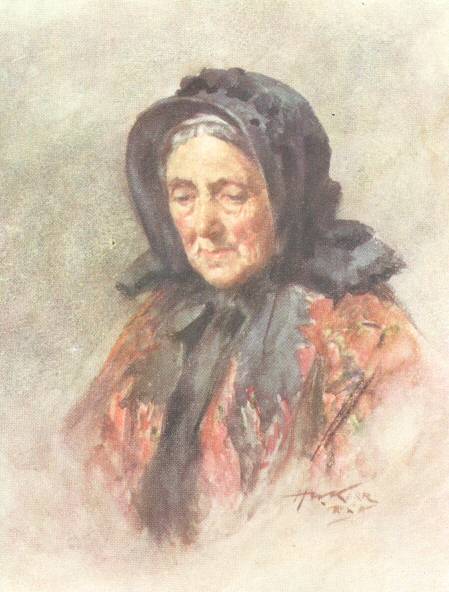
Soon after the affair of “the wee deil in thestane,” as it was called, a sough reached us that theAmericas were seized with the rebellious spirit of the tentribes, and were snapping their fingers in the face of theking’s government. The news came on a Saturday night,for we had no newspapers in those days, and was brought by RobinModiwort, that fetched the letters from the Irville post. Thomas Fullarton (he has been dead many a day) kept the groceryshop at Irville, and he had been in at Glasgow, as was his yearlycustom, to settle his accounts, and to buy a hogshead of tobacco,with sugar and other spiceries; and being in Glasgow, Thomas wastold by the merchant of a great rise in tobacco, that hadhappened by reason of the contumacity of the plantations, and itwas thought that blood would be spilt before things were ended,for that the King and Parliament were in a great passion withthem. But as Charles Malcolm, in the king’s ship, wasthe only one belonging to the parish that was likely to be artand part in the business, we were in a manner little troubled atthe time with this first gasp of the monster of war, who, for oursins, was ordained to swallow up and devour so many of ourfellow-subjects, before he was bound again in the chains of mercyand peace.
I had, in the meantime, written a letter to the LordEaglesham, to get Charles Malcolm out of the clutches of thepressgang in the man-of-war; and about a month after, hislordship sent me an answer, wherein was enclosed a letter fromthe captain of the ship, saying, that Charles Malcolm was so gooda man that he was reluctant to part with him, and that Charleshimself was well contented to remain aboard. Anent which,his lordship said to me, that he had written back to the captainto make a midshipman of Charles, and that he would take him underhis own protection, which was great joy on two accounts to usall, especially to his mother; first, to hear that Charles was agood man, although in years still but a youth; and, secondly,that my lord had, of his own free-will, taken him under the wingof his patronage.
But the sweet of this world is never to be enjoyed withoutsome of the sour. The coal bark between Irville andBelfast, in which Robert Malcolm, the second son of his mother,was serving his time to be a sailor, got a charter, as it wascalled, to go with to Norway for deals, which grieved Mrs.Malcolm to the very heart; for there was then no short cut by thecanal, as now is, between the rivers of the Forth and Clyde, butevery ship was obligated to go far away round by the Orkneys,which, although a voyage in the summer not overly dangerous,there being long days and short nights then, yet in the winter itwas far otherwise, many vessels being frozen up in the Baltictill the spring; and there was a story told at the time, of anIrville bark coming home in the dead of the year, that lost herway altogether, and was supposed to have sailed north into utterdarkness, for she was never more heard of: and many an awfulthing was said of what the auld mariners about the shore thoughtconcerning the crew of that misfortunate vessel. However,Mrs. Malcolm was a woman of great faith, and having placed herreliance on Him who is the orphan’s stay and widow’strust, she resigned her bairn into his hands, with a religioussubmission to his pleasure, though the mother’s tear ofweak human nature was on her cheek and in her e’e. And her faith was well rewarded, for the vessel brought him safehome, and he had seen such a world of things, that it was just toread a story-book to hear him tell of Elsineur and Gottenburg,and other fine and great places that we had never heard of tillthat time; and he brought me a bottle of Riga balsam, which forhealing cuts was just miraculous, besides a clear bottle ofRososolus for his mother, a spirit which for cordiality could notbe told; for though since that time we have had many a sort ofDantzic cordial, I have never tasted any to compare with RobinMalcolm’s Rososolus. The Lady Macadam, who had aknowledge of such things, declared it was the best of the bestsort; for Mrs. Malcolm sent her ladyship some of it in adoctor’s bottle, as well as to Mrs. Balwhidder, who wasthen at the downlying with our daughter Janet—a woman nowin the married state, that makes a most excellent wife, havingbeen brought up with great pains, and well educated, as I shallhave to record by-and-by.
About the Christmas of this year, Lady Macadam’s sonhaving been perfected in the art of war at a school in France,had, with the help of his mother’s friends, and hisfather’s fame, got a stand of colours in the Royal Scotsregiment; he came to show himself in his regimentals to his ladymother, like a dutiful son, as he certainly was. Ithappened that he was in the kirk in his scarlets and gold, on thesame Sunday that Robert Malcolm came home from the long voyage toNorway for deals; and I thought when I saw the soldier and thesailor from the pulpit, that it was an omen of war, among ourharmless country folks, like swords and cannon amidst ploughs andsickles, coming upon us; and I became laden in spirit, and had amost weighty prayer upon the occasion, which was long afterremembered, many thinking, when the American war broke out, thatI had been gifted with a glimmering of prophecy on that day.
It was during this visit to his lady mother, that young LairdMacadam settled the correspondence with Kate Malcolm, which, inthe process of time, caused us all so much trouble; for it was aclandestine concern: but the time is not yet ripe for me to speakof it more at large. I should, however, mention, beforeconcluding this annal, that Mrs. Malcolm herself was this winterbrought to death’s door by a terrible host that came on herin the kirk, by taking a kittling in her throat. It was aterrification to hear her sometimes; but she got the better of itin the spring, and was more herself thereafter than she had beenfor years before; and her daughter Effie or Euphemia, as she wascalled by Miss Sabrina, the schoolmistress, was growing up to bea gleg and clever quean; she was, indeed, such a spirit in herway, that the folks called her Spunkie; while her son William,that was the youngest of the five, was making a wonderfulproficiency with Mr. Lorimore. He was indeed a douce,well-doing laddie, of a composed nature; insomuch that the mastersaid he was surely chosen for the ministry. In short, themore I think on what befell this family, and of the greatmeekness and Christian worth of the parent, I verily believethere never could have been in any parish such a manifestation ofthe truth, that they who put their trust in the Lord, are sure ofhaving a friend that will never forsake them.
p.78CHAPTER XI
YEAR 1770This blessed Ann. Dom. was one ofthe Sabbaths of my ministry. When I look back upon it, allis quiet and good order: the darkest cloud of the smuggling hadpassed over, at least from my people, and the rumours ofrebellion in America were but like the distant sound of the barsof Ayr. We sat, as it were, in a lown and pleasant place,beholding our prosperity, like the apple-tree adorned with hergarlands of flourishes, in the first fair mornings of the spring,when the birds were returning thanks to their Maker for thecoming again of the seed-time, and the busy bee goeth forth fromher cell, to gather honey from the flowers of the field, and thebroom of the hill, and the blue-bells and gowans, which Nature,with a gracious and a gentle hand, scatters in the valley, as shewalketh forth in her beauty, to testify to the goodness of theFather of all mercies.
Both at the spring and the harvest sacraments, the weather wasas that which is in Paradise; there was a glad composure in allhearts, and the minds of men were softened towards eachother. The number of communicants was greater than had beenknown for many years, and the tables were filled by the piousfrom many a neighbouring parish: those of my hearers who hadopposed my placing, declared openly, for a testimony ofsatisfaction and holy thankfulness, that the tent, so surroundedas it was on both occasions, was a sight they never had expectedto see. I was, to be sure, assisted by some of the bestdivines then in the land, but I had not been a sluggard myself inthe vineyard.
Often, when I think on this year, so fruitful in pleasantintimacies, has the thought come into my mind, that as the Lordblesses the earth from time to time with a harvest of more thanthe usual increase, so, in like manner, he is sometimes for aseason pleased to pour into the breasts of mankind a largerportion of good-will and charity, disposing them to love oneanother, to be kindly to all creatures, and filled with thedelight of thankfulness to himself, which is the greatest ofblessings.
It was in this year that the Earl of Eaglesham ordered thefair to be established in the village; and it was a day ofwonderful festivity to all the bairns, and lads and lassies, formiles round. I think, indeed, that there has never beensuch a fair as the first since; for although we have moremountebanks and merry-andrews now, and richer cargoes ofgroceries and packman’s stands, yet there has been afalling off in the light-hearted daffing, while the hobleshows inthe change-houses have been awfully augmented. It was onthis occasion that Punch’s opera was first seen in ourcountry side, and surely never was there such a funny curiosity;for although Mr. Punch himself was but a timber idol, he was asdroll as a true living thing, and napped with his head socomical; but oh! he was a sorrowful contumacious captain, and itwas just a sport to see how he rampaged, and triumphed, andsang. For months after, the laddie weans did nothing butsqueak and sing like Punch. In short, a blithe spirit wasamong us throughout this year, and the briefness of the chroniclebears witness to the innocency of the time.
p.81CHAPTER XII
YEAR 1771It was in this year that mytroubles with Lady Macadam’s affair began. She was awoman, as I have by hint here and there intimated, of a prelaticdisposition, seeking all things her own way, and not overlyscrupulous about the means, which I take to be the true humour ofprelacy. She was come of a high episcopal race in the eastcountry, where sound doctrine had been long but little heard, andshe considered the comely humility of a presbyter as thewickedness of hypocrisy; so that, saving in the way ofneighbourly visitation, there was no sincere communion betweenus. Nevertheless, with all her vagaries, she had theelement of a kindly spirit, that would sometimes kythe in actionsof charity, that showed symptoms of a true Christian grace, hadit been properly cultivated; but her morals had been greatlyneglected in her youth, and she would waste her precious time inthe long winter nights, playing at the cards with her visitors;in the which thriftless and sinful pastime, she was at greatpains to instruct Kate Malcolm, which I was grieved tounderstand. What, however, I most misliked in her ladyship,was a lightness and juvenility of behaviour altogether unbecomingher years; for she was far past three-score, having been longmarried without children. Her son, the soldier officer,came so late, that it was thought she would have been taken up asan evidence in the Douglas cause. She was, to be sure,crippled with the rheumatics, and no doubt the time hung heavy onher hands; but the best friends of recreation and sport mustallow, that an old woman, sitting whole hours jingling with thatparalytic chattel a spinnet, was not a natural object! What, then, could be said for her singing Italian songs, andgetting all the newest from Vauxhall in London, a boxful at atime, with new novel-books, and trinkum-trankum flowers andfeathers, and sweetmeats, sent to her by a lady of the bloodroyal of Paris? As for the music, she was at great pains toinstruct Kate, which, with the other things she taught, weresufficient, as my lady said herself, to qualify poor Kate for aduchess or a governess, in either of which capacities, herladyship assured Mrs. Malcolm, she would do honour to herinstructor, meaning her own self; but I must come to the pointanent the affair.
One evening, early in the month of January, as I was sittingby myself in my closet studying the Scots Magazine, whichI well remember the new number had come but that very night, Mrs.Balwhidder being at the time busy with the lasses in the kitchen,and superintending, as her custom was, for she was a cleverwoman, a great wool-spinning we then had, both little wheel andmeikle wheel, for stockings and blankets—sitting, as I wassaying, in the study, with the fire well gathered up, for anight’s reflection, a prodigious knocking came to the door,by which the book was almost startled out of my hand, and all thewheels in the house were silenced at once. This was herladyship’s flunkey, to beg me to go to her, whom hedescribed as in a state of desperation. Christianityrequired that I should obey the summons; so, with what haste Icould, thinking that perhaps, as she had been low-spirited forsome time about the young laird’s going to the Indies, shemight have got a cast of grace, and been wakened in despair tothe state of darkness in which she had so long lived, I made asfew steps of the road between the manse and her house as it wasin my ability to do.
On reaching the door, I found a great light in thehouse—candles burning up stairs and down stairs, and asough of something extraordinar going on. I went into thedining-room, where her ladyship was wont to sit; but she was notthere—only Kate Malcolm all alone, busily picking bits ofpaper from the carpet. When she looked up, I saw that hereyes were red with weeping, and I was alarmed, and said,“Katy, my dear, I hope there is no danger?” Upon which the poor lassie rose, and, flinging herself in achair, covered her face with her hands, and wept bitterly.
“What is the old fool doing with the wench?” crieda sharp angry voice from the drawing-room—“why doesnot he come to me?” It was the voice of Lady Macadamherself, and she meant me. So I went to her; but, oh! shewas in a far different state from what I had hoped. Thepride of this world had got the upper hand of her, and wasplaying dreadful antics with understanding. There was she,painted like a Jezebel, with gum-flowers on her head, as was hercustom every afternoon, sitting on a settee, for she was lame,and in her hand she held a letter. “Sir,” saidshe, as I came into the room, “I want you to go instantlyto that young fellow, your clerk, (meaning Mr. Lorimore, theschoolmaster, who was likewise session-clerk and precentor,) andtell him I will give him a couple of hundred pounds to marry MissMalcolm without delay, and undertake to procure him a living fromsome of my friends.”
“Softly, my lady, you must first tell me the meaning ofall this haste of kindness,” said I, in my calm methodicalmanner. At the which she began to cry and sob, like apetted bairn, and to bewail her ruin, and the dishonour of herfamily. I was surprised, and beginning to be confounded; atlength out it came. The flunkey had that night brought twoLondon letters from the Irville post, and Kate Malcolm being outof the way when he came home, he took them both in to herladyship on the silver server, as was his custom; and herladyship, not jealousing that Kate could have a correspondencewith London, thought both the letters were for herself, for theywere franked; so, as it happened, she opened the one that was forKate, and this, too, from the young laird, her own son. Shecould not believe her eyes when she saw the first words in hishand of write; and she read, and she better read, till she readall the letter, by which she came to know that Kate and herdarling were trysted, and that this was not the first love-letterwhich had passed between them. She, therefore, tore it inpieces, and sent for me, and screamed for Kate; in short, went,as it were, off at the head, and was neither to bind nor to holdon account of this intrigue, as she, in her wrath, stigmatisedthe innocent gallanting of poor Kate and the young laird.
I listened in patience to all she had to say anent thediscovery, and offered her the very best advice; but she deridedmy judgment; and because I would not speak outright to Mr.Lorimore, and get him to marry Kate off hand, she bade megood-night with an air, and sent for him herself. He,however, was on the brink of marriage with his present worthyhelpmate, and declined her ladyship’s proposals, whichangered her still more. But although there was surely agreat lack of discretion in all this, and her ladyship wasentirely overcome with her passion, she would not part with Kate,nor allow her to quit the house with me, but made her sup withher as usual that night, calling her sometimes a perfidiousbaggage, and at other times, forgetting her delirium, speaking toher as kindly as ever. At night, Kate as usual helped herladyship into her bed, (this she told me with tears in her eyesnext morning;) and when Lady Macadam, as was her wont, bent tokiss her for good-night, she suddenly recollected “theintrigue,” and gave Kate such a slap on the side of thehead, as quite dislocated for a time the intellects of the pooryoung lassie. Next morning, Kate was solemnly advised neverto write again to the laird, while the lady wrote him a letter,which, she said, would be as good as a birch to the breech of theboy. Nothing, therefore, for some time, indeed, throughoutthe year, came of the matter; but her ladyship, when Mrs.Balwhidder soon after called on her, said that I was anose-of-wax, and that she never would speak to me again, whichsurely was not a polite thing to say to Mrs. Balwhidder, mysecond wife.
This stramash was the first time I had interposed in thefamily concerns of my people; for it was against my nature tomake or meddle with private actions saving only such as in courseof nature came before the session; but I was not satisfied withthe principles of Lady Macadam, and I began to be weary aboutKate Malcolm’s situation with her ladyship, whose ways ofthinking I saw were not to be depended on, especially in thosethings wherein her pride and vanity were concerned. But thetime ran on—the butterflies and the blossoms were succeededby the leaves and the fruit, and nothing of a particular naturefarther molested the general tranquillity of this year; about theend of which, there came on a sudden frost, after a tack of wetweather. The roads were just a sheet of ice, like a frozenriver; insomuch that the coal-carts could not work; and one ofour cows, (Mrs. Balwhidder said, after the accident, it was ourbest; but it was not so much thought of before,) fell in comingfrom the glebe to the byre, and broke its two hinder legs, whichobligated us to kill it, in order to put the beast out ofpain. As this happened after we had salted our mart, itoccasioned us to have a double crop of puddings, and such a showof hams in the kitchen, as was a marvel to our visitors tosee.
p.88CHAPTER XIII
YEAR 1772On New-Year’s night, thisyear, a thing happened, which, in its own nature, was a trifle;but it turned out as a mustard-seed that grows into a greattree. One of the elders, who has long been dead and gone,came to the manse about a fact that was found out in the clachan,and after we had discoursed on it some time, he rose to take hisdeparture. I went with him to the door with the candle inmy hand—it was a clear frosty night, with a sharp wind; andthe moment I opened the door, the blast blew out the candle, sothat I heedlessly, with the candlestick in my hand, walked withhim to the yett without my hat, by which I took a sore cold in myhead, that brought on a dreadful toothache; insomuch, that I wasobligated to go into Irville to get the tooth drawn, and thiscaused my face to swell to such a fright, that, on theSabbath-day, I could not preach to my people. There was,however, at that time, a young man, one Mr. Heckletext, tutor inSir Hugh Montgomerie’s family, and who had shortly beforebeen licensed. Finding that I would not be able to preachmyself, I sent to him, and begged he would officiate for me,which he very pleasantly consented to do, being, like all theyoung clergy, thirsting to show his light to the world. ’Twixt the fore and afternoon’s worship, he took hischeck of dinner at the manse, and I could not but say that heseemed both discreet and sincere. Judge, however, what wasbrewing, when the same night Mr. Lorimore came and told me, thatMr. Heckletext was the suspected person anent the fact that hadbeen instrumental, in the hand of a chastising Providence, toafflict me with the toothache, in order, as it afterwards came topass, to bring the hidden hypocrisy of the ungodly preacher tolight. It seems that the donsie lassie who was in fault,had gone to the kirk in the afternoon, and seeing who was in thepulpit, where she expected to see me, was seized with thehysterics, and taken with her crying on the spot, the which beinguntimely, proved the death of both mother and bairn, before thething was properly laid to the father’s charge.
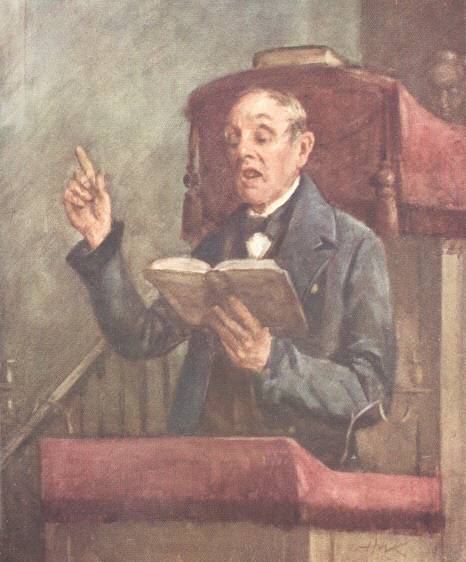
This caused a great uproar in the parish. I was sorelyblamed to let such a man as Mr. Heckletext go up into my pulpit,although I was as ignorant of his offences as the innocent childthat perished; and, in an unguarded hour, to pacify some of theelders, who were just distracted about the disgrace, I consentedto have him called before the session. He obeyed the call,and in a manner that I will never forget; for he was a sorrow ofsin and audacity, and demanded to know why, and for what reason,he was summoned. I told him the whole affair in my calm andmoderate way; but it was oil cast upon a burning coal. Heflamed up in a terrible passion; threepit at the elders that theyhad no proof whatever of his having had any trafficking in thebusiness, which was the case; for it was only a notion, the poordeceased lassie never having made a disclosure: called themlibellous conspirators against his character, which was his onlyfortune, and concluded by threatening to punish them, though heexempted me from the injury which their slanderous insinuationshad done to his prospects in life. We were all terrified,and allowed him to go away without uttering a word; and sureenough he did bring a plea in the courts of Edinburgh against Mr.Lorimore and the elders for damages, laid at a great sum.
What might have been the consequence, no one can tell; butsoon after he married Sir Hugh’s house-keeper, and wentwith her into Edinburgh, where he took up a school; and, beforethe trial came on, that is to say, within three months of the daythat I myself married them, Mrs. Heckletext was delivered of athriving lad bairn, which would have been a witness for theelders, had the worst come to the worst. This was, indeed,we all thought, a joyous deliverance to the parish, and it was alesson to me never to allow any preacher to mount my pulpit,unless I knew something of his moral character.
In other respects, this year passed very peaceably in theparish: there was a visible increase of worldly circumstances,and the hedges which had been planted along the toll-road, beganto put forth their branches, and to give new notions oforderlyness and beauty to the farmers. Mrs. Malcolm heardfrom time to time from her son Charles, on board the man-of-warthe Avenger, where he was midshipman; and he had found afriend in the captain, that was just a father to him. Hersecond son, Robert, being out of his time at Irville, went to theClyde to look for a berth, and was hired to go to Jamaica, in aship called the Trooper. He was a lad of greatersobriety of nature than Charles; douce, honest, and faithful; andwhen he came home, though he brought no limes to me to makepunch, like his brother, he brought a Muscovy duck to LadyMacadam, who had, as I have related, in a manner educated hissister Kate. That duck was the first of the kind we hadever seen, and many thought it was of the goose species, onlywith short bowly legs. It was, however, a tractable andhomely beast; and after some confabulation, as my lady herselftold Mrs. Balwhidder, it was received into fellowship by herother ducks and poultry. It is not, however, so much onaccount of the rarity of the creature, that I have introduced ithere, as for the purpose of relating a wonderful operation thatwas performed on it by Miss Sabrina, the schoolmistress.
There happened to be a sack of beans in our stable, and LadyMacadam’s hens and fowls, which were not overly fed at homethrough the inattention of her servants, being great stravaigersfor their meat, in passing the door went in to pick, and theMuscovy, seeing a hole in the bean-sack, dabbled out a crapfulbefore she was disturbed. The beans swelled on the poorbird’s stomach, and her crap bellied out like the kyte of aGlasgow magistrate, until it was just a sight to be seen with itshead back on its shoulders. The bairns of the clachanfollowed it up and down, crying, the lady’s mucklejock’s aye growing bigger, till every heart was wae for thecreature. Some thought it was afflicted with a tympathy,and others, that it was the natural way for such-like ducks tocleck their young. In short, we were all concerned; and mylady, having a great opinion of Miss Sabrina’s skill, had aconsultation with her on the case, at which Miss Sabrina advised,that what she called the Cæsarean operation should betried, which she herself performed accordingly, by opening thecreature’s crap, and taking out as many beans as filled amutchkin stoup, after which she sewed it up, and the Muscovy wentits way to the water-side, and began to swim, and was as jocundas ever; insomuch, that in three days after it was quite cured ofall the consequences of its surfeit.
I had at one time a notion to send an account of this to theScots Magazine, but something always came in the way toprevent me; so that it has been reserved for a place in thischronicle, being, after Mr. Heckletext’s affair, the mostmemorable thing in our history of this year.
p.94CHAPTER XIV
YEAR 1773In this Ann. Dom. there wassomething like a plea getting to a head, between the session andsome of the heritors, about a new school-house; the thatch havingbeen torn from the rigging of the old one by a blast of wind, onthe first Monday of February, by which a great snow storm gotadmission, and the school was rendered utterlyuninhabitable. The smaller sort of lairds were very willingto come into the plan with an extra contribution, because theyrespected the master, and their bairns were at the school; butthe gentlemen, who had tutors in their own houses, were not somanageable; and some of them even went so far as to say, that thekirk, being only wanted on Sunday, would do very well for aschool all the rest of the week, which was a very profane way ofspeaking; and I was resolved to set myself against any suchthing, and to labour, according to the power and efficacy of mystation, to get a new school built.
Many a meeting the session had on the subject; and theheritors debated, and discussed, and revised their proceedings,and still no money for the needful work was forthcoming. Whereupon it happened one morning, as I was rummaging in myscrutoire, that I laid my hand on the Lord Eaglesham’sletter anent Charles Malcolm; and it was put into my head at thatmoment, that if I was to write to his lordship, who was thegreatest heritor, and owned now the major part of the parish,that by his help and influence I might be an instrument to thebuilding of a comfortable new school. Accordingly, I satdown and wrote my lord all about the accident, and the state ofthe school-house, and the divisions and seditions among theheritors, and sent the letter to him at London by the post thesame day, without saying a word to any living soul on thesubject.
This in me was an advised thought; for, by the return of post,his lordship with his own hand, in a most kind manner, authorizedme to say that he would build a new school at his own cost, andbade me go over and consult about it with his steward at thecastle, to whom he had written by the same post the necessaryinstructions. Nothing could exceed the gladness which thenews gave to the whole parish, and none said more in behalf ofhis lordship’s bounty and liberality than the heritors;especially those gentry who grudged the undertaking, when it wasthought that it would have to come out of their ownpock-nook.
In the course of the summer, just as the roof was closing inof the school-house, my lord came to the castle with a greatcompany, and was not there a day till he sent for me to comeover, on the next Sunday, to dine with him; but I sent him wordthat I could not do so, for it would be a transgression of theSabbath, which made him send his own gentleman, to make hisapology for having taken so great a liberty with me, and to begme to come on the Monday, which I accordingly did, and nothingcould be better than the discretion with which I was used. There was a vast company of English ladies and gentlemen, and hislordship, in a most jocose manner, told them all how he hadfallen on the midden, and how I had clad him in my clothes, andthere was a wonder of laughing and diversion; but the mostparticular thing in the company, was a large, round-faced man,with a wig, that was a dignitary in some great Episcopalianchurch in London, who was extraordinary condescending towards me,drinking wine with me at the table, and saying weighty sentences,in a fine style of language, about the becoming grace ofsimplicity and innocence of heart, in the clergy of alldenominations of Christians, which I was pleased to hear; forreally he had a proud red countenance, and I could not havethought he was so mortified to humility within, had I not heardwith what sincerity he delivered himself, and seen how muchreverence and attention was paid to him by all present,particularly by my lord’s chaplain, who was a pious andpleasant young divine, though educated at Oxford for theEpiscopalian persuasion.
One day, soon after, as I was sitting in my closet conning asermon for the next Sunday, I was surprised by a visit from thedean, as the dignitary was called. He had come, he said, towait on me as rector of the parish—for so, it seems, theycall a pastor in England—and to say, that, if it wasagreeable, he would take a family dinner with us before he leftthe castle. I could make no objection to this kindness; butsaid I hoped my lord would come with him, and that we would doour best to entertain them with all suitable hospitality. About an hour or so after he had returned to the castle, one ofthe flunkeys brought a letter from his lordship, to say, that notonly he would come with the dean, but that they would bring hisother guests with them; and that, as they could only drink Londonwine, the butler would send me a hamper in the morning, assured,as he was pleased to say, that Mrs. Balwhidder would otherwiseprovide good cheer.
This notification, however, was a great trouble to my wife,who was only used to manufacture the produce of our glebe andyard to a profitable purpose, and not used to the treatment ofdeans and lords, and other persons of quality. However, shewas determined to stretch a point on this occasion; and we had,as all present declared, a charming dinner; for fortunately oneof the sows had a litter of pigs a few days before, and inaddition to a goose, that is but a boss bird, we had a roastedpig with an apple in its mouth, which was just a curiosity tosee; and my lord called it a tithe pig; but I told him it was oneof Mrs. Balwhidder’s own clecking, which saying of minemade no little sport when expounded to the dean.
But, och how! this was the last happy summer that we had formany a year in the parish; and an omen of the dule that ensued,was in a sacrilegious theft that a daft woman, Jenny Gaffaw, andher idiot daughter, did in the kirk, by tearing off and stealingthe green serge lining of my lord’s pew, to make, as theysaid, a hap for their shoulders in the cold weather—saving,however, the sin, we paid no attention at the time to themischief and tribulation that so unheard-of a trespass boded tous all. It took place about Yule, when the weather was coldand frosty, and poor Jenny was not very able to go about seekingher meat as usual. The deed, however, was mainly done byher daughter, who, when brought before me, said, “her poormother’s back had mair need of claes than thekirk-boards;” which was so true a thing, that I could notpunish her, but wrote anent it to my lord, who not onlyoverlooked the offence, but sent orders to the servants at thecastle to be kind to the poor woman, and the natural, herdaughter.
p.99CHAPTER XV
YEAR 1774When I look back on this year, andcompare what happened therein with the things that had gonebefore, I am grieved to the heart, and pressed down with anafflicted spirit. We had, as may be read, trials andtribulations in the days that were past; and in the rank andboisterous times of the smuggling there was much sin and blemishamong us, but nothing so dark and awful as what fell out in thecourse of this unhappy year. The evil omen of daft JennyGaffaw and her daughter’s sacrilege, had soon a bloodyverification.
About the beginning of the month of March in this year, thewar in America was kindling so fast that the government wasobligated to send soldiers over the sea, in the hope to quell therebellious temper of the plantations; and a party of a regimentthat was quartered at Ayr was ordered to march to Greenock, to bethere shipped off. The men were wild and wickedprofligates, without the fear of the Lord before their eyes; andsome of them had drawn up with light women in Ayr, who followedthem on their march. This the soldiers did not like, notwishing to be troubled with such gear in America; so the women,when they got the length of Kilmarnock, were ordered to retreatand go home, which they all did but one Jean Glaikit, whopersisted in her intent to follow her joe, Patrick O’Neil,a Catholic Irish corporal. The man did, as he said, all inhis capacity to persuade her to return, but she was acontumacious limmer, and would not listen to reason; so that, inpassing along our toll-road, from less to more, the miserablewretches fell out, and fought, and the soldier put an end to herwith a hasty knock on the head with his firelock, and marched onafter his comrades.
The body of the woman was, about half an hour after, found bythe scholars of Mr. Lorimore’s school, who had got the playto see the marching, and to hear the drums of the soldiers. Dreadful was the shout and the cry throughout the parish at thisfoul work. Some of the farmer lads followed the soldiers onhorseback, and others ran to Sir Hugh, who was a justice of thepeace, for his advice.—Such a day as that was!
However, the murderer was taken, and, with his arms tiedbehind him with a cord, he was brought back to the parish, wherehe confessed before Sir Hugh the deed, and how it happened. He was then put in a cart, and, being well guarded by six of thelads, was taken to Ayr jail.
It was not long after this that the murderer was brought totrial, and, being found guilty on his own confession, he wassentenced to be executed, and his body to be hung in chains nearthe spot where the deed was done. I thought that all in theparish would have run to desperation with horror when the news ofthis came, and I wrote immediately to the Lord Eaglesham to getthis done away by the merciful power of the government, which hedid, to our great solace and relief.
In the autumn, the young Laird Macadam, being ordered with hisregiment for the Americas, got leave from the king to come andsee his lady mother, before his departure. But it was notto see her only, as will presently appear.
Knowing how much her ladyship was averse to the notion he hadof Kate Malcolm, he did not write of his coming, lest she wouldsend Kate out of the way, but came in upon them at a late hour,as they were wasting their precious time, as was the nightly wontof my lady, with a pack of cards; and so far was she from beingpleased to see him, that no sooner did she behold his face, but,like a tap of tow, she kindled upon both him and Kate, andordered them out of her sight and house. The young folk haddiscretion: Kate went home to her mother, and the laird came tothe manse, and begged us to take him in. He then told mewhat had happened; and that, having bought a captain’scommission, he was resolved to marry Kate, and hoped I wouldperform the ceremony, if her mother would consent. “As for mine,” said he, “she will never agree;but, when the thing is done, her pardon will not be difficult toget; for, with all her whims and caprice, she is generous andaffectionate.” In short, he so wiled and beguiled me,that I consented to marry them, if Mrs. Malcolm wasagreeable. “I will not disobey my mother,” saidhe, “by asking her consent, which I know she will refuse;and, therefore, the sooner it is done the better.” Sowe then stepped over to Mrs. Malcolm’s house, where wefound that saintly woman, with Kate and Effie, and Willie,sitting peacefully at their fireside, preparing to read theirBibles for the night. When we went in, and when I saw Kate,that was so ladylike there, with the decent humility of herparent’s dwelling, I could not but think she was destinedfor a better station; and when I looked at the captain, ahandsome youth, I thought surely their marriage is made inheaven; and so I said to Mrs. Malcolm, who after a timeconsented, and likewise agreed that her daughter should go withthe captain to America; for her faith and trust in the goodnessof Providence was great and boundless, striving, as it were, tobe even with its tender mercies. Accordingly, thecaptain’s man was sent to bid the chaise wait that hadtaken him to the lady’s, and the marriage was sanctified byme before we left Mrs. Malcolm’s. No doubt, theyought to have been proclaimed three several Sabbaths; but Isatisfied the session, at our first meeting, on account of thenecessity of the case. The young couple went in the chaisetravelling to Glasgow, authorising me to break the matter to LadyMacadam, which was a sore task; but I was spared from theperformance. For her ladyship had come to herself, andthinking on her own rashness in sending away Kate and the captainin the way she had done, she was like one by herself. Allthe servants were scattered out and abroad in quest of thelovers; and some of them, seeing the chaise drive from Mrs.Malcolm’s door with them in it, and me coming out,jealoused what had been done, and told their mistress outright ofthe marriage, which was to her like a clap of thunder; insomuchthat she flung herself back in her settee, and was beating anddrumming with her heels on the floor, like a madwoman in Bedlam,when I entered the room. For some time she took no noticeof me, but continued her din; but, by-and-by, she began to turnher eyes in fiery glances upon me, till I was terrified lest shewould fly at me with her claws in her fury. At last shestopped all at once, and in a calm voice, said, “But itcannot now be helped, where are thevagabonds?”—“They are gone,” repliedI.—“Gone?” cried she, “gonewhere?”—“To America, I suppose,” was myanswer; upon which she again threw herself back in the settee,and began again to drum and beat with her feet as before. But not to dwell on small particularities, let it suffice to say,that she sent her coachman on one of her coach horses, which,being old and stiff, did not overtake the fugitives till theywere in their bed at Kilmarnock, where they stopped that night;but when they came back to the lady’s in the morning, shewas as cagey and meikle taken up with them, as if they had gottenher full consent and privilege to marry from the first. Thus was the first of Mrs. Malcolm’s children well andcreditably settled. I have only now to conclude withobserving, that my son Gilbert was seized with the smallpox aboutthe beginning of December, and was blinded by them for seventeendays; for the inoculation was not in practice yet among us,saving only in the genteel families that went into Edinburgh forthe education of their children, where it was performed by thefaculty there.
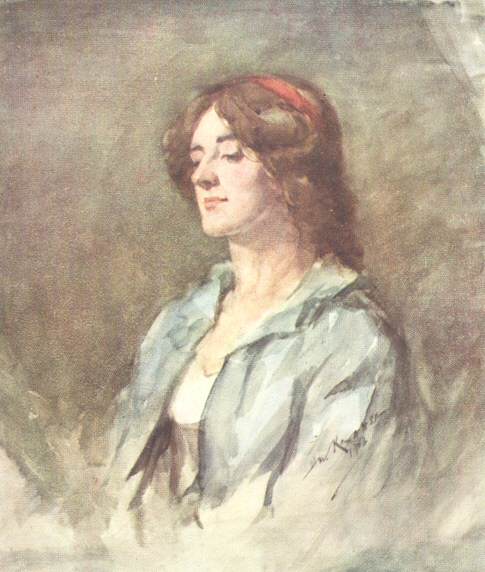
p.105CHAPTER XVI
YEAR 1775The regular course of nature iscalm and orderly, and tempests and troubles are but lapses fromthe accustomed sobriety with which Providence works out thedestined end of all things. From Yule till Pace-Mondaythere had been a gradual subsidence of our personal and parochialtribulations, and the spring, though late, set in bright andbeautiful, and was accompanied with the spirit of contentment; sothat, excepting the great concern that we all began to take inthe American rebellion, especially on account of Charles Malcolmthat was in the man-of-war, and of Captain Macadam that hadmarried Kate, we had throughout the better half of the year butlittle molestation of any sort. I should, however, note theupshot of the marriage.
By some cause that I do not recollect, if I ever had itproperly told, the regiment wherein the captain had bought hiscommission was not sent to the plantations, but only over toIreland, by which the captain and his lady were allowed toprolong their stay in the parish with his mother; and he, comingof age while he was among us, in making a settlement on his wife,bought the house at the Braehead, which was then just built byThomas Shivers the mason, and he gave that house, with ajudicious income, to Mrs. Malcolm, telling her that it was notbecoming, he having it in his power to do the contrary, that sheshould any longer be dependent on her own industry. Forthis the young man got a name like a sweet odour in all thecountry side; but that whimsical and prelatic lady his mother,just went out of all bounds, and played such pranks for an oldwoman, as cannot be told. To her daughter-in-law, however,she was wonderful kind; and, in fitting her out for going withthe captain to Dublin, it was extraordinary to hear what aparaphernalia she provided her with. But who could havethought that in this kindness a sore trial was brewing forme!
It happened that Miss Betty Wudrife, the daughter of anheritor, had been on a visit to some of her friends in Edinburgh;and being in at Edinburgh, she came out with a fine mantle,decked and adorned with many a ribbon-knot, such as had neverbeen seen in the parish. The Lady Macadam, hearing of thisgrand mantle, sent to beg Miss Betty to lend it to her, to make acopy for young Mrs. Macadam. But Miss Betty was so vogiewith her gay mantle, that she sent back word, it would be makingit o’er common; which so nettled the old courtly lady, thatshe vowed revenge, and said the mantle would not be long seen onMiss Betty. Nobody knew the meaning of her words; but shesent privately for Miss Sabrina, the schoolmistress, who was ayeproud of being invited to my lady’s, where she went on theSabbath night to drink tea, and read Thomson’sSeasonsand Hervey’s Meditationsfor herladyship’s recreation. Between the two, a secret plotwas laid against Miss Betty and her Edinburgh mantle; and MissSabrina, in a very treacherous manner, for the which I afterwardschided her severely, went to Miss Betty, and got a sight of themantle, and how it was made, and all about it, until she was in acapacity to make another like it; by which my lady and her, fromold silk and satin negligées which her ladyship had wornat the French court, made up two mantles of the selfsame fashionas Miss Betty’s, and, if possible, more sumptuouslygarnished, but in a flagrant fool way. On the Sundaymorning after, her ladyship sent for Jenny Gaffaw, and her daftdaughter Meg, and showed them the mantles, and said she wouldgive then half-a-crown if they would go with them to the kirk,and take their place in the bench beside the elders, and, afterworship, walk home before Miss Betty Wudrife. The two poornatural things were just transported with the sight of suchbravery, and needed no other bribe; so, over their bits of raggedduds, they put on the pageantry, and walked away to the kirk likepeacocks, and took their place on the bench, to the greatdiversion of the whole congregation.
I had no suspicion of this, and had prepared an affectingdiscourse about the horrors of war, in which I touched, with atender hand, on the troubles that threatened families and kindredin America; but all the time I was preaching, doing my best, andexpatiating till the tears came into my eyes, I could not divinewhat was the cause of the inattention of my people. But thetwo vain haverels were on the bench under me, and I could not seethem; where they sat, spreading their feathers and picking theirwings, stroking down and setting right their finery; with such anair as no living soul could see and withstand; while every eye inthe kirk was now on them, and now at Miss Betty Wudrife, who wasin a worse situation than if she had been on the stool ofrepentance.
Greatly grieved with the little heed that was paid to mydiscourse, I left the pulpit with a heavy heart; but when I cameout into the kirkyard, and saw the two antics linking likeladies, and aye keeping in the way before Miss Betty, and lookingback and around in their pride and admiration, with high headsand a wonderful pomp, I was really overcome, and could not keepmy gravity, but laughed loud out among the graves, and in theface of all my people; who, seeing how I was vanquished in thatunguarded moment by my enemy, made a universal and mostunreverent breach of all decorum, at which Miss Betty, who hadbeen the cause of all, ran into the first open door, and almostfainted away with mortification.
This affair was regarded by the elders as a sinful trespass onthe orderlyness that was needful in the Lord’s house; andthey called on me at the manse that night, and said it would be aguilty connivance if I did not rebuke and admonish Lady Macadamof the evil of her way; for they had questioned daft Jenny, andhad got at the bottom of the whole plot and mischief. ButI, who knew her ladyship’s light way, would fain have hadthe elders to overlook it, rather than expose myself to hertantrums; but they considered the thing as a great scandal, so Iwas obligated to conform to their wishes. I might, however,have as well stayed at home, for her ladyship was in one of herjocose humours when I went to speak to her on the subject; and itwas so far from my power to make a proper impression on her ofthe enormity that had been committed, that she made me laugh, inspite of my reason, at the fantastical drollery of her maliciousprank on Miss Betty Wudrife.
It, however, did not end here; for the session, knowing thatit was profitless to speak to the daft mother and daughter, whohad been the instruments, gave orders to Willy Howking, thebetheral, not to let them again so far into the kirk; and Willy,having scarcely more sense than them both, thought proper to keepthem out next Sunday altogether. The twa said nothing atthe time, but the adversary was busy with them; for, on theWednesday following, there being a meeting of the synod at Ayr,to my utter amazement the mother and daughter made theirappearance there in all their finery, and raised a complaintagainst me and the session, for debarring them from churchprivileges. No stage play could have produced such aneffect. I was perfectly dumfoundered; and every member ofthe synod might have been tied with a straw, they were soovercome with this new device of that endless woman, when bent onprovocation—the Lady Macadam; in whom the saying wasverified, that old folk are twice bairns; for in such plays,pranks, and projects, she was as playrife as a very lassie at hersampler; and this is but a swatch to what lengths she wouldgo. The complaint was dismissed, by which the session andme were assoilzied; but I’ll never forget till the day ofmy death what I suffered on that occasion, to be so put to thewall by two born idiots.
p.111CHAPTER XVII
YEAR 1776It belongs to the chroniclers ofthe realm to describe the damage and detriment which fell on thepower and prosperity of the kingdom, by reason of the rebellion,that was fired into open war, against the name and authority ofthe king in the plantations of America; for my task is todescribe what happened within the narrow bound of the pasturageof the Lord’s flock, of which, in his bounty and mercy, hemade me the humble, willing, but alas! the weak and ineffectualshepherd.
About the month of February, a recruiting party came to ourneighbour town of Irville, to beat up for men to be soldiersagainst the rebels; and thus the battle was brought, as it were,to our gates; for the very first man that took on with them wasone Thomas Wilson, a cottar in our clachan, who, up to that time,had been a decent and creditable character. He was at firsta farmer lad, but had forgathered with a doited tawpy, whom hemarried, and had offspring three or four. For some time itwas noticed that he had a down and thoughtful look, that hiscleeding was growing bare, and that his wife kept an untrighouse, which, it was feared by many, was the cause of Thomasgoing o’er often to the change-house; he was, in short,during the greater part of the winter, evidently a man foregonein the pleasures of this world, which made all that knew himcompassionate his situation.
No doubt, it was his household ills that burdened him pastbearing, and made him go into Irville, when he heard of therecruiting, and take on to be a soldier. Such awally-wallying as the news of this caused at every door; for thered-coats—from the persecuting days, when the black-cuffsrampaged through the country—soldiers that fought for hirewere held in dread and as a horror among us, and terrible werethe stories that were told of their cruelty and sinfulness;indeed, there had not been wanting in our time a sample of whatthey were, as witness the murder of Jean Glaikit by PatrickO’Neil, the Irish corporal, anent which I have treated atlarge in the memorables of the year 1774.
A meeting of the session was forthwith held; for here wasThomas Wilson’s wife and all his weans, an awful cess,thrown upon the parish; and it was settled outright among us,that Mr. Docken, who was then an elder, but is since dead, aworthy man, with a soft tongue and a pleasing manner, should goto Irville, and get Thomas, if possible, released from therecruiters. But it was all in vain; the sergeant would notlisten to him, for Thomas was a strapping lad; nor would the poorinfatuated man himself agree to go back, but cursed like acadger, and swore that, if he stayed any longer among hisplagues, he would commit some rash act; so we were saddled withhis family, which was the first taste and preeing of what war iswhen it comes into our hearths, and among the breadwinners.
The evil, however, did not stop here. Thomas, when hewas dressed out in the king’s clothes, came over to see hisbairns, and take a farewell of his friends, and he looked sogallant, that the very next market-day another lad of the parishlisted with him; but he was a ramplor, roving sort of a creature,and, upon the whole, it was thought he did well for the parishwhen he went to serve the king.
The listing was a catching distemper. Before the summerwas over, the other three of the farming lads went off with thedrum, and there was a wailing in the parish, which made me preacha touching discourse. I likened the parish to a widow womanwith a small family, sitting in her cottage by the fireside,herself spinning with an eident wheel, ettling her best to getthem a bit and a brat, and the poor weans all canty about thehearthstane—the little ones at their playocks, and theelder at their tasks—the callans working with hooks andlines to catch them a meal of fish in the morning—and thelassies working stockings to sell at the next Marymasfair.—And then I likened war to a calamity coming amongthem—the callans drowned at their fishing—the lassiesled to a misdoing—and the feckless wee bairns laid on thebed of sickness, and their poor forlorn mother sitting by herselfat the embers of a cauldrife fire; her tow done, and no a bodleto buy more; drooping a silent and salt tear for her babies, andthinking of days that war gone, and, like Rachel weeping for herchildren, she would not be comforted. With this Iconcluded, for my own heart filled full with the thought, andthere was a deep sob in the Church; verily it was Rachel weepingfor her children.
In the latter end of the year, the man-of-war, with CharlesMalcolm in her, came to the tail of the Bank at Greenock, topress men as it was thought, and Charles got leave from hiscaptain to come and see his mother; and he brought with him Mr.Howard, another midshipman, the son of a great parliament man inLondon, which, as we have tasted the sorrow, gave us some insightinto the pomp of war, Charles was now grown up into a fine youngman, rattling, light-hearted, and just a cordial of gladness, andhis companion was every bit like him. They were dressed intheir fine gold-laced garbs and nobody knew Charles when he cameto the clachan, but all wondered, for they were on horseback, androde to the house where his mother lived when he went away, butwhich was then occupied by Miss Sabrina and her school. Miss Sabrina had never seen Charles, but she had heard of him;and when he enquired for his mother, she guessed who he was, andshowed him the way to the new house that the captain had boughtfor her.
Miss Sabrina, who was a little overly perjink at times,behaved herself on this occasion with a true spirit, and gave herlassies the play immediately; so that the news of Charles’sreturn was spread by them like wildfire, and there was awonderful joy in the whole town. When Charles had seen hismother, and his sister Effie, with that douce and well-manneredlad William, his brother—for of their meeting I cannotspeak, not being present—he then came with his friend tosee me at the manse, and was most jocose with me, and, in a wayof great pleasance, got Mrs. Balwhidder to ask his friend tosleep at the manse. In short, we had just a ploy the wholetwo days they stayed with us, and I got leave from LordEaglesham’s steward to let them shoot on my lord’sland; and I believe every laddie wean in the parish attended themto the field. As for old Lady Macadam, Charles being, asshe said, a near relation, and she having likewise some knowledgeof his comrade’s family, she was just in her element withthem, though they were but youths; for she a woman naturally of afantastical, and, as I have narrated, given to comical devices,and pranks to a degree. She made for them a ball, to whichshe invited all the bonniest lassies, far and near, in theparish, and was out of the body with mirth, and had a fiddlerfrom Irville; and it was thought by those that were there, thathad she not been crippled with the rheumatics, she would havedanced herself. But I was concerned to hear both Charlesand his friend, like hungry hawks, rejoicing at the prospect ofthe war, hoping thereby, as soon as their midship term was out,to be made lieutenants; saving this, there was no allay in thehappiness they brought with them to the parish, and it was adelight to see how auld and young of all degrees made of Charles;for we were proud of him, and none more than myself, though hebegan to take liberties with me, calling me old governor; it was,however, in a warm-hearted manner, only I did not like it whenany of the elders heard. As for his mother, she deportedherself like a saint on the occasion. There was atemperance in the pleasure of her heart, and in her thankfulness,that is past the compass of words to describe. Even LadyMacadam, who never could think a serious thought all her days,said, in her wild way that the gods had bestowed more care in themaking of Mrs. Malcolm’s temper, than on the bodies andsouls of all the saints in the calendar. On the Sunday thestrangers attended divine worship, and I preached a sermonpurposely for them, and enlarged at great length and fulness onhow David overcame Goliath; and they both told me that they hadnever heard such a good discourse; but I do not think they weregreat judges of preachings. How, indeed, could Mr. Howardknow anything of sound doctrine, being educated, as he told me,at Eton school, a prelatic establishment! Nevertheless, hewas a fine lad; and though a little given to frolic anddiversion, he had a principle of integrity, that afterwardskythed into much virtue; for, during this visit, he took a notionof Effie Malcolm, and the lassie of him, then a sprightly andblooming creature, fair to look upon, and blithe to see; and hekept up a correspondence with her till the war was over, whenbeing a captain of a frigate, he came down among us, and theywere married by me, as shall be related in its proper place.
p.118CHAPTER XVIII
YEAR 1777This may well be called the year ofthe heavy heart, for we had sad tidings of the lads that wentaway as soldiers to America. First, there was a boding inthe minds of all their friends that they were never to see themmore; and their sadness, like a mist spreading from the watersand covering the fields, darkened the spirit of theneighbours. Secondly, a sound was bruited about that theking’s forces would have a hot and a sore struggle beforethe rebels were put down, if they were ever put down. Thencame the cruel truth of all that the poor lads’ friends hadfeared. But it is fit and proper that I should relate atlength, under their several heads, the sorrows and afflictions asthey came to pass.
One evening, as I was taking my walk alone, meditating mydiscourse for the next Sabbath—it was shortly afterCandlemas—it was a fine clear frosty evening, just as thesun was setting. Taking my walk alone, and thinking of thedreadfulness of Almighty power, and how that, if it was nottempered and restrained by infinite goodness, and wisdom, andmercy, the miserable sinner, man, and all things that live, wouldbe in a woeful state, I drew near the beild where old WidowMirkland lived by herself, who was grand-mother to Jock Hempy,the ramplor lad, that was the second who took on for asoldier. I did mind of this at the time; but, passing thehouse, I heard the croon, as it were, of a laden soul busy withthe Lord, and, not to disturb the holy workings of grace, Ipaused and listened. It was old Mizy Mirkland herself,sitting at the gable of the house, looking at the sun setting inall his glory behind the Arran hills; but she was notpraying—only moaning to herself—an oozing out, as itmight be called, of the spirit from her heart, then grievouslyoppressed with sorrow, and heavy bodements of grey hairs andpoverty.—“Yonder it slips awa’,” she wassaying, “and my poor bairn, that’s o’er theseas in America, is maybe looking on its bright face, thinking ofhis hame, and aiblins of me, that did my best to breed him up inthe fear of the Lord; but I couldna warsle wi’ what wasordained. Ay, Jock! as ye look at the sun gaun down, asmany a time, when ye were a wee innocent laddie at my knee here,I hae bade ye look at him as a type of your Maker, ye will hae asore heart; for ye hae left me in my need, when ye should haebeen near at hand to help me, for the hard labour and industrywith which I brought you up. But it’s theLord’s will. Blessed be the name of the Lord, thatmakes us to thole the tribulations of this world, and will rewardus, through the mediation of Jesus, hereafter.” Shewept bitterly as she said this, for her heart was tried, but theblessing of a religious contentment was shed upon her; and Istepped up to her, and asked about her concerns, for, saving as aparishioner, and a decent old woman, I knew little of her. Brief was her story; but it was one ofmisfortune.—“But I will not complain,” shesaid, “of the measure that has been meted unto me. Iwas left myself an orphan; when I grew up, and was married to mygude-man, I had known but scant and want. Our days offelicity were few; and he was ta’en awa’ from meshortly after my Mary was born. A wailing baby, and awidow’s heart, was a’ he left me. I nursed herwith my salt tears, and bred her in straits; but the favour ofGod was with us, and she grew up to womanhood as lovely as therose, and as blameless as the lily. In her time she wasmarried to a farming lad. There never was a brawer pair inthe kirk, than on that day when they gaed there first as man andwife. My heart was proud, and it pleased the Lord tochastise my pride—to nip my happiness, even in thebud. The very next day he got his arm crushed. Itnever got well again; and he fell into a decay, and died in thewinter, leaving my Mary far on in the road to be a mother.
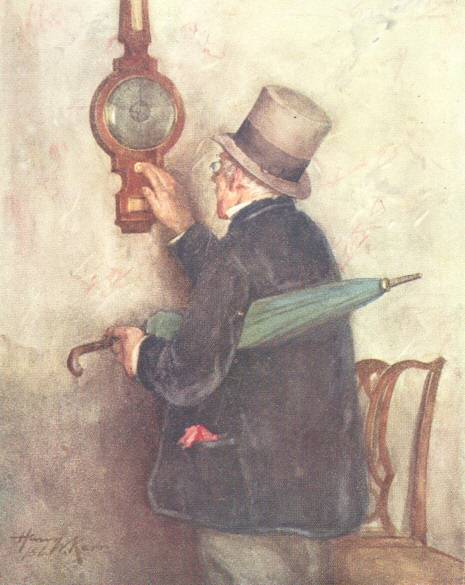
“When her time drew near, we both happened to be workingin the yard. She was delving to plant potatoes, and I toldher it would do her hurt; but she was eager to provide something,as she said, for what might happen. Oh! it was anill-omened word. The same night her trouble came on, andbefore the morning she was a cauld corpse, and another wee weefatherless baby was greeting at my bosom—it was himthat’s noo awa’ in America. He grew up to be afine bairn, with a warm heart, but a light head, and, wanting therein of a father’s power upon him, was no sa douce as Icould have wished; but he was no man’s foe save hisown. I thought, and hoped, as he grew to years ofdiscretion, he would have sobered, and been a consolation to myold age; but he’s gone, and he’ll never comeback—disappointment is my portion in this world, and I haveno hope; while I can do, I will seek no help, but threescore andfifteen can do little, and a small ail is a great evil to an agedwoman, who has but the distaff for her breadwinner.”
I did all that I could to bid her be of good cheer, but thecomfort of a hopeful spirit was dead within her; and she told me,that by many tokens she was assured her bairn was alreadyslain.—“Thrice,” said she, “I have seenhis wraith—the first time he was in the pride of his youngmanhood, the next he was pale and wan, with a bloody and gashywound in his side, and the third time there was a smoke, and,when it cleared away, I saw him in a grave, with neitherwinding-sheet nor coffin.”
The tale of this pious and resigned spirit dwelt in mine ear,and, when I went home, Mrs. Balwhidder thought that I had metwith an o’ercome, and was very uneasy; so she got the teasoon ready to make me better; but scarcely had we tasted thefirst cup when a loud lamentation was heard in the kitchen. This was from that tawpy the wife of Thomas Wilson, with herthree weans. They had been seeking their meat among thefarmer houses, and, in coming home, forgathered on the road withthe Glasgow carrier, who told them that news had come, in theLondon Gazette, of a battle, in which the regiment thatThomas had listed in was engaged, and had suffered loss both inrank and file; none doubting that their head was in the number ofthe slain, the whole family grat aloud, and came to the manse,bewailing him as no more; and it afterwards turned out to be thecase, making it plain to me that there is a farseeing discernmentin the spirit, that reaches beyond the scope of our incarnatesenses.
But the weight of the war did not end with these afflictions;for, instead of the sorrow that the listing caused, and theanxiety after, and the grief of the bloody tidings, operating aswholesome admonition to our young men, the natural perversity ofthe human heart was more and more manifested. A wonderfulinterest was raised among us all to hear of what was going on inthe world; insomuch, that I myself was no longer contented withthe relation of the news of the month in the ScotsMagazine, but joined with my father-in-law, Mr. Kibbock, toget a newspaper twice a-week from Edinburgh. As for LadyMacadam, who being naturally an impatient woman, she had one sentto her three times a-week from London, so that we had somethingfresh five times every week; and the old papers were lent out tothe families who had friends in the wars. This was done onmy suggestion, hoping it would make all content with theirpeaceable lot; but dominion for a time had been given to thepower of contrariness, and it had quite an opposite effect. It begot a curiosity, egging on to enterprise; and, greatly to mysorrow, three of the brawest lads in the parish, or in anyparish, all in one day took on with a party of the Scots Greysthat were then lying in Ayr; and nothing would satisfy thecallans at Mr. Lorimore’s school, but, instead of theirinnocent plays with girs, and shinties, and sicklike, they mustgo ranking like soldiers, and fight sham-fights in bodies. In short, things grew to a perfect hostility, for a swarm ofweans came out from the schools of Irville on a Saturdayafternoon, and, forgathering with ours, they had a battle withstones on the toll-road, such as was dreadful to hear of; formany a one got a mark that day he will take to the grave withhim.
It was not, however, by accidents of the field only, that wewere afflicted; those of the flood, too, were sent likewiseagainst us. In the month of October, when the corn was yetin the holms, and on the cold land by the river side, the waterof Irville swelled to a great spait, from bank to brae, sweepingall before it, and roaring, in its might, like an agent of divinedispleasure, sent forth to punish the inhabitants of theearth. The loss of the victual was a thing reparable, andthose that suffered did not greatly complain; for, in otherrespects, their harvest had been plenteous: but the river, in itsfury, not content with overflowing the lands, burst through thesandy hills with a raging force, and a riving asunder of thesolid ground, as when the fountains of the great deep were brokenup. All in the parish was a-foot, and on the hills, someweeping and wringing their hands, not knowing what would happen,when they beheld the landmarks of the waters deserted, and theriver breaking away through the country, like the war-horse setloose in his pasture, and glorying in his might. By thischange in the way and channel of the river, all the mills in ourparish were left more than half a mile from dam or lade; and thefarmers through the whole winter, till the new mills were built,had to travel through a heavy road with their victual, which wasa great grievance, and added not a little to the afflictions ofthis unhappy year, which to me were not without a particularity,by the death of a full cousin of Mrs. Balwhidder, my first wife;she was grievously burnt by looting over a candle. Hermutch, which was of the high structure then in vogue, took fire,and being fastened with corking-pins to a great toupee, it couldnot be got off until she had sustained a deadly injury, of which,after lingering long, she was kindly eased by her removal fromtrouble. This sore accident was to me a matter of deepconcern and cogitation; but as it happened in Tarbolton, and noin our parish, I have only alluded to it to show, that when mypeople were chastised by the hand of Providence, their pastor wasnot spared, but had a drop from the same vial.
p.126CHAPTER XIX
YEAR 1778This year was as the shadow of thebygane: there was less actual suffering, but what we came throughcast a gloom among us, and we did not get up our spirits till thespring was far advanced; the corn was in the ear, and the sun fartowards midsummer height, before there was any regular show ofgladness in the parish.
It was clear to me that the wars were not to be soon over; forI noticed, in the course of this year, that there was a greaterchristening of lad bairns than had ever been in any year duringmy incumbency; and grave and wise persons, observant of the signsof the times, said, that it had been long held as a sureprognostication of war, when the births of male childrenoutnumbered that of females.
Our chief misfortune in this year was a revival of that wickedmother of many mischiefs, the smuggling trade, which concerned megreatly; but it was not allowed to it to make any thing like apermanent stay among us, though in some of the neighbouringparishes, its ravages, both in morals and property, were verydistressing, and many a mailing was sold to pay for the triumphsof the cutters and gaugers; for the government was by this timegrown more eager, and the war caused the king’s ships to beout and about, which increased the trouble of the smugglers,whose wits in their turn were thereby much sharpened.
After Mrs. Malcolm, by the settlement of Captain Macadam, hadgiven up her dealing, two maiden women, that were sisters, Bettyand Janet Pawkie, came in among us from Ayr, where they hadfriends in league with some of the laigh land folk, that carriedon the contraband with the Isle of Man, which was the very eye ofthe smuggling. They took up the tea-selling, which Mrs.Malcolm had dropped, and did business on a larger scale, having ageneral huxtry, with parliament-cakes, and candles, andpincushions, as well as other groceries, in their window. Whether they had any contraband dealings, or were onlyback-bitten, I cannot take it upon me to say; but it wasjealoused in the parish that the meal in the sacks, that came totheir door at night, and was sent to the Glasgow market in themorning, was not made of corn. They were, however, decentwomen, both sedate and orderly; the eldest, Betty Pawkie, was ofa manly stature, and had a long beard, which made her have acoarse look; but she was, nevertheless, a worthy, well-doingcreature, and at her death she left ten pounds to the poor of theparish, as may be seen in the mortification board that thesession put up in the kirk as a testification and an example.
Shortly after the revival of the smuggling, an exciseman wasput among us, and the first was Robin Bicker, a very civil ladthat had been a flunkey with Sir Hugh Montgomerie, when he was aresidenter in Edinburgh, before the old Sir Hugh’sdeath. He was a queer fellow, and had a coothy way ofgetting in about folk, the which was very serviceable to him inhis vocation; nor was he overly gleg: but when a job was illdone, and he was obliged to notice it, he would often break outon the smugglers for being so stupid, so that for an exciseman hewas wonderful well liked, and did not object to a waught ofbrandy at a time; when the auld wives ca’d itwell-water. It happened, however, that some unneighbourlyperson sent him notice of a clecking of tea chests, or brandykegs, at which both Jenny and Betty Pawkie were thehowdies. Robin could not but therefore enter their house;however, before going in, he just cried at the door to somebodyon the road, so as to let the twa industrious lassies hear he wasat hand. They were not slack in closing the trance-door,and putting stoups and stools behind it, so as to cause trouble,and give time before any body could get in. They thenemptied their chaff-bed, and filled the tikeing with tea, andBetty went in on the top, covering herself with the blanket, andgraining like a woman in labour. It was thought that RobinBicker himself would not have been overly particular in searchingthe house, considering there was a woman seemingly in thedeath-thraws; but a sorner, an incomer from the east country, andthat hung about the change-house as a divor hostler, that wouldrather gang a day’s journey in the dark than turn a spadein day-light, came to him as he stood at the door, and went inwith him to see the sport. Robin, for some reason, couldnot bid him go away, and both Betty and Janet were sure he was inthe plot against them; indeed, it was always thought he was aninformer, and no doubt he was something not canny, for he had adown look.
It was some time before the doorway was cleared of the stoupsand stools, and Jenny was in great concern, and flustered, as shesaid, for her poor sister, who was taken with aheart-colic. “I’m sorry for her,” saidRobin, “but I’ll be as quiet as possible;” andso he searched all the house, but found nothing; at the which hiscompanion, the divor east country hostler, swore an oath thatcould not be misunderstood; so, without more ado, but as allthought against the grain, Robin went up to sympathize with Bettyin the bed, whose groans were loud and vehement. “Letme feel your pulse,” said Robin, and he looted down as sheput forth her arm from aneath the clothes, and laying his hand onthe bed, cried, “Hey! what’s this? this is a costlyfilling.” Upon which Betty jumpet up quite recovered,and Jenny fell to the wailing and railing, while the hostler fromthe east country took the bed of tea on his back, to carry it tothe change-house, till a cart was gotten to take it into thecustom-house at Irville.
Betty Pawkie being thus suddenly cured, and grudging the lossof property, took a knife in her hand, and as the divor wascrossing the burn at the stepping-stones that lead to the back ofthe change-house, she ran after him and ripped up the tikeing,and sent all the tea floating away on the burn, which was thoughta brave action of Betty, and the story not a little helped tolighten our melancholy meditations.
Robin Bicker was soon after this affair removed to anotherdistrict, and we got in his place one Mungo Argyle, who was asproud as a provost, being come of Highland parentage. Blackwas the hour he came among my people; for he was needy andgreedy, and rode on the top of his commission. Of all themanifold ills in the train of smuggling, surely the excisemen arethe worst, and the setting of this rabiator over us was a severejudgment for our sins. But he suffered for’t, andpeace be with him in the grave, where the wicked cease fromtroubling!
Willie Malcolm, the youngest son of his mother, had by thistime learned all that Mr. Lorimore, the schoolmaster, couldteach; and as it was evidenced to every body, by his mild mannersand saintliness of demeanour, that he was a chosen vessel, hismother longed to fulfil his own wish, which was doubtless thenatural working of the act of grace that had been shed upon him;but she had not the wherewithal to send him to the college ofGlasgow, where he was desirous to study, and her just pride wouldnot allow her to cess his brother-in-law, the Captain Macadam,whom, I should now mention, was raised in the end of this year,as we read in the newspapers, to be a major. I thought herin this somewhat unreasonable, for she would not be persuaded tolet me write to the captain; but when I reflected on the goodthat Willie Malcolm might in time do as a preacher, I saidnothing more to her, but indited a letter to the Lord Eaglesham,setting forth the lad’s parts, telling who he was and allabout his mother’s scruples; and, by the retour of the postfrom London his lordship sent me an order on his steward, to payme twenty pounds towards equipping my protegée, as hecalled Willie, with a promise to pay for his education, which wassuch a great thing for his lordship to do off-hand on myrecommendation, that it won much affection throughout the countryside; and folks began to wonder, rehearsing the great things, aswas said, that I had gotten my lord at different times, and ondivers occasions, to do, which had a vast of influence among mybrethren of the presbytery, and they grew into a state of greatercordiality with me, looking on me as a man having authority; butI was none thereat lifted up, for not being gifted with the powerof a kirk-filling eloquence, I was but little sought for atsacraments, and fasts, and solemn days, which was doubtless wellordained; for I had no motive to seek fame in foreign pulpits,but was left to walk in the paths of simplicity within my ownparish. To eschew evil myself, and to teach others to dothe same, I thought the main duties of the pastoral office, andwith a sincere heart endeavoured what in me lay to perform themwith meekness, sobriety, and a spirit wakeful to the inroads ofsin and Satan. But oh, the sordiness of humannature!—The kindness of the Lord Eaglesham’s owndisposition was ascribed to my influence, and many a dry answer Iwas obliged to give to applicants that would have me trouble hislordship, as if I had a claim upon him. In the ensuingyear, the notion of my cordiality with him came to a great head,and brought about an event, that could not have been forethoughtby me as a thing within the compass of possibility to bring topass.
p.133CHAPTER XX
YEAR 1779I was named in this year for theGeneral Assembly, and Mrs. Balwhidder, by her continual thrift,having made our purse able to stand a shake against the wind, weresolved to go into Edinburgh in a creditable manner. Accordingly, in conjunct with Mrs. Dalrymple, the lady of a majorof that name, we hired the Irville chaise, and we put up inGlasgow, at the Black Boy, where we stayed all night. Nextmorning, by seven o’clock, we got into a fly-coach for thecapital of Scotland, which we reached after a heavy journey aboutthe same hour in the evening, and put up at the public where itstopped till the next day; for really both me and Mrs. Balwhidderwere worn out with the undertaking, and found a cup of tea a vastrefreshment.
Betimes, in the morning, having taken our breakfast, we got acaddy to guide us and our wallise to Widow M‘Vicar’s,at the head of the Covenanters’ Close. She was arelation to my first wife, Betty Lanshaw, my own full cousin thatwas, and we had advised her, by course of post, of our coming,and intendment to lodge with her as uncos and strangers. But Mrs. M‘Vicar kept a cloth shop, and sold plaidings andflannels, besides Yorkshire superfines, and was used to thesudden incoming of strangers, especially visitants, both from theWest and the North Highlands, and was withal a gawsy furthywoman, taking great pleasure in hospitality, and every sort ofkindliness and discretion. She would not allow of such athing as our being lodgers in her house, but was so cagey to seeus, and to have it in her power to be civil to a minister, as shewas pleased to say, of such repute, that nothing less wouldcontent her but that we must live upon her, and partake of allthe best that could be gotten for us within the walls of“the gude town.”
When we found ourselves so comfortable, Mrs. Balwhidder and mewaited on my patron’s family that was, the young ladies,and the laird, who had been my pupil, but was now an advocatehigh in the law. They likewise were kind also. Inshort, every body in Edinburgh were in a manner wearisome kind,and we could scarcely find time to see the Castle and the palaceof Holyrood-house, and that more sanctified place, where theMaccabeus of the Kirk of Scotland, John Knox, was wont tolive.
Upon my introduction to his grace the Commissioner, I wasdelighted and surprised to find the Lord Eaglesham at the levee,and his lordship was so glad on seeing me, that he made me morekenspeckle than I could have wished to have been in hisgrace’s presence; for, owing to the same, I was required topreach before his grace, upon a jocose recommendation of hislordship; the which gave me great concern, and daunted me so thatin the interim I was almost bereft of all peace and studiouscomposure of mind. Fain would I have eschewed the honourthat was thus thrust upon me; but both my wife and Mrs.M‘Vicar were just lifted out of themselves with thethought.
When the day came, I thought all things in this world wereloosened from their hold, and that the sure and steadfast earthitself was grown coggly beneath my feet, as I mounted thepulpit. With what sincerity I prayed for help that day! andnever stood man more in need of it; for through all my prayer thecongregation was so watchful and still, doubtless to note if mydoctrine was orthodox, that the beating of my heart might havebeen heard to the uttermost corners of the kirk.
I had chosen as my text, from Second Samuel, xixth chapter and35th verse, these words—“Can I hear any more thevoice of singing men and singing women? Wherefore, then,should thy servant be yet a burden to the king?” Andhardly had I with a trembling voice read the words, when Iperceived an awful stir in the congregation; for all applied thewords to the state of the church, and the appointment of hisgrace the Commissioner. Having paused after giving out thetext, the same fearful and critical silence again ensued, andevery eye was so fixed upon me, that I was for a time deprived ofcourage to look about; but heaven was pleased to compassionate myinfirmity, and as I proceeded, I began to warm as in my ownpulpit. I described the gorgeous Babylonian harlot ridingforth in her chariots of gold and silver, with trampling steedsand a hurricane of followers, drunk with the cup of abominations,all shouting with revelry, and glorying in her triumph, treadingdown in their career those precious pearls, the saints andmartyrs, into the mire beneath their swinish feet. “Before her you may behold Wantonness playing the tinklingcymbal, Insolence beating the drum, and Pride blowing thetrumpet. Every vice is there with his emblems; and theseller of pardons, with his crucifix and triple crown, isdistributing his largess of perdition. The voices of menshout to set wide the gates, to give entrance to the queen ofnations, and the gates are set wide, and they all enter. The avenging gates close on them—they are all shut up inhell.”
There was a sough in the kirk as I said these words; for thevision I described seemed to be passing before me as I spoke, andI felt as if I had witnessed the everlasting destruction ofAntichrist, and the worshippers of the Beast. But soonrecovering myself, I said in a soft and gentle manner,“Look at yon lovely creature in virgin-raiment, with theBible in her hand. See how mildly she walks along, givingalms to the poor as she passes on towards the door of that lowlydwelling—Let us follow her in—She takes her seat inthe chair at the bedside of the poor old dying sinner; and as hetosses in the height of penitence and despair, she reads to himthe promise of the Saviour—‘This night thou shalt bewith me in Paradise;’ and he embraces her with transports,and, falling back on his pillow, calmly closes his eyes inpeace. She is the true religion; and when I see what shecan do even in the last moments of the guilty, well may weexclaim, when we think of the symbols and pageantry of thedeparted superstition, Can I hear any more the voice of singingmen and singing women? No; let us cling to the simplicityof the Truth that is now established in our nativeland.”
At the conclusion of this clause of my discourse, thecongregation, which had been all so still and so solemn, nevercoughing, as was often the case among my people, gave a greatrustle, changing their positions, by which I was almost overcome;however, I took heart and ventured on, and pointed out that, withour Bible and an orthodox priesthood, we stood in no need of theking’s authority, however bound we were, in temporalthings, to respect it; and I showed this at some length, cryingout in the words of my text, “Wherefore, then, should thyservant be yet a burden to the king?” in the saying ofwhich I happened to turn my eyes towards his grace theCommissioner, as he sat on the throne, and I thought hiscountenance was troubled, which made me add, that he might notthink I meant him any offence, “That the King of the Churchwas one before whom the great, and the wise, and thegood—all doomed and sentenced convicts—implore hismercy.” “It is true,” said I, “thatin the days of his tribulation he was wounded for our iniquities,and died to save us; but, at his death, his greatness wasproclaimed by the quick and the dead. There was sorrow, andthere was wonder, and there was rage, and there was remorse; butthere was no shame there—none blushed on that day at thatsight but yon glorious luminary.” The congregationrose, and looked round, as the sun that I pointed at shone in atthe window. I was disconcerted by their movement, and myspirit was spent, so that I could say no more.
When I came down from the pulpit, there was a great pressingin of acquaintance and ministers, who lauded me exceedingly; butI thought it could be only in derision, therefore I slipped hometo Mrs. M‘Vicar’s as fast as I could.
Mrs. M‘Vicar, who was a clever, hearing-all sort of aneighbour, said my sermon was greatly thought of, and that I hadsurprised everybody; but I was fearful there was something ofjocularity at the bottom of this, for she was a flaunty woman,and liked well to give a good-humoured gibe or jeer. However, his grace the Commissioner was very thankful for thediscourse, and complimented me on what he called my apostolicalearnestness; but he was a courteous man, and I could not trust tohim, especially as my lord Eaglesham had told me in secrecybefore—it’s true, it was in his gallantingway—that, in speaking of the king’s servant as I haddone, I had rather gone beyond the bounds of modernmoderation. Altogether, I found neither pleasure nor profitin what was thought so great an honour, but longed for theprivacy of my own narrow pasture, and little flock.
It was in this visit to Edinburgh that Mrs. Balwhidder boughther silver teapot, and other ornamental articles; but this wasnot done, as she assured me, in a vain spirit of bravery, which Icould not have abided, but because it was well known that teadraws better in a silver pot, and drinks pleasanter in a chinacup, than out of any other kind of cup or teapot.
By the time I got home to the manse, I had been three wholeweeks and five days absent, which was more than all my absencestogether, from the time of my placing; and my people were glowingwith satisfaction when they saw us driving in a Glasgow chaisethrough the clachan to the manse.
The rest of the year was merely a quiet succession of smallincidents, none of which are worthy of notation, though they wereall severally, no doubt, of aught somewhere, as they took us bothtime and place in the coming to pass, and nothing comes to passwithout helping onwards to some great end; each particular littlething that happens in the world being a seed sown by the hand ofProvidence to yield an increase, which increase is destined, inits turn, to minister to some higher purpose, until at last theissue affects the whole earth. There is nothing in all theworld that doth not advance the cause of goodness; no, not eventhe sins of the wicked, though, through the dim casement of hermortal tabernacle, the soul of man cannot discern the methodthereof.
p.141CHAPTER XXI
YEAR 1780This was, among ourselves, anotheryear of few events. A sound, it is true, came among us of adesign, on the part of the government in London, to bring backthe old harlotry of papistry; but we spent our time in the lea ofthe hedge, and the lown of the hill. Some there were that apanic seized upon when they heard of Lord George Gordon, thatzealous Protestant, being committed to the Tower; but for mypart, I had no terror upon me, for I saw all things around megoing forward improving; and I said to myself, it is not so whenProvidence permits scathe and sorrow to fall upon a nation. Civil troubles, and the casting down of thrones, is alwaysforewarned by want and poverty striking the people. What Ihave, therefore, chiefly to record as the memorables of thisyear, are things of small import—the main of which are,that some of the neighbouring lairds, taking example by Mr.Kibbock, my father-in-law that was, began in this fall to plantthe tops of their hills with mounts of fir-trees; and MungoArgyle, the exciseman, just herried the poor smugglers to death,and made a power of prize-money, which, however, had not thewonted effect of riches, for it brought him no honour; and helived in the parish like a leper, or any other kind ofexcommunicated person.
But I should not forget a most droll thing that took placewith Jenny Gaffaw, and her daughter. They had been missedfrom the parish for some days, and folk began to be uneasy aboutwhat could have become of the two silly creatures; till onenight, at the dead hour, a strange light was seen beaming andburning at the window of the bit hole where they lived. Itwas first observed by Lady Macadam, who never went to bed at anyChristian hour, but sat up reading her new French novels andplay-books with Miss Sabrina, the schoolmistress. She gavethe alarm, thinking that such a great and continuous light from alone house, where never candle had been seen before, could benothing less than the flame of a burning. And sending MissSabrina and the servants to see what was the matter, they behelddaft Jenny, and her as daft daughter, with a score of candledoups, (Heaven only knows where they got them!) placed in thewindow, and the twa fools dancing, and linking, and admiringbefore the door. “What’s all this about,Jenny,” said Miss Sabrina.—“Awa’wi’ you, awa’ wi’ you—ye wicked pope, yewhore of Babylon—is na it for the glory of God, and theProtestant religion? d’ye think I will be a pope as long aslight can put out darkness?”—And with that the motherand daughter began again to leap and dance as madly asbefore.
It seems that poor Jenny, having heard of the luminations thatwere lighted up through the country on the ending of the PopishBill, had, with Meg, travelled by themselves into Glasgow, wherethey had gathered or begged a stock of candles, and coming backunder the cloud of night, had surprised and alarmed the wholeclachan, by lighting up their window in the manner that I havedescribed. Poor Miss Sabrina, at Jenny’s uncivilsalutation, went back to my lady with her heart full, and wouldfain have had the idiots brought to task before the session, forwhat they had said to her. But I would not hear tell ofsuch a thing, for which Miss Sabrina owed me a grudge that wasnot soon given up. At the same time, I was grieved to seethe testimonies of joyfulness for a holy victory, brought intosuch disrepute by the ill-timed demonstrations of the twoirreclaimable naturals, that had not a true conception of thecause for which they were triumphing.
p.144CHAPTER XXII
YEAR 1781If the two last years passedo’er the heads of me and my people without any manifestdolour, which is a great thing to say for so long a period inthis world, we had our own trials and tribulations in the one ofwhich I have now to make mention. Mungo Argyle, theexciseman, waxing rich, grew proud and petulant, and would haveruled the country side with a rod of iron. Nothing lesswould serve him than a fine horse to ride on, and a world ofother conveniences and luxuries, as if he had been on an equalitywith gentlemen. And he bought a grand gun, which was calleda fowling-piece; and he had two pointer dogs, the like of whichhad not been seen in the parish since the planting of theEaglesham-wood on the moorland, which was four years before I gotthe call. Every body said the man was fey; and truly, whenI remarked him so gallant and gay on the Sabbath at the kirk, andnoted his glowing face and gleg een, I thought at times there wassomething no canny about him. It was indeed clear to beseen, that the man was hurried out of himself; but nobody couldhave thought that the death he was to dree would have been whatit was.
About the end of summer my Lord Eaglesham came to the castle,bringing with him an English madam, that was his Miss. Somedays after he came down from London, as he was riding past themanse, his lordship stopped to enquire for my health, and I wentto the door to speak to him. I thought that he did not meetme with that blithe countenance he was wont, and in going away,he said with a blush, “I fear I dare not ask you to come tothe castle.” I had heard of his concubine, and Isaid, “In saying so, my lord, you show a spark of grace;for it would not become me to see what I have heard; and I amsurprised, my lord, you will not rather take a lady of yourown.” He looked kindly, but confused, saying, he didnot know where to get one; so seeing his shame, and not wishingto put him out of conceit entirely with himself, I replied,“Na, na, my lord, there’s nobody will believe that,for there never was a silly Jock, but there was as silly aJenny,” at which he laughed heartily, and rode away. But I know not what was in’t; I was troubled in mind abouthim, and thought, as he was riding away, that I would never seehim again; and sure enough it so happened; for the next day,being airing in his coach with Miss Spangle, the lady he hadbrought, he happened to see Mungo Argyle with his dogs and hisgun, and my lord being as particular about his game as the otherwas about boxes of tea and kegs of brandy, he jumped out of thecarriage, and ran to take the gun. Words passed, and theexciseman shot my lord. Never shall I forget that day; suchriding, such running, the whole country side afoot; but the samenight my lord breathed his last; and the mad and wild reprobatethat did the deed was taken up and sent off to Edinburgh. This was a woeful riddance of that oppressor, for my lord was agood landlord and a kind-hearted man; and albeit, though a littlethoughtless, was aye ready to make his power, when the way waspointed out, minister to good works. The whole parishmourned for him, and there was not a sorer heart in all itsbounds than my own. Never was such a sight seen as hisburial: the whole country side was there, and all as solemn as ifthey had been assembled in the valley of Jehoshaphat in thelatter day. The hedges where the funeral was to pass wereclad with weans, like bunches of hips and haws, and the kirkyardwas as if all its own dead were risen. Never, do I think,was such a multitude gathered together. Some thought therecould not be less than three thousand grown men, besides womenand children.
Scarcely was this great public calamity past, for it could bereckoned no less, when one Saturday afternoon, as Miss Sabrina,the schoolmistress, was dining with Lady Macadam, her ladyshipwas stricken with the paralytics, and her face so thrown in thecourse of a few minutes, that Miss Sabrina came flying to themanse for the help and advice of Mrs. Balwhidder. A doctorwas gotten with all speed by express; but her ladyship wassmitten beyond the reach of medicine. She lived, however,some time after; but oh! she was such an object, that it was agrief to see her. She could only mutter when she tried tospeak, and was as helpless as a baby. Though she neverliked me, nor could I say there was many things in her demeanourthat pleased me; yet she was a free-handed woman to the needful,and when she died she was more missed than it was thought shecould have been.
Shortly after her funeral, which was managed by a gentlemansent from her friends in Edinburgh, that I wrote to about hercondition, the Major, her son, with his lady, Kate Malcolm, andtwo pretty bairns, came and stayed in her house for a time, andthey were a great happiness to us all, both in the way ofdrinking tea, and sometimes taking a bit of dinner, their onlymother now, the worthy and pious Mrs. Malcolm, being regularly ofthe company.
Before the end of the year, I should mention, that the fortuneof Mrs. Malcolm’s family got another shove upwards, by thepromotion of her second son, Robert Malcolm, who, being grown anexpert and careful mariner, was made captain of a grand ship,whereof Provost Maitland of Glasgow, that was kind to his motherin her distresses, was the owner. But that douce ladWillie, her youngest son, who was at the university of Glasgowunder the Lord Eaglesham’s patronage, was like to havesuffered a blight. However, Major Macadam, when I spoke tohim anent the young man’s loss of his patron, said, with apleasant generosity, he should not be stickit; and, accordingly,he made up, as far as money could, for the loss of his lordship;but there was none that made up for the great power andinfluence, which, I have no doubt, the Earl would have exerted inhis behalf, when he was ripened for the church. So that,although in time William came out a sound and heart-searchingpreacher, he was long obliged, like many another unfriendedsaint, to cultivate sand, and wash Ethiopians in the shape of aneast country gentleman’s camstrairy weans; than which, ashe wrote me himself, there cannot be on earth a greater trial oftemper. However, in the end he was rewarded, and is notonly now a placed minister, but a doctor of divinity.
The death of Lady Macadam was followed by another parochialmisfortune; for, considering the time when it happened, we couldcount it as nothing less. Auld Thomas Howkings, thebetheral, fell sick, and died in the course of a week’sillness, about the end of November; and the measles coming atthat time upon the parish, there was such a smashery of the poorweans as had not been known for an age; insomuch that JamesBanes, the lad who was Thomas Howkings’ helper, rose inopen rebellion against the session during his superior’sillness; and we were constrained to augment his pay, and topromise him the place if Thomas did not recover, which it wasthen thought he could not do. On the day this happened,there were three dead children in the clachan, and a panic andconsternation spread about the burial of them when JamesBane’s insurrection was known, which made both me and thesession glad to hush up the affair, that the heart of the publicmight have no more than the sufferings of individuals to hurtit.—Thus ended a year, on many accounts, heavy to beremembered.
p.150CHAPTER XXIII
YEAR 1782Although I have not been particularin noticing it, from time to time, there had been an occasionalgoing off, at fairs and on market-days, of the lads of the parishas soldiers, and when Captain Malcolm got the command of hisship, no less than four young men sailed with him from theclachan; so that we were deeper and deeper interested in theproceedings of the doleful war that was raging in theplantations. By one post we heard of no less than threebrave fellows belonging to us being slain in one battle, forwhich there was a loud and general lamentation.
Shortly after this, I got a letter from Charles Malcolm, avery pretty letter it indeed was: he had heard of my LordEaglesham’s murder, and grieved for the loss, both becausehis lordship was a good man, and because he had been such afriend to him and his family. “But,” saidCharles, “the best way I can show my gratitude for hispatronage, is to prove myself a good officer to my king andcountry.” Which I thought a brave sentiment, and waspleased thereat; for somehow Charles, from the time he brought methe limes to make a bowl of punch, in his pocket from Jamaica,had built a nest of affection in my heart. But, oh! thewicked wastry of life in war. In less than a month after,the news came of a victory over the French fleet, and by the samepost I got a letter from Mr. Howard, that was the midshipman whocame to see us with Charles, telling me that poor Charles hadbeen mortally wounded in the action, and had afterwards died ofhis wounds. “He was a hero in the engagement,”said Mr. Howard, “and he died as a good and a brave manshould.”—These tidings gave me one of the soresthearts I ever suffered, and it was long before I could gatherfortitude to disclose the tidings to poor Charles’smother. But the callants of the school had heard of thevictory, and were going shouting about, and had set the steeplebell a-ringing, by which Mrs. Malcolm heard the news; and knowingthat Charles’s ship was with the fleet, she came over tothe manse in great anxiety to hear the particulars, somebodytelling her that there had been a foreign letter to me by thepostman.
When I saw her I could not speak, but looked at her in pity,and, the tear fleeing up into my eyes, she guessed what hadhappened. After giving a deep and sore sigh, she enquired,“How did he behave? I hope well, for he was aye agallant laddie!”—and then she wept verybitterly. However, growing calmer, I read to her theletter; and, when I had done, she begged me to give it to her tokeep, saying, “It’s all that I have now left of mypretty boy; but it’s mair precious to me than the wealth ofthe Indies;” and she begged me to return thanks to the Lordfor all the comforts and manifold mercies with which her lot hadbeen blessed, since the hour she put her trust in him alone; andthat was when she was left a penniless widow, with her fivefatherless bairns.
It was just an edification of the spirit to see the Christianresignation of this worthy woman. Mrs. Balwhidder wasconfounded, and said, there was more sorrow in seeing the deepgrief of her fortitude than tongue could tell.
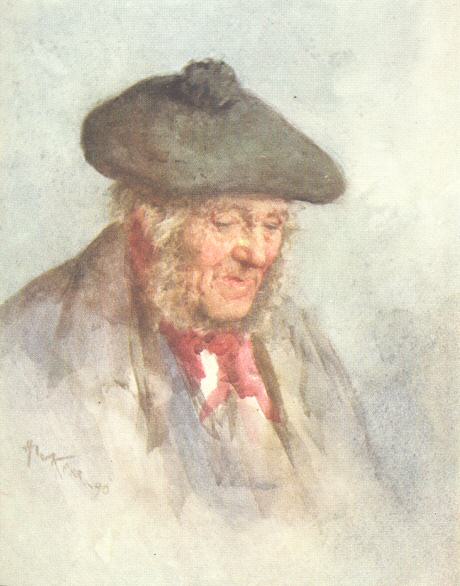
Having taken a glass of wine with her, I walked out to conducther to her own house; but in the way we met with a severetrial. All the weans were out parading with napkins andkail-blades on sticks, rejoicing and triumphing in the gladtidings of victory. But when they saw me and Mrs. Malcolmcoming slowly along, they guessed what had happened, and threwaway their banners of joy; and standing all up in a row, withsilence and sadness, along the kirkyard wall as we passed, showedan instinct of compassion that penetrated to my very soul. The poor mother burst into fresh affliction, and some of thebairns into an audible weeping; and, taking one another by thehand, they followed us to her door, like mourners at afuneral. Never was such a sight seen in any townbefore. The neighbours came to look at it as we walkedalong, and the men turned aside to hide their faces; while themothers pressed their babies fondlier to their bosoms, andwatered their innocent faces with their tears.
I prepared a suitable sermon, taking as the words of my text,“Howl, ye ships of Tarshish, for your strength is laidwaste.” But when I saw around me so many of my peopleclad in complimentary mourning for the gallant Charles Malcolm,and that even poor daft Jenny Gaffaw, and her daughter, had on anold black riband; and when I thought of him, the spirited laddie,coming home from Jamaica with his parrot on his shoulder, and hislimes for me, my heart filled full, and I was obliged to sit downin the pulpit, and drop a tear.
After a pause, and the Lord having vouchsafed to compose me, Irose up, and gave out that anthem of triumph, the 124th psalm,the singing of which brought the congregation round tothemselves; but still I felt that I could not preach as I hadmeant to do; therefore I only said a few words of prayer, andsinging another psalm, dismissed the congregation.
p.154CHAPTER XXIV
YEAR 1783This was another Sabbath year of myministry. It has left me nothing to record but a silentincrease of prosperity in the parish. I myself had now inthe bank more than a thousand pounds, and every thing wasthriving around. My two bairns, Gilbert, that is now themerchant in Glasgow, was grown into a sturdy ramplor laddie, andJanet, that is married upon Dr. Kittleword, the minister ofSwappington, was as fine a lassie for her years as the eyes of aparent could desire to see.
Shortly after the news of the peace, an event at which allgave themselves up to joy, a thing happened among us that at thetime caused much talk; but although very dreadful, was yet not soserious, some how or other, as such an awsome doing should havebeen. Poor Jenny Gaffaw happened to take a heavy cold, andsoon thereafter died. Meg went about from house to house,begging dead-clothes, and got the body straighted in a wonderfuldecent manner, with a plate of earth and salt placed uponit—an admonitory type of mortality and eternal life thathas ill-advisedly gone out of fashion. When I heard ofthis, I could not but go to see how a creature that was notthought possessed of a grain of understanding, could have done somuch herself. On entering the door, I beheld Meg sittingwith two or three of the neighbouring kimmers, and the corpselaid out on a bed. “Come awa’, sir,” saidMeg; “this is an altered house. They’re ganethat keepit it bein; but, sir, we maun a’ come tothis—we maun pay the debt o’ nature—death is agrim creditor, and a doctor but brittle bail when the hour ofreckoning’s at han’! What a pity it is, mother,that you’re now dead, for here’s the minister come tosee you. Oh, sir! but she would have had a proud heart tosee you in her dwelling, for she had a genteel turn, and wouldnot let me, her only daughter, mess or mell wi’ the lathronlasses of the clachan. Ay, ay, she brought me up with care,and edicated me for a lady: nae coarse wark darkened mylily-white hands. But I maun work now; I maun dree thepenalty of man.”
Having stopped some time, listening to the curious maunneringof Meg, I rose to come away; but she laid her hand on my arm,saying, “No, sir, ye maun taste before ye gang! Mymother had aye plenty in her life, nor shall her latter day beneedy.”
Accordingly, Meg, with all the due formality common on suchoccasions, produced a bottle of water, and a dram-glass, whichshe filled and tasted, then presented to me, at the same timeoffering me a bit of bread on a slate. It was aconsternation to everybody how the daft creature had learnt allthe ceremonies, which she performed in a manner past the power ofpen to describe, making the solemnity of death, by her strangemockery, a kind of merriment, that was more painful than sorrow;but some spirits are gifted with a faculty of observation, that,by the strength of a little fancy, enables them to make awonderful and truthlike semblance of things and events, whichthey never saw, and poor Meg seemed to have this gift.
The same night, the session having provided a coffin, the bodywas put in, and removed to Mr. Mutchkin’s brewhouse, wherethe lads and lassies kept the late-wake.
Saving this, the year flowed in a calm, and we floated on inthe stream of time towards the great ocean of eternity, likeducks and geese in the river’s tide, that are carried downwithout being sensible of the speed of the current. Alas!we have not wings like them, to fly back to the place we set outfrom.
p.157CHAPTER XXV
YEAR 1784I have ever thought that this was abright year, truly an Ann. Dom., for in it many of the lads camehome that had listed to be soldiers; and Mr. Howard, that was themidshipman, being now a captain of a man-of-war, came down fromEngland and married Effie Malcolm, and took her up with him toLondon, where she wrote to her mother, that she found his familypeople of great note, and more kind to her than she couldwrite. By this time, also, Major Macadam was made acolonel, and lived with his lady in Edinburgh, where they weremuch respected by the genteeler classes, Mrs. Macadam beingconsidered a great unco among them for all manner of ladylikeornaments, she having been taught every sort of perfection inthat way by the old lady, who was educated at the court ofFrance, and was, from her birth, a person of quality. Inthis year, also, Captain Malcolm, her brother, married a daughterof a Glasgow merchant, so that Mrs. Malcolm, in her decliningyears, had the prospect of a bright setting; but nothing couldchange the sober Christianity of her settled mind; and althoughshe was strongly invited, both by the Macadams and the Howards,to see their felicity, she ever declined the same,saying—“No! I have been long out of the world,or rather, I have never been in it; my ways are not as theirs;and although I ken their hearts would be glad to be kind to me, Imight fash their servants, or their friends might think me unlikeother folk, by which, instead of causing pleasure, mortificationmight ensue; so I will remain in my own house, trusting that,when they can spare the time, they will come and seeme.”
There was a spirit of true wisdom in this resolution, for itrequired a forbearance that in weaker minds would have relaxed;but though a person of a most slender and delicate frame of body,she was a Judith in fortitude; and in all the fortune that seemednow smiling upon her, she never was lifted up, but bore alwaysthat pale and meek look, which gave a saintliness to herendeavours in the days of her suffering and poverty.
But when we enjoy most, we have least to tell. I lookback on this year as on a sunny spot in the valley, amidst theshadows of the clouds of time; and I have nothing to record, savethe remembrance of welcomings and weddings, and a meeting ofbairns and parents, that the wars and the waters had long ragedbetween. Contentment within the bosom, lent a liveliergrace to the countenance of Nature; and everybody said, that inthis year the hedges were greener than common, the gowansbrighter on the brae, and the heads of the statelier treesadorned with a richer coronal of leaves and blossoms. Allthings were animated with the gladness of thankfulness, andtestified to the goodness of their Maker.
p.160CHAPTER XXVI
YEAR 1785Well may we say, in the pious wordsof my old friend and neighbour, the Reverend Mr. Keekie ofLoupinton, that the world is such a wheel-carriage, that it mightvery properly be called the WHIRL’D. This reflection wasbrought home to me in a very striking manner, while I waspreparing a discourse for my people, to be preached on theanniversary day of my placing, in which I took a view of what hadpassed in the parish during the five-and-twenty years that I hadbeen, by the grace of God, the pastor thereof. The bairns,that were bairns when I came among my people, were ripened untoparents, and a new generation was swelling in the bud aroundme. But it is what happened that I have to give an accountof.
This year the Lady Macadam’s jointure-house that was,having been long without a tenant, a Mr. Cayenne and his family,American loyalists, came and took it, and settled among us for atime. His wife was a clever woman, and they had twodaughters, Miss Virginia and Miss Carolina; but he was himself anettercap, a perfect spunkie of passion, as ever was known in townor country. His wife had a terrible time o’t withhim, and yet the unhappy man had a great share of common sense,and, saving the exploits of his unmanageable temper, was anhonest and creditable gentleman. Of his humour we soon hada sample, as I shall relate at length all about it.
Shortly after he came to the parish, Mrs. Balwhidder and mewaited upon the family to pay our respects, and Mr. Cayenne, in afree and hearty manner, insisted on us staying to dinner. His wife, I could see, was not satisfied with this, not being, asI discerned afterwards, prepared to give an entertainment tostrangers; however, we fell into the misfortune of staying, andnothing could exceed the happiness of Mr. Cayenne. Ithought him one of the blithest bodies I had ever seen, and hadno notion that he was such a tap of tow as in the sequel heproved himself.
As there was something extra to prepare, the dinner was alittle longer of being on the table than usual, at which he beganto fash, and every now and then took a turn up and down the room,with his hands behind his back, giving a short melancholiouswhistle. At length the dinner was served, but it was morescanty than he had expected, and this upset his good-humouraltogether. Scarcely had I asked the blessing when he beganto storm at his blackamoor servant, who was, however, used to hisway, and did his work without minding him; but by some neglectthere was no mustard down, which Mr. Cayenne called for in thevoice of a tempest, and one of the servant lassies came in withthe pot, trembling. It happened that, as it had not beenused for a day or two before, the lid was clagged, and, as itwere, glued in, so that Mr. Cayenne could not get it out, whichput him quite wud, and he attempted to fling it at Sambo, theblack lad’s head, but it stottit against the wall, and thelid flying open, the whole mustard flew in his own face, whichmade him a sight not to be spoken of. However it calmedhim; but really, as I had never seen such a man before, I couldnot but consider the accident as a providential reproof, andtrembled to think what greater evil might fall out in the handsof a man so left to himself in the intemperance of passion.
But the worst thing about Mr. Cayenne was his meddling withmatters in which he had no concern; for he had a most irksomenature, and could not be at rest, so that he was truly a thorn inour side. Among other of his strange doings, was the parthe took in the proceedings of the session, with which he had aslittle to do, in a manner, as the man in the moon; but having nobusiness on his hands, he attended every sederunt, and from lessto more, having no self-government, he began to give his opinionin our deliberations; and often bred us trouble, by causingstrife to arise.
It happened, as the time of the summer occasion was drawingnear, that it behoved us to make arrangements about theassistance; and upon the suggestion of the elders, to which Ipaid always the greatest deference, I invited Mr. Keekie ofLoupinton, who was a sound preacher, and a great expounder of thekittle parts of the Old Testament, being a man well versed in theHebrew and etymologies, for which he was much reverenced by theold people that delighted to search the Scriptures. I hadalso written to Mr. Sprose of Annock, a preacher of another sort,being a vehement and powerful thresher of the word, making thechaff and vain babbling of corrupt commentators to fly from hishand. He was not, however, so well liked, as he wanted thatconnect method which is needful to the enforcing ofdoctrine. But he had never been among us, and it wasthought it would be a godly treat to the parish to let the peoplehear him. Besides Mr. Sprose, Mr. Waikle of Gowanry, aquiet hewer out of the image of holiness in the heart, waslikewise invited, all in addition to our old stoops from theadjacent parishes.
None of these three preachers were in any estimation with Mr.Cayenne, who had only heard each of them once; and he, happeningto be present in the session-house at the time, enquired how wehad settled. I thought this not a very orderly question,but I gave him a civil answer, saying, that, Mr. Keekie ofLoupinton would preach on the morning of the fast-day, Mr. Sproseof Annock in the afternoon, and Mr. Waikle of Gowanry on theSaturday. Never shall I or the elders, while the breath oflife is in our bodies, forget the reply. Mr. Cayenne struckthe table like a clap of thunder, and cried, “Mr. Keekie ofLoupinton, and Mr. Sprose of Annock, and Mr. Waikle of Gowanry,and all suck trash, may go to — and be —!” andout of the house he bounced, like a hand-ball stotting on astone.
The elders and me were confounded, and for some time we couldnot speak, but looked at each other, doubtful if our ears heardaright. At long and length I came to myself; and, in thestrength of God, took my place at the table, and said, this wasan outrageous impiety not to be borne, which all the eldersagreed to; and we thereupon came to a resolve, which I dictatedmyself, wherein we debarred Mr. Cayenne from ever after entering,unless summoned, the session-house, the which resolve we directedthe session-clerk to send to him direct, and thus we vindicatedthe insulted privileges of the church.
Mr. Cayenne had cooled before he got home, and our papercoming to him in his appeased blood, he immediately came to themanse, and made a contrite apology for his hasty temper, which Ireported in due time and form, to the session, and there thematter ended. But here was an example plain to be seen ofthe truth of the old proverb, that as one door shuts anotheropens; for scarcely were we in quietness by the decease of thatold light-headed woman, the Lady Macadam, till a full equivalentfor her was given in this hot and fiery Mr. Cayenne.
p.166CHAPTER XXVII
YEAR 1786From the day of my settlement, Ihad resolved, in order to win the affections of my people, and topromote unison among the heritors, to be of as little expense tothe parish as possible; but by this time the manse had falleninto a sore state of decay—the doors were wormed on thehinges—the casements of the windows chattered all thewinter, like the teeth of a person perishing with cold, so thatwe had no comfort in the house; by which, at the urgentinstigations of Mrs. Balwhidder, I was obligated to represent oursituation to the session. I would rather, having so muchsaved money in the bank, paid the needful repairs myself, thanhave done this, but she said it would be a rank injustice to ourown family; and her father, Mr. Kibbock, who was verylong-headed, with more than a common man’s portion ofunderstanding, pointed out to me, that, as my life was but in mylip, it would be a wrong thing towards whomsoever was ordained tobe my successor, to use the heritors to the custom of theminister paying for the reparations of the manse, as it mighthappen he might not be so well able to afford it as me. Soin a manner, by their persuasion, and the constraint of thejustice of the case, I made a report of the infirmities both ofdoors and windows, as well as of the rotten state of the floors,which were constantly in want of cobbling. Over and aboveall, I told them of the sarking of the roof, which was as frushas a puddock-stool; insomuch, that in every blast some of thepins lost their grip, and the slates came hurling off.
The heritors were accordingly convened, and, after somedeliberation, they proposed that the house should be seen to, andwhitewashed and painted; and I thought this might do, for I sawthey were terrified at the expense of a thorough repair; but whenI went home and repeated to Mrs. Balwhidder what had been said atthe meeting, and my thankfulness at getting the heritors’consent to do so much, she was excessively angry, and told me,that all the painting and whitewashing in the world would availnothing, for that the house was as a sepulchre full ofrottenness; and she sent for Mr. Kibbock, her father, to conferwith him on the way of getting the matter put to rights.
Mr. Kibbock came, and hearing of what had passed, pondered forsome time, and then said, “All was very right! the minister(meaning me) has just to get tradesmen to look at the house, andwrite out their opinion of what it needs. There will beplaster to mend; so, before painting, he will get aplasterer. There will be a slater wanted; he has just toget a slater’s estimate, and a wright’s, and soforth, and when all is done, he will lay them before the sessionand the heritors, who, no doubt, will direct the reparations togo forward.”
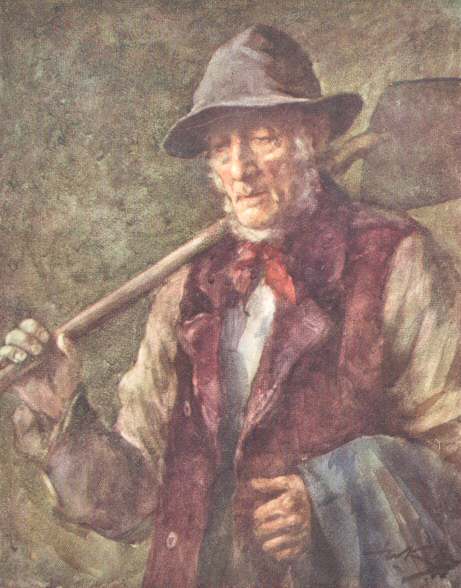
This was very pawkie, counselling, of Mr. Kibbock, and I didnot see through it at the time, but did as he recommended, andtook all the different estimates, when they came in, to thesession. The elders commended my prudence exceedingly forso doing, before going to work; and one of them asked me what theamount of the whole would be, but I had not cast it up. Some of the heritors thought that a hundred pounds would besufficient for the outlay; but judge of our consternation, when,in counting up all the sums of the different estimates together,we found them well on towards a thousand pounds. “Better big a new house at once, than do this!” criedall the elders, by which I then perceived the draughtiness of Mr.Kibbock’s advice. Accordingly, another meeting of theheritors was summoned, and after a great deal of controversy, itwas agreed that a new manse should be erected; and, shortlyafter, we contracted with Thomas Trowel, the mason to build onefor six hundred pounds, with all the requisite appurtenances, bywhich a clear gain was saved to the parish, by the foresight ofMr. Kibbock, to the amount of nearly four hundred pounds. But the heritors did not mean to have allowed the sort of repairthat his plan comprehended. He was, however, a farforecasting man; the like of him for natural parts not being inour country side; and nobody could get the whip-hand of him,either in a bargain or an improvement, when he once was sensibleof the advantage. He was, indeed, a blessing to the shire,both by his example as a farmer, and by his sound and discreetadvice in the contentions of his neighbours, being a man, as wasa saying among the commonality, “wiser than the law and thefifteen Lords of Edinburgh.”
The building of the new manse occasioned a heavy cess on theheritors, which made them overly ready to pick holes in the coatsof me and the elders; so that, out of my forbearance and delicacyin time past, grew a lordliness on their part, that was an illreturn for the years that I had endured no little inconveniencyfor their sake. It was not in my heart or principles toharm the hair of a dog; but when I discerned the austerity withwhich they were disposed to treat their minister, I bethought methat, for the preservation of what was due to the establishmentand the upholding of the decent administration of religion, Iought to set my face against the sordid intolerance by which theywere actuated. This notion I weighed well before divulgingit to any person; but when I had assured myself as to therectitude thereof, I rode over one day to Mr. Kibbock’s,and broke my mind to him about claiming out of the teinds anaugmentation of my stipend, not because I needed it, but in case,after me, some bare and hungry gorbie of the Lord should be sentupon the parish, in no such condition to plea with the heritorsas I was. Mr. Kibbock highly approved of my intent; and byhis help, after much tribulation, I got an augmentation both inglebe and income; and to mark my reason for what I did, I tookupon me to keep and clothe the wives and orphans of the parish,who lost their breadwinners in the American war. But forall that, the heritors spoke of me as an avaricious Jew, and madethe hard-won fruits of Mrs. Balwhidder’s great thrift andgood management a matter of reproach against me. Few ofthem would come to the church, but stayed away, to the detrimentof their own souls hereafter, in order, as they thought, topunish me; so that, in the course of this year, there was avisible decay of the sense of religion among the better orders ofthe parish, and, as will be seen in the sequel, their evilexample infected the minds of many of the rising generation.
It was in this year that Mr. Cayenne bought the mailing of theWheatrigs, but did not begin to build his house till thefollowing spring; for being ill to please with a plan, he fellout with the builders, and on one occasion got into such apassion with Mr. Trowel, the mason, that he struck him a blow onthe face, for which he was obligated to make atonement. Itwas thought the matter would have been carried before the Lords;but, by the mediation of Mr. Kibbock, with my helping hand, areconciliation was brought about, Mr. Cayenne indemnifying themason with a sum of money to say no more anent it; after which,he employed him to build his house, a thing that no man couldhave thought possible, who reflected on the enmity betweenthem.
p.172CHAPTER XXVIII
YEAR 1787There had been, as I havefrequently observed, a visible improvement going on in theparish. From the time of the making of the toll-road, everynew house that was built in the clachan was built along thatroad. Among other changes hereby caused, the LadyMacadam’s jointure-house that was, which stood in apleasant parterre, inclosed within a stone wall and an iron gate,having a pillar with a pineapple head on each side, came to be inthe middle of the town. While Mr. Cayenne inhabited thesame, it was maintained in good order; but on his flitting to hisown new house on the Wheatrigs, the parterre was soon overrunwith weeds, and it began to wear the look of a waste place. Robert Toddy, who then kept the change-house, and who had, fromthe lady’s death, rented the coach-house for stabling, inthis juncture thought of it for an inn; so he set his own houseto Thomas Treddles the weaver, whose son, William, is now thegreat Glasgow manufacturer, that has cotton-mills andsteam-engines, and took, “the Place,” as it wascalled, and had a fine sign, TheCross-Keys, painted and put up in golden characters, bywhich it became one of the most noted inns anywhere to be seen;and the civility of Mrs. Toddy was commended by allstrangers. But although this transmutation from achange-house to an inn was a vast amendment, in a manner, to theparish, there was little amendment of manners thereby; for thefarmer lads began to hold dancings and other riotous proceedingsthere, and to bring, as it were, the evil practices of towns intothe heart of the country. All sort of licence was allowedas to drink and hours; and the edifying example of Mr. Mutchkinsand his pious family, was no longer held up to the imitation ofthe wayfaring man.
Saving the mutation of “the Place” into an inn,nothing very remarkable happened in this year. We got intoour new manse about the middle of March; but it was rather damp,being new plastered, and it caused me to have a severe attack ofthe rheumatics in the fall of the year.
I should not, in my notations, forget to mark a new luxurythat got in among the commonality at this time. By theopening of new roads, and the traffic thereon with carts andcarriers, and by our young men that were sailors going to theClyde, and sailing to Jamaica and the West Indies, heaps of sugarand coffee-beans were brought home, while many, among thekail-stocks and cabbages in their yards, had planted groset andberry bushes; which two things happening together, the fashion tomake jam and jelly, which hitherto had been only known in thekitchens and confectionaries of the gentry, came to be introducedinto the clachan. All this, however, was not without aplausible pretext; for it was found that jelly was an excellentmedicine for a sore throat, and jam a remedy as good as Londoncandy for a cough, or a cold, or a shortness of breath. Icould not, however, say that this gave me so much concern as thesmuggling trade, only it occasioned a great fasherie to Mrs.Balwhidder; for, in the berry time, there was no end to theborrowing of her brass-pan to make jelly and jam, till Mrs. Toddyof the Cross-Keys bought one, which, in its turn, came intorequest, and saved ours.
It was in the Martinmas quarter of this year that I got thefirst payment of my augmentation. Having no desire to ripup old sores, I shall say no more anent it, the worst beinganticipated in my chronicle of the last year; but there was athing happened in the payment that occasioned a vexation at thetime, of a very disagreeable nature. Daft Meg Gaffaw, who,from the tragical death of her mother, was a privileged subject,used to come to the manse on the Saturdays for a meal of meat;and so it fell out that as, by some neglect of mine, no steps hadbeen taken to regulate the disposal of the victual thatconstituted the means of the augmentation, some of the heritors,in an ungracious temper, sent what they called the tithe-ball(the Lord knows it was not the fiftieth!) to the manse, where Ihad no place to put it. This fell out on a Saturday night,when I was busy with my sermon, thinking not of silver or gold,but of much better; so that I was greatly molested and disturbedthereby. Daft Meg, who sat by the kitchen chimley-lug,hearing a’, said nothing for a time; but when she saw howMrs. Balwhidder and me were put to, she cried out with a loudvoice, like a soul under the inspiration ofprophecy—“When the widow’s cruse had filled allthe vessels in the house, the Lord stopped the increase. Verily, verily, I say unto you, if your barns be filled, and yourgirnell-kists can hold no more, seek till ye shall find the tumebasins of the poor, and therein pour the corn, and the oil, andthe wine of your abundance; so shall ye be blessed of theLord.” The which words I took for an admonition, anddirecting the sacks to be brought into the dining-room and otherchambers of the manse, I sent off the heritors’ servants,that had done me this prejudice, with an unexpectedthankfulness. But this, as I afterwards was informed, boththem and their masters attributed to the greedy grasp of avarice,with which they considered me as misled; and having said so,nothing could exceed their mortification on Monday, when theyheard (for they were of those who had deserted the kirk) that Ihad given by the precentor notice to every widow in the parishthat was in need, to come to the manse and she would receive herportion of the partitioning of the augmentation. Thus,without any offence on my part, saving the strictness of justice,was a division made between me and the heritors; but the peoplewere with me; and my own conscience was with me; and though thefronts of the lofts and the pews of the heritors were but thinlyfilled, I trusted that a good time was coming, when the gentrywould see the error of their way. So I bent the head ofresignation to the Lord, and, assisted by the wisdom of Mr.Kibbock, adhered to the course I had adopted; but at the close ofthe year my heart was sorrowful for the schism; and my prayer onHogmanay was one of great bitterness of soul, that such an evilhad come to pass.
p.177CHAPTER XXIX
YEAR 1788It had been often remarked byingenious men, that the Brawl burn, which ran through the parish,though a small, was yet a rapid stream, and had a wonderfulcapability for damming, and to turn mills. From the timethat the Irville water deserted its channel this brook grew intorepute, and several mills and dams had been erected on itscourse. In this year a proposal came from Glasgow to builda cotton-mill on its banks, beneath the Witch-linn, which beingon a corner of the Wheatrig, the property of Mr. Cayenne, he notonly consented thereto, but took a part in the profit or losstherein; and, being a man of great activity, though we thoughthim, for many a day, a serpent-plague sent upon the parish, heproved thereby one of our greatest benefactors. Thecotton-mill was built, and a spacious fabric it was—nothinglike it had been seen before in our day and generation—and,for the people that were brought to work in it, a new town wasbuilt in the vicinity, which Mr. Cayenne, the same being foundedon his land, called Cayenneville, the name of the plantation inVirginia that had been taken from him by the rebelliousAmericans. From that day Fortune was lavish of her favoursupon him; his property swelled, and grew in the mostextraordinary manner, and the whole country side was stirringwith a new life. For, when the mill was set a-going, he gotweavers of muslin established in Cayenneville; and shortly after,but that did not take place till the year following, he broughtwomen all the way from the neighbourhood of Manchester, inEngland, to teach the lassie bairns in our old clachantambouring.
Some of the ancient families, in their turreted houses, werenot pleased with this innovation, especially when they saw thehandsome dwellings that were built for the weavers of the mills,and the unstinted hand that supplied the wealth required for thecarrying on of the business. It sank their pride intoinsignificance, and many of them would almost rather have wantedthe rise that took place in the value of their lands, than haveseen this incoming of what they called o’er-seaspeculation. But, saving the building of the cotton-mill,and the beginning of Cayenneville, nothing more memorablehappened in this year, still it was nevertheless a year of agreat activity. The minds of men were excited to newenterprises; a new genius, as it were, had descended upon theearth, and there was an erect and outlooking spirit abroad thatwas not to be satisfied with the taciturn regularity of ancientaffairs. Even Miss Sabrina Hooky, the schoolmistress,though now waned from her meridian, was touched with theenlivening rod, and set herself to learn and to teach tambouring,in such a manner as to supersede by precept and example that oldtime-honoured functionary, as she herself called it, thespinning-wheel, proving, as she did one night to Mr. Kibbock andme, that, if more money could be made by a woman tambouring thanby spinning, it was better for her to tambour than to spin.
But, in the midst of all this commercing and manufacturing, Ibegan to discover signs of decay in the wonted simplicity of ourcountry ways. Among the cotton-spinners and muslin weaversof Cayenneville were several unsatisfied and ambitious spirits,who clubbed together, and got a London newspaper to theCross-Keys, where they were nightly in the habit of meeting anddebating about the affairs of the French, which were thengathering towards a head. They were represented to me aslads by common in capacity, but with unsettled notions ofreligion. They were, however, quiet and orderly; and someof them since, at Glasgow, Paisley, and Manchester, even, I amtold, in London, have grown into a topping way.
It seems they did not like my manner of preaching, and on thataccount absented themselves from public worship; which, when Iheard, I sent for some of them, to convince them of their errorwith regard to the truth of divers points of doctrine; but theyconfounded me with their objections, and used my arguments, whichwere the old and orthodox proven opinions of the Divinity Hall,as if they had been the light sayings of a vain man. Sothat I was troubled, fearing that some change would ensue to mypeople, who had hitherto lived amidst the boughs and branches ofthe gospel unmolested by the fowler’s snare, and I setmyself to watch narrowly, and with a vigilant eye, what wouldcome to pass.
There was a visible increase among us of worldly prosperity inthe course of this year; insomuch that some of the farmers, whowere in the custom of taking their vendibles to the neighbouringtowns on the Tuesdays, the Wednesdays, and Fridays, were led toopen a market on the Saturdays in our own clachan, the whichproved a great convenience. But I cannot take it upon me tosay, whether this can be said to have well begun in the presentAnn. Dom., although I know that in the summer of the ensuing yearit was grown into a settled custom; which I well recollect by theMacadams coming with their bairns to see Mrs. Malcolm, theirmother, suddenly on a Saturday afternoon; on which occasion meand Mrs. Balwhidder were invited to dine with them, and Mrs.Malcolm bought in the market for the dinner that day, both muttonand fowls, such as twenty years before could not have been gotfor love or money on such a pinch. Besides, she had twobottles of red and white wine from the Cross-Keys, luxurieswhich, saving in the Breadland House in its best days, could nothave been had in the whole parish, but must have been broughtfrom a borough town; for Eaglesham Castle is not within thebounds of Dalmailing, and my observe does not apply to the stockand stores of that honourable mansion, but only to the dwellingsof our own heritors, who were in general straitened in theircircumstances, partly with upsetting, and partly by the eatingrust of family pride, which hurt the edge of many a clever fellowamong them, that would have done well in the way of trade, butsunk into divors for the sake of their genteelity.
p.182CHAPTER XXX
YEAR 1789This I have always reflected uponas one of our blessed years. It was not remarkable for anyextraordinary occurrence; but there was a hopefulness in theminds of men, and a planning of new undertakings, of which,whatever may be the upshot, the devising is ever rich in thecheerful anticipations of good.
Another new line of road was planned, for a shorter cut to thecotton-mill, from the main road to Glasgow, and a public-housewas opened in Cayenneville: the latter, however, was not an eventthat gave me much satisfaction; but it was a convenience to theinhabitants, and the carriers that brought the cotton-bags andtook away the yarn twice a-week, needed a place ofrefreshment. And there was a stage-coach set up thriceevery week from Ayr, that passed through the town, by which itwas possible to travel to Glasgow between breakfast and dinnertime, a thing that could not, when I came to the parish, havebeen thought within the compass of man.
This stage-coach I thought one of the greatest conveniencesthat had been established among us; and it enabled Mrs.Balwhidder to send a basket of her fresh butter into the Glasgowmarket, by which, in the spring and the fall of the year, she gota great price; for the Glasgow merchants are fond of excellenteatables, and the payment was aye ready money—Tam Whirlitthe driver paying for the one basket when he took up theother.
In this year William Malcolm, the youngest son of the widow,having been some time a tutor in a family in the east country,came to see his mother, as indeed he had done every year from thetime he went to the college; but this occasion was maderemarkable by his preaching in my pulpit. His oldacquaintance were curious to hear him; and I myself had a sort ofa wish likewise, being desirous to know how far he was orthodox;so I thought fit, on the suggestion of one of the elders, to askhim to preach one day for me, which, after some fleeching, heconsented to do. I think, however, there was a true modestyin his diffidence, although his reason was a weak one, being lesthe might not satisfy his mother, who had as yet never heardhim. Accordingly, on the Sabbath after, he did preach, andthe kirk was well packed, and I was not one of the leastattentive of the congregation. His sermon assuredly waswell put together and there was nothing to object to in hisdoctrine; but the elderly people thought his language rather tooEnglified, which I thought likewise; for I never could abide thatthe plain auld Kirk of Scotland, with her sober presbyteriansimplicity, should borrow, either in word or in deed, from thelanguage of the prelatic hierarchy of England. Nevertheless, the younger part of the congregation were loud inhis praise, saying, there had not been heard before such a styleof language in our side of the country. As for Mrs.Malcolm, his mother, when I spoke to her anent the same, she saidbut little, expressing only her hope that his example would beworthy of his precepts; so that, upon the whole, it was asatisfaction to us all, that he was likely to prove a stoop andupholding pillar to the Kirk of Scotland. And his motherhad the satisfaction, before she died, to see him a placedminister, and his name among the authors of his country; for hepublished at Edinburgh a volume of Moral Essays, of which he sentme a pretty bound copy, and they were greatly creditable to hispen, though lacking somewhat of that birr and smeddum that is thejuice and flavour of books of that sort.
p.185CHAPTER XXXI
YEAR 1790The features of this Ann. Dom.partook of the character of its predecessor. Several newhouses were added to the clachan; Cayenneville was spreading outwith weavers’ shops, and growing up fast into a town. In some respects it got the start of ours; for one day, when Iwas going to dine with Mr. Cayenne at Wheatrig House, not alittle to my amazement, did I behold a bookseller’s shopopened there, with sticks of red and black wax, pouncet-boxes,pens, pocket-books, and new publications, in the window, such asthe like of was only to be seen in cities and boroughtowns. And it was lighted at night by a patent lamp, whichshed a wonderful beam, burning oil, and having no smoke. The man sold likewise perfumery, powder-puffs, trinkets, andDublin dolls, besides penknives, Castile soap, andwalking-sticks, together with a prodigy of other luxuries tootedious to mention.
Upon conversing with the man, for I was enchanted to go intothis phenomenon, for as no less could I regard it, he told methat he had a correspondence with London, and could get me downany book published there within the same month in which it cameout; and he showed me divers of the newest come out, of which Idid not read even in the Scots Magazinetill more thanthree months after, although I had till then always consideredthat work as most interesting for its early intelligence. But what I was most surprised to hear, was, that he took in adaily London newspaper for the spinners and weavers, who paid hima penny a-week a-piece for the same; they being all greatly takenup with what, at the time, was going on in France.
This bookseller in the end, however, proved a whawp in ournest, for he was in league with some of the English reformers;and when the story took wind three years after, concerning theplots and treasons of the corresponding societies and democrats,he was fain to make a moonlight flitting, leaving his wife for atime to manage his affairs. I could not, however, think anyill of the man notwithstanding; for he had very correct notionsof right and justice, in a political sense, and when he came intothe parish he was as orderly and well-behaved as any other body;and conduct is a test that I have always found as good for aman’s principles as professions. Nor, at the time ofwhich I am speaking, was there any of that dread or fear ofreforming the government that has since been occasioned by thewild and wasteful hand which the French employed in theirrevolution.
But, among other improvements, I should mention that a DoctorMarigold came and settled in Cayenneville, a small, round,happy-tempered man, whose funny stories were far better likedthan his drugs. There was a doubt among some of the weaversif he was a skilful Esculapian; and this doubt led to theirholding out an inducement to another medical man, Dr. Tanzey, tosettle there likewise, by which it grew into a saying, that atCayenneville there was a doctor for health as well as sickness;for Dr. Marigold was one of the best hands in the country at apleasant punch-bowl, while Dr. Tanzey had all the requisiteknowledge for the faculty for the bedside.
It was in this year that the hour-plate and hand on the kirksteeple were renewed, as indeed, may yet be seen by the date,though it be again greatly in want of fresh gilding; for it wasby my advice that the figures of the Ann. Dom. were placed one ineach corner. In this year, likewise, the bridge over theBrawl burn was built—a great convenience, in the wintertime, to the parishioners that lived on the north side; for whenthere happened to be a spait on the Sunday, it kept them from thekirk; but I did not find that the bridge mended the matter, tillafter the conclusion of the war against the democrats, and thebeginning of that which we are now waging with Boney, their childand champion. It is, indeed, wonderful to think of theoccultation of grace that was taking place about this time,throughout the whole bound of Christendom; for I could mark avisible darkness of infidelity spreading in the corner of thevineyard committed to my keeping, and a falling away of the vinesfrom their wonted props and confidence in the truths ofRevelation. But I said nothing. I knew that the faithcould not be lost, and that it would be found purer and purer themore it was tried; and this I have lived to see, many now beingzealous members of the church, that were abundantly lukewarm atthe period of which I am now speaking.
p.189CHAPTER XXXII
YEAR 1791In the spring of this year, I tookmy son Gilbert into Glasgow, to place him in acounting-house. As he had no inclination for any of thelearned professions, and not having been there from the time whenI was sent to the General Assembly, I cannot express myastonishment at the great improvements, surpassing far all thatwas done in our part of the country, which I thought was not tobe paralleled. When I came afterwards to reflect on mysimplicity in this, it was clear to me that we should not judgeof the rest of the world by what we see going on aroundourselves, but walk abroad into other parts, and thereby enlargeour sphere of observation, as well as ripen our judgment ofthings.
But although there was no doubt a great and visible increaseof the city, loftier buildings on all sides, and streets thatspread their arms far into the embraces of the country, I thoughtthe looks of the population were impaired, and that there was agreater proportion of long white faces in the Trongate, than whenI attended the Divinity class. These, I was told, were theweavers and others concerned in the cotton trade, which I couldwell believe, for they were very like in their looks to the menof Cayenneville; but from living in a crowded town, and notbreathing a wholesome country air between their tasks, they had astronger cast of unhealthy melancholy. I was therefore veryglad that Providence had placed in my hand the pastoral staff ofa country parish; for it cut me to the heart to see so many youngmen, in the rising prime of life, already in the arms of a paleconsumption. “If, therefore,” said I to Mrs.Balwhidder, when I returned home to the manse, “we live, asit were, within the narrow circle of ignorance, we are sparedfrom the pain of knowing many an evil; and, surely, in muchknowledge there is sadness of heart.”
But the main effect of this was to make me do all in my powerto keep my people contented with their lowly estate; for in thatsame spirit of improvement, which was so busy every where, Icould discern something like a shadow, that showed it was notaltogether of that pure advantage which avarice led all soeagerly to believe. Accordingly, I began a series ofsermons on the evil and vanity of riches, and, for the most partof the year, pointed out in what manner they led the possessor toindulge in sinful luxuries, and how indulgence begat desire, anddesire betrayed integrity and corrupted the heart; making itevident that the rich man was liable to forget his unmeritedobligations to God, and to oppress the laborious and the needfulwhen he required their services.
Little did I imagine, in thus striving to keep aloof theravenous wolf Ambition from my guileless flock, that I was givingcause for many to think me an enemy to the king and government,and a perverter of Christianity, to suit levellingdoctrines. But so it was. Many of the heritorsconsidered me a blackneb, though I knew it not, but went on inthe course of my duty, thinking only how best to preserve peaceon earth and goodwill towards men. I saw, however, analtered manner in the deportment of several, with whom I had longlived in friendly terms. It was not marked enough to makeme inquire the cause, but sufficiently plain to affect my ease ofmind. Accordingly, about the end of this year, I fell intoa dull way: my spirit was subdued, and at times I was aweary ofthe day, and longed for the night, when I might close my eyes inpeaceful slumbers. I missed my son Gilbert, who had been acompanion to me in the long nights, while his mother was busywith the lasses, and their ceaseless wheels and cardings, in thekitchen. Often could I have found it in my heart to havebanned that never-ceasing industry, and to tell Mrs. Balwhidder,that the married state was made for something else than to makenapery and beetle blankets; but it was her happiness to keep allat work, and she had no pleasure in any other way of life, so Isat many a night by the fireside with resignation; sometimes inthe study, and sometimes in the parlour, and, as I was doingnothing, Mrs. Balwhidder said it was needless to light thecandle. Our daughter Janet was in this time at aboarding-school in Ayr, so that I was really a most solitarymarried man.
p.192CHAPTER XXXIII
YEAR 1792When the spring in this year beganto brighten on the brae, the cloud of dulness that had darkenedand oppressed me all the winter somewhat melted away, and I couldnow and then joke again at the never-ending toil and trouble ofthat busiest of all bees, the second Mrs. Balwhidder. Butstill I was far from being right: a small matter affected me, andI was overly given to walking by myself, and musing on thingsthat I could tell nothing about—my thoughts were just therack of a dream without form, and driving witlessly as the smokethat mounteth up, and is lost in the airy heights of the sky.
Heeding little of what was going on in the clachan, and takingno interest in the concerns of any body, I would have beencontented to die, but I had no ail about me. An accident,however, fell out, that, by calling on me for an effort, had theblessed influence of clearing my vapours almost entirelyaway.
One morning as I was walking on the sunny side of the road,where the footpath was in the next year made to the cotton-mill,I fell in with Mr. Cayenne, who was seemingly much fashed—asmall matter could do that at any time; and he came up to me witha red face and an angry eye. It was not my intent to speakto him; for I was grown loth to enter into conversation with anybody, so I bowed and passed on. “What,” criedMr. Cayenne, “and will you not speak to me?” Iturned round, and said meekly, “Mr. Cayenne, I have noobjections to speak to you; but having nothing particular to say,it did not seem necessary just now.”
He looked at me like a gled, and in a minute exclaimed,“Mad, by Jupiter! as mad as a March hare!” Hethen entered into conversation with me, and said, that he hadnoticed me an altered man, and was just so far on his way to themanse, to enquire what had befallen me. So, from less tomore, we entered into the marrow of my case; and I told him how Ihad observed the estranged countenances of some of the heritors;at which he swore an oath, that they were a parcel of thedamn’dest boobies in the country, and told me how they hadtaken it into their heads that I was a leveller. “ButI know you better,” said Mr. Cayenne, “and have stoodup for you as an honest conscientious man, though I don’tmuch like your humdrum preaching. However, let that pass; Iinsist upon your dining with me to-day, when some of these arrantfools are to be with us, and the devil’s in’t if Idon’t make you friends with them.” I did notthink Mr. Cayenne, however, very well qualified for peacemaker,but, nevertheless, I consented to go; and having thus got aninkling of the cause of that cold back-turning which haddistressed me so much, I made such an effort to remove the errorthat was entertained against me, that some of the heritors,before we separated, shook me by the hands with the cordiality ofrenewed friendship; and, as if to make amends for past neglect,there was no end to their invitations to dinner which had theeffect of putting me again on my mettle, and removing the thickand muddy melancholious humour out of my blood.
But what confirmed my cure was the coming home of my daughterJanet from the Ayr boarding-school, where she had learnt to playon the spinnet, and was become a conversible lassie, with acompetent knowledge, for a woman of geography and history; sothat when her mother was busy with the weariful booming wheel,she entertained me sometimes with a tune, and sometimes with hertongue, which made the winter nights fly cantily by.
Whether it was owing to the malady of my imaginationthroughout the greatest part of this year, or that really nothingparticular did happen to interest me, I cannot say; but it isvery remarkable that I have nothing remarkable torecord—further, than I was at the expense myself of gettingthe manse rough-case, and the window cheeks painted, with roansput up, rather than apply to the heritors; for they were alwayssorely fashed when called upon for outlay.
p.196CHAPTER XXXIV
YEAR 1793On the first night of this year Idreamt a very remarkable dream, which, when I now recall to mindat this distance of time, I cannot but think that there was acase of prophecy in it. I thought that I stood on the towerof an old popish kirk, looking out at the window upon thekirkyard, where I beheld ancient tombs, with effigies andcoats-of-arms on the wall thereof, and a great gate at the oneside, and a door that led into a dark and dismal vault at theother. I thought all the dead that were lying in the commongraves, rose out of their coffins; at the same time, from the oldand grand monuments, with the effigies and coats-of-arms, camethe great men, and the kings of the earth with crowns on theirheads, and globes and sceptres in their hands.
I stood wondering what was to ensue, when presently I heardthe noise of drums and trumpets, and anon I beheld an army withbanners entering in at the gate; upon which the kings and thegreat men came also forth in their power and array, and adreadful battle was foughten; but the multitude that had risenfrom the common graves, stood afar off, and were butlookers-on.
The kings and their host were utterly discomfited. Theywere driven within the doors of their monuments, theircoats-of-arms were broken off, and their effigies cast down, andthe victors triumphed over them with the flourishes of trumpetsand the waving of banners. But while I looked, the visionwas changed, and I then beheld a wide and a dreary waste, andafar off the steeples of a great city, and a tower in the midst,like the tower of Babel, and on it I could discern, written incharacters of fire, “Public Opinion.” While Iwas pondering at the same, I heard a great shout, and presentlythe conquerors made their appearance, coming over the desolatemoor. They were going in great pride and might towards thecity; but an awful burning rose, afar as it were in the darkness,and the flames stood like a tower of fire that reached unto theheavens. And I saw a dreadful hand and an arm stretchedfrom out of the cloud, and in its hold was a besom made of thehail and the storm, and it swept the fugitives like dust; and intheir place I saw the churchyard, as it were, cleared and spreadaround, the graves closed, and the ancient tombs, with theircoats-of-arms and their effigies of stone, all as they were inthe beginning. I then awoke, and behold it was a dream.
This vision perplexed me for many days, and when the news camethat the King of France was beheaded by the hands of his people,I received, as it were, a token in confirmation of the visionthat had been disclosed to me in my sleep, and I preached adiscourse on the same, and against the French Revolution, thatwas thought one of the greatest and soundest sermons that I hadever delivered in my pulpit.
On the Monday following, Mr. Cayenne, who had been some timebefore appointed a justice of the peace, came over from WheatrigHouse to the Cross-Keys, where he sent for me and divers otherrespectable inhabitants of the clachan, and told us that he wasto have a sad business, for a warrant was out to bring before himtwo democratical weaver lads, on a suspicion of hightreason. Scarcely were the words uttered when they werebrought in, and he began to ask them how they dared to think ofdividing, with their liberty and equality of principles, his andevery other man’s property in the country. The menanswered him in a calm manner, and told him they sought noman’s property, but only their own natural rights; uponwhich he called them traitors and reformers. They deniedthey were traitors, but confessed they were reformers, and saidthey knew not how that should be imputed to them as a fault, forthat the greatest men of all times had beenreformers,—“Was not,” they said, “ourLord Jesus Christ a reformer?”—“And what thedevil did he make of it?” cried Mr. Cayenne, bursting withpassion; “Was he not crucified?”
I thought, when I heard these words, that the pillars of theearth sank beneath me, and that the roof of the house was carriedaway in a whirlwind. The drums of my ears crackit, bluestarns danced before my sight, and I was fain to leave the houseand hie me home to the manse, where I sat down in my study, likea stupified creature, awaiting what would betide. Nothing,however, was found against the weaver lads; but I never from thatday could look on Mr. Cayenne as a Christian, though surely hewas a true government-man.
Soon after this affair, there was a pleasant re-edification ofa gospel-spirit among the heritors, especially when they heardhow I had handled the regicides in France; and on the followingSunday, I had the comfortable satisfaction to see many agentleman in their pews, that had not been for years within akirk-door. The democrats, who took a world of trouble tomisrepresent the actions of the gentry, insinuated that all thiswas not from any new sense of grace, but in fear of their beingreported as suspected persons to the king’sgovernment. But I could not think so, and considered theirrenewal of communion with the church as a swearing of allegianceto the King of kings, against that host of French atheists, whohad torn the mortcloth from the coffin, and made it a banner,with which they were gone forth to war against the Lamb. The whole year was, however, spent in great uneasiness, and theproclamation of the war was followed by an appalling stop intrade. We heard of nothing but failures on all hands; andamong others that grieved me, was that of Mr. Maitland ofGlasgow, who had befriended Mrs. Malcolm in the days of heraffliction, and gave her son Robert his fine ship. It was asore thing to hear of so many breakings, especially of oldrespected merchants like him, who had been a Lord Provost, andwas far declined into the afternoon of life. He did not,however, long survive the mutation of his fortune; but bendinghis aged head in sorrow, sank down beneath the stroke, to rise nomore.
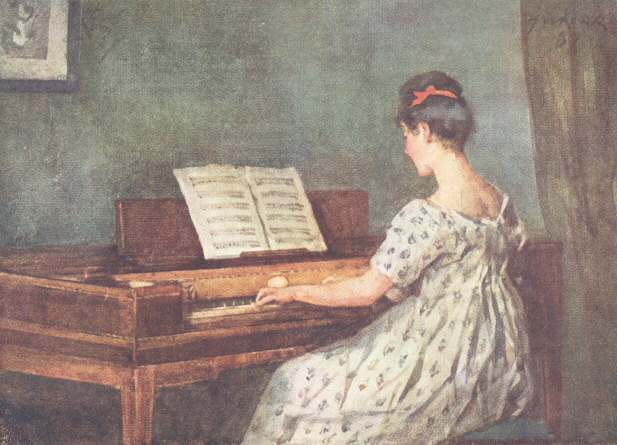
p.201CHAPTER XXXV
YEAR 1794This year had opened into all theleafiness of midsummer before anything memorable happened in theparish, further than that the sad division of my people intogovernment-men and jacobins was perfected. This calamity,for I never could consider such heartburning among neighbours asany thing less than a very heavy calamity, was assuredlyoccasioned by faults on both sides; but it must be confessed thatthe gentry did nothing to win the commonality from the errors oftheir way. A little more condescension on their part wouldnot have made things worse, and might have made them better; butpride interposed, and caused them to think that any show ofaffability from them would be construed by the democrats into aterror of their power; while the democrats were no less to blame;for hearing how their compeers were thriving in France, anddemolishing every obstacle to their ascendency, they were crouseand really insolent, evidencing none of that temperance inprosperity that proves the possessors worthy of their goodfortune.
As for me, my duty in these circumstances was plain andsimple. The Christian religion was attempted to be broughtinto disrepute; the rising generation were taught to gibe at itsholiest ordinances; and the kirk was more frequented as a placeto while away the time on a rainy Sunday, than for any insight ofthe admonitions and revelations in the sacred book. Knowingthis, I perceived that it would be of no effect to handle muchthe mysteries of the faith; but as there was at the time a bruitand a sound about universal benevolence, philanthropy, utility,and all the other disguises with which an infidel philosophyappropriated to itself the charity, brotherly love, and welldoinginculcated by our holy religion, I set myself to task upon theseheads, and thought it no robbery to use a little of the stratagememployed against Christ’s kingdom, to promote the intereststhereof in the hearts and understandings of those whose earswould have been sealed against me, had I attempted to expoundhigher things. Accordingly, on one day it was my practiceto show what the nature of Christian charity was, comparing it tothe light and warmth of the sun, that shines impartially on thejust and the unjust—showing that man, without the sense ofit as a duty, was as the beasts that perish, and that everyfeeling of his nature was intimately selfish, but then whenactuated by this divine impulse, he rose out of himself, andbecame as a god, zealous to abate the sufferings of all thingsthat live; and, on the next day, I demonstrated that the newbenevolence which had come so much into vogue, was but anotherversion of this Christian virtue. In like manner, I dealtwith brotherly love, bringing it home to the business and bosomsof my hearers, that the Christianity of it was neither enlargednor bettered by being baptized with the Greek name ofphilanthropy. With welldoing, however, I went more roundlyto work, I told my people that I thought they had more sense thanto secede from Christianity to become Utilitarians; for that itwould be a confession of ignorance of the faith they deserved,seeing that it was the main duty inculcated by our religion to doall in morals and manners to which the newfangled doctrine ofutility pretended.
These discourses, which I continued for sometime, had no greateffect on the men; but being prepared in a familiar householdmanner, they took the fancies of the young women, which was to mean assurance that the seed I had planted would in time shootforth; for I reasoned with myself, that if the gudeman of theimmediate generation should continue free-thinkers, their wiveswill take care that those of the next shall not lack that spunkof grace; so I was cheered under that obscurity which fell uponChristianity at this time, with a vista beyond, in which I saw,as it were, the children unborn, walking on the bright green, andin the unclouded splendour of the faith.
But what with the decay of trade, and the temptation of theking’s bounty, and, over all, the witlessness that was inthe spirit of man at this time, the number that enlisted in thecourse for the year from the parish was prodigious. In oneweek no less than three weavers and two cotton-spinners went overto Ayr, and took the bounty of the Royal Artillery. But Icould not help remarking to myself, that the people were grown soused to changes and extraordinary adventures, that the singleenlistment of Thomas Wilson, at the beginning of the Americanwar, occasioned a far greater grief and work among us, than allthe swarms that went off week after week in the months ofNovember and December of this year.
p.205CHAPTER XXXVI
YEAR 1795The present Ann. Dom. was usheredin with an event that I had never dreaded to see in my day, inour once sober and religious country parish. The number oflads that had gone over to Ayr to be soldiers from among thespinners and weavers of Cayenneville had been so great, that thegovernment got note of it, and sent a recruiting party to bequartered in the town; for the term clachan was beginning by thistime to wear out of fashion: indeed, the place itself wasoutgrowing the fitness of that title. Never shall I forgetthe dunt that the first tap of the drum gied to my heart, as Iwas sitting on Hansel Monday by myself at the parlour fireside,Mrs. Balwhidder being throng with the lassies looking out awashing, and my daughter at Ayr, spending a few days with her oldcomrades of the boarding school. I thought it was theenemy; and then anon the sound of the fife came shrill to theear, for the night was lown and peaceful. My wife and allthe lassies came flying in upon me, crying all in the name ofheaven, what could it be? by which I was obligated to put on mybig-coat, and, with my hat and staff, go out to enquire. The whole town was aloof, the aged at the doors in clusters, andthe bairns following the tattoo, as it was called, and at everydoubling beat of the drum, shouting as if they had been in theface of their foemen.
Mr. Archibald Dozendale, one of my elders, was saying toseveral persons around him, just as I came up, “Hech, sirs!but the battle draws near our gates,” upon which there wasa heavy sigh from all that heard him; and then they told me ofthe sergeant’s business; and we had a serious communingtogether anent the same. But while we were thus standingdiscoursing on the causey, Mrs. Balwhidder and the servantlassies could thole no longer, but in a troop came in quest ofme, to hear what was doing. In short, it was a night bothof sorrow and anxiety. Mr. Dozendale walked back to themanse with us, and we had a sober tumbler of toddy together;marvelling exceedingly where these fearful portents and changeswould stop, both of us being of opinion that the end of the worldwas drawing nearer and nearer.
Whether it was, however, that the lads belonging to the placedid not like to show themselves with the enlistment cockadesamong their acquaintance, or that there was any other reason, Icannot take it upon me to say; but certain it is, the recruitingparty came no speed, and, in consequence, were removed about theend of March.
Another thing happened in this year, too remarkable for me toneglect to put on record, as it strangely and strikingly markedthe rapid revolutions that were going on. In the month ofAugust at the time of the fair, a gang of playactors came, andhired Thomas Thacklan’s barn for their enactments. They were the first of that clanjamfrey who had ever been in theparish; and there was a wonderful excitement caused by therumours concerning them. Their first performance wasDouglas Tragedyand the Gentle Shepherd: and thegeneral opinion was, that the lad who played Norval in the play,and Patie in the farce, was an English lord’s son, who hadrun away from his parents rather than marry an old cracket ladywith a great portion. But, whatever truth there might be inthis notion, certain it is, the whole pack was in a state ofperfect beggary; and yet, for all that, they not only in theirparts, as I was told, laughed most heartily, but made others dothe same; for I was constrained to let my daughter go to seethem, with some of her acquaintance; and she gave me such anaccount of what they did, that I thought I would have liked tohave gotten a keek at them myself. At the same time, I mustown this was a sinful curiosity, and I stifled it to the best ofmy ability. Among other plays that they did, was one calledMacbeth and the Witches, which the Miss Cayennes had seenperformed in London, when they were there in the winter time withtheir father, for three months, seeing the world, after comingfrom the boarding-school. But it was no more like the trueplay of Shakespeare the poet, according to their account, than aduddy betheral, set up to fright the sparrows from the peas, islike a living gentleman. The hungry players, instead ofbehaving like guests at the royal banquet, were voracious on theneedful feast of bread, and the strong ale, that served for winein decanters. But the greatest sport of all was about akail-pot, that acted the part of a caldron, and which should havesunk with thunder and lightning into the earth; however, it didquite as well, for it made its exit, as Miss Virginia said, bywalking quietly off, being pulled by a string fastened to one ofits feet. No scene of the play was so much applauded asthis one; and the actor who did the part of King Macbeth made amost polite bow of thankfulness to the audience, for theapprobation with which they had received the performance of thepot.
We had likewise, shortly after the “Omnes exeunt”of the players, an exhibition of a different sort in the samebarn. This was by two English quakers, and a quaker lady,tanners of Kendal, who had been at Ayr on some leather business,where they preached, but made no proselytes. The travellerswere all three in a whisky, drawn by one of the best-orderedhorses, as the hostler at the Cross-Keys told me, everseen. They came to the Inn to their dinner, and meaning tostay all night, sent round, to let it be known that they wouldhold a meeting in Friend Thacklan’s barn; but Thomas deniedthey were either kith or kin to him: this, however, was their wayof speaking.
In the evening, owing to the notice, a great congregation wasassembled in the barn, and I myself, along with Mr. ArchibaldDozendale, went there likewise, to keep the people in awe; for wefeared the strangers might be jeered and insulted. Thethree were seated aloft on a high stage, prepared on purpose,with two mares and scaffold-deals, borrowed from Mr. Trowel themason. They sat long, and silent; but at last the spiritmoved the woman, and she rose, and delivered a very sensibleexposition of Christianity. I was really surprised to hearsuch sound doctrine; and Mr. Dozendale said, justly, that it wasmore to the purpose than some that my younger brethren fromEdinburgh endeavoured to teach. So, that those who went tolaugh at the sincere simplicity of the pious quakers, wererebuked by a very edifying discourse on the moral duties of aChristian’s life.
Upon the whole, however, this, to the best of my recollection,was another unsatisfactory year. In this we were,doubtless, brought more into the world; but we had a greatervariety of temptation set before us, and there was still jealousyand estrangement in the dispositions of the gentry, and the lowerorders, particularly the manufacturers. I cannot say,indeed, that there was any increase of corruption among the ruralportion of my people; for their vocation calling them to workapart, in the purity of the free air of heaven, they were keptuncontaminated by that seditious infection which fevered theminds of the sedentary weavers, and working like flatulence inthe stomachs of the cotton-spinners, sent up into their heads avain and diseased fume of infidel philosophy.
p.211CHAPTER XXXVII
YEAR 1796The prosperity of fortune is likethe blossoms of spring, or the golden hue of the eveningcloud. It delighteth the spirit, and passeth away.
In the month of February my second wife was gathered to theLord. She had been very ill for some time with an income inher side, which no medicine could remove. I had the bestdoctors in the country side to her; but their skill was of noavail, their opinions being that her ail was caused by aninternal abscess, for which physic has provided no cure. Her death was to me a great sorrow; for she was a most excellentwife, industrious to a degree, and managed every thing with sobrisk a hand, that nothing went wrong that she put it to. With her I had grown richer than any other minister in thepresbytery; but, above all, she was the mother of my bairns,which gave her a double claim upon me.
I laid her by the side of my first love, Betty Lanshaw, my owncousin that was, and I inscribed her name upon the sameheadstone; but time had drained my poetical vein, and I have notyet been able to indite an epitaph on her merits and virtues, forshe had an eminent share of both. Her greatestfault—the best have their faults—was anover-earnestness to gather gear; in the doing of which I thoughtshe sometimes sacrificed the comforts of a pleasant fireside; forshe was never in her element but when she was keeping theservants eident at their work. But, if by this shesubtracted something from the quietude that was most consonant tomy nature, she has left cause, both in bank and bond, for me andher bairns to bless her great household activity.
She was not long deposited in her place of rest till I hadoccasion to find her loss. All my things were kept by herin a most perjink and excellent order; but they soon fell into anamazing confusion; for, as she often said to me, I had a turn forheedlessness; insomuch, that although my daughter Janet was grownup, and able to keep the house, I saw that it would be necessary,as soon as decency would allow, for me to take anotherwife. I was moved to this chiefly by foreseeing that mydaughter would in time be married, and taken away from me, butmore on account of the servant lasses, who grew out of allbounds, verifying the proverb, “Well kens the mouse whenthe cat’s out of the house.” Besides this, Iwas now far down in the vale of years, and could not expect to belong without feeling some of the penalties of old age, although Iwas still a hail and sound man. It therefore behoved me tolook in time for a helpmate, to tend me in my approachinginfirmities.
Upon this important concern I reflected, as I may say, in thewatches of the night; and, considering the circumstances of mysituation, I saw it would not do for me to look out for an overlyyoung woman, nor yet would it do for one of my ways to take anelderly maiden, ladies of that sort being liable to possessstrong-set particularities. I therefore resolved that mychoice should lie among widows of a discreet age; and I had aglimmer in my mind of speaking to Mrs. Malcolm; but when Ireflected on the saintly steadiness of her character, I wassatisfied it would be of no use to think of her. Accordingly, I bent my brows, and looked towards Irville, whichis an abundant trone for widows and other single women; and Ifixed my purpose on Mrs. Nugent, the relic of a professor in theuniversity of Glasgow, both because she was a well-bred woman,without any children to plea about the interest of my own two,and likewise because she was held in great estimation by all whoknew her, as a lady of a Christian principle.
It was some time in the summer, however, before I made up mymind to speak to her on the subject; but one afternoon, in themonth of August, I resolved to do so, and with that intent walkedleisurely over to Irville; and after calling on the Rev. Dr.Dinwiddie, the minister, I stepped in, as if by chance, to Mrs.Nugent’s. I could see that she was a little surprisedat my visit; however, she treated me with every possiblecivility, and her servant lass bringing in the tea-things in amost orderly manner, as punctually as the clock was striking, sheinvited me to sit still, and drink my tea with her; which I did,being none displeased to get such encouragement. However, Isaid nothing that time, but returned to the manse, very wellcontent with what I had observed, which made me fain to repeat myvisit. So, in the course of the week, taking Janet mydaughter with me, we walked over in the forenoon, and called atMrs. Nugent’s first, before going to any other house; andJanet saying, as we came out to go to the minister’s, thatshe thought Mrs. Nugent an agreeable woman, I determined to knockthe nail on the head without further delay.
Accordingly, I invited the minister and his wife to dine withus on the Thursday following; and before leaving the town, I madeJanet, while the minister and me were handling a subject, as asort of thing in common civility, go to Mrs. Nugent, and inviteher also. Dr. Dinwiddie was a gleg man, of a jocose nature;and he, guessing something of what I was ettling at, was verymirthful with me; but I kept my own counsel till a meetseason.
On the Thursday, the company as invited came, and nothingextraordinary was seen; but in cutting up and helping a hen, Dr.Dinwiddie put one wing on Mrs. Nugent’s plate, and theother wing on my plate, and said, there have been greatermiracles than these two wings flying together, which was a sharpjoke, that caused no little merriment at the expense of Mrs.Nugent and me. I, however, to show that I was none daunted,laid a leg also on her plate, and took another on my own, saying,in the words of the reverend doctor, there have been greatermiracles than that these two legs should lie in the same nest,which was thought a very clever come off; and, at the same time,I gave Mrs. Nugent a kindly nip on her sonsy arm, which wasbreaking the ice in as pleasant a way as could be. Inshort, before anything passed between ourselves on the subject,we were set down for a trysted pair; and this being the case, wewere married as soon as a twelvemonth and a day had passed fromthe death of the second Mrs. Balwhidder; and neither of us havehad occasion to rue the bargain. It is, however, but apiece of justice due to my second wife to say, that this was nota little owing to her good management; for she had left such awell-plenished house, that her successor said, we had nothing todo but to contribute to one another’s happiness.
In this year nothing more memorable happened in the parish,saving that the cotton-mill dam burst about the time of theLammas flood, and the waters went forth like a deluge ofdestruction, carrying off much victual, and causing a vast ofdamage to the mills that are lower down the stream. It wasjust a prodigy to see how calmly Mr. Cayenne acted on thatoccasion; for, being at other times as crabbed as a wud terrier,folk were afraid to tell him, till he came out himself in themorning and saw the devastation; at the sight of which he gaveonly a shrill whistle, and began to laugh at the idea of the menfearing to take him the news, as if he had not fortune andphilosophy enough, as he called it, to withstand much greatermisfortunes.
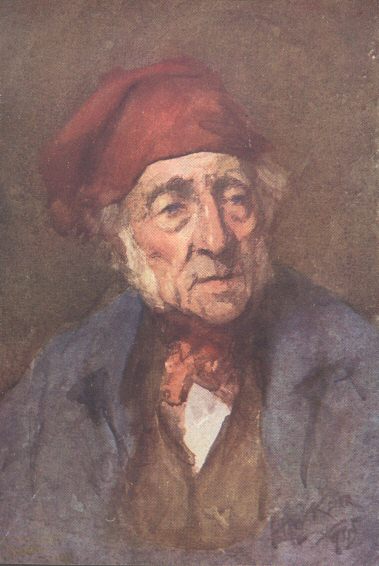
p.217CHAPTER XXXVIII
YEAR 1797When I have seen in my walks theirrational creatures of God, the birds and the beasts, governedby a kindly instinct in attendance on their young, often has itcome into my head that love and charity, far more than reason orjustice, formed the tie that holds the world, with all itsjarring wants and woes, in social dependence and obligationtogether; and, in this year, a strong verification of thesoundness of this notion was exemplified in the conduct of thepoor haverel lassie Meg Gaffaw, whose naturality on the occasionof her mother’s death I have related at length in thischronicle.
In the course of the summer, Mr. Henry Melcomb, who was anephew to Mr. Cayenne, came down from England to see hisuncle. He had just completed his education at the collegeof Christ Church, in Oxford, and was the most perfect younggentleman that had ever been seen in this part of thecountry.
In his appearance he was a very paragon, with a fine manlycountenance, frank-hearted, blithe, and, in many points ofcharacter, very like my old friend the Lord Eaglesham, who wasshot. Indeed, in some respects, he was even above hislordship; for he had a great turn at ready wit, and could jokeand banter in a most agreeable manner. He came very oftento the manse to see me, and took great pleasure in my company,and really used a freedom that was so droll, I could scarcelykeep my composity and decorum with him. Among others thatshared in his attention, was daft Meg Gaffaw, whom he hadforgathered with one day in coming to see me; and afterconversing with her for some time, he handed her, as she told meherself, over the kirk-stile like a lady of high degree, and camewith her to the manse door linking by the arm.
From the ill-timed daffin of that hour, poor Meg fell deep inlove with Mr. Melcomb; and it was just a playacting to see thearts and antics she put in practice to win his attention. In her garb, she had never any sense of a proper propriety, butwent about the country asking for shapings of silks and satins,with which she patched her duds, calling them by the divers namesof robes and negligées. All hitherto, however, hadbeen moderation, compared to the daffadile of vanity which shewas now seen, when she had searched, as she said, to the bottomof her coffer. I cannot take it upon me to describe her;but she kythed in such a variety of cuffs and ruffles, feathers,old gumflowers, painted paper knots, ribbons, and furs, andlaces, and went about gecking and simpering with an old fan inher hand, that it was not in the power of nature to look at herwith sobriety.
Her first appearance in this masquerading was at the kirk onthe Sunday following her adventure with Mr. Melcomb, and it waswith a sore difficulty that I could keep my eyes off her, even inprayer; and when the kirk skailed, she walked before him,spreading all her grandeur to catch his eye, in such a manner ashad not been seen or heard of since the prank that Lady Macadamplayed Miss Betty Wudrife.
Any other but Mr. Melcomb would have been provoked by thefool’s folly; but he humoured her wit, and, to theamazement of the whole people, presented her his hand, andallemanded her along in a manner that should not have been seenin any street out of a king’s court, and far less on theLord’s day. But, alas! this sport did not lastlong. Mr. Melcomb had come from England to be‘married’ to his cousin, Miss Virginia Cayenne, andpoor daft Meg never heard of it till the banns for their purposeof marriage was read out by Mr. Lorimore on the Sabbathafter. The words were scarcely out of his mouth, when thesimple and innocent natural gave a loud shriek, that terrifiedthe whole congregation, and ran out of the kirk demented. There was no more finery for poor Meg; but she went and satopposite to the windows of Mr. Cayenne’s house, where Mr.Melcomb was, with clasped hands and beseeching eyes, like amonumental statue in alabaster, and no entreaty could drive heraway. Mr. Melcomb sent her money, and the bride many a finething; but Meg flung them from her, and clasped her hands again,and still sat. Mr. Cayenne would have let loose thehouse-dog on her, but was not permitted.
In the evening it began to rain, and they thought that and thecoming darkness would drive her away; but when the servantslooked out before barring the doors, there she was in the sameposture. I was to perform the marriage ceremony at seveno’clock in the morning, for the young pair were to go thatnight to Edinburgh; and when I went, there was Meg sittinglooking at the windows with her hands clasped. When she sawme she gave a shrill cry, and took me by the hand, and wised meto go back, crying out in a heart-breaking voice, “O,Sir! No yet—no yet! He’ll maybe drawback, and think of a far truer bride.” I was wae forher and very angry with the servants for laughing at the fondfolly of the ill-less thing.
When the marriage was over, and the carriage at the door, thebridegroom handed in the bride. Poor Meg saw this, andjumping up from where she sat, was at his side like a spirit, ashe was stepping in, and, taking him by the hand, she looked inhis face so piteously, that every heart was sorrowful, for shecould say nothing. When he pulled away his hand, and thedoor was shut, she stood as if she had been charmed to the spot,and saw the chaise drive away. All that were about the doorthen spoke to her, but she heard us not. At last she gave adeep sigh, and the water coming into her eye, she said,“The worm—the worm is my bonny bridegroom, and Jennywith the many-feet my bridal maid. The mill-damwater’s the wine o’ the wedding, and the clay and theclod shall be my bedding. A lang night is meet for abridal, but none shall be langer than mine.” Insaying which words, she fled from among us, with heels like thewind. The servants pursued; but long before they could stopher, she was past redemption in the deepest plumb of thecotton-mill dam.
Few deaths had for many a day happened in the parish, to causeso much sorrow as that of this poor silly creature. She wasa sort of household familiar among us, and there was much likethe inner side of wisdom in the pattern of her sayings, many ofwhich are still preserved as proverbs.
p.222CHAPTER XXXIX
YEAR 1798This was one of the heaviest yearsin the whole course of my ministry. The spring was slow ofcoming, and cold and wet when it did come; the dibs were full,the roads foul, and the ground that should have been dry at theseed-time, was as claggy as clay, and clung to the harrow. The labour of man and beast was thereby augmented; and all naturebeing in a state of sluggish indisposition, it was evident toevery eye of experience that there would be a greatdisappointment to the hopes of the husbandman.
Foreseeing this, I gathered the opinion of all the mostsagacious of my parishioners, and consulted with them for aprovision against the evil day, and we spoke to Mr. Cayenne onthe subject, for he had a talent by common in matters ofmercantile management. It was amazing, considering his hottemper, with what patience he heard the grounds of ourapprehension, and how he questioned and sifted the experience ofthe old farmers, till he was thoroughly convinced that allsimilar seed-times were ever followed by a short crop. Hethen said, that he would prove himself a better friend to theparish than he was thought. Accordingly, as he afterwardstold me himself, he wrote off that very night to hiscorrespondents in America, to buy for his account all the wheatand flour they could get, and ship it to arrive early in thefall; and he bought up likewise in countries round the Balticgreat store of victual, and brought in two cargoes to Irville onpurpose for the parish, against the time of need, making for theoccasion a garnel of one of the warehouses of thecotton-mill.
The event came to pass as had been foretold: the harvest fellshort, and Mr. Cayenne’s cargoes from America and theBaltic came home in due season, by which he made a terrible powerof money, clearing thousands on thousands by post afterpost—making more profit, as he said himself, in the courseof one month, he believed, than ever was made by any individualwithin the kingdom of Scotland in the course of a year.—Hesaid, however that he might have made more if he had bought upthe corn at home; but being convinced by us that there would be ascarcity, he thought it his duty as an honest man to draw fromthe stores and granaries of foreign countries, by which he wassure he would serve his country, and be abundantlyrewarded. In short, we all reckoned him another Joseph whenhe opened his garnels at the cotton-mill, and, after distributinga liberal portion to the poor and needy, selling the remainder atan easy rate to the generality of the people. Some of theneighbouring parishes, however, were angry that he would notserve them likewise, and called him a wicked and extortionateforestaller; but he made it plain to the meanest capacity, thatif he did not circumscribe his dispensation to our own bounds itwould be as nothing. So that, although he brought awonderful prosperity in by the cotton-mill, and a plenteoussupply of corn in a time of famine, doing more in these thingsfor the people than all the other heritors had done from thebeginning of time, he was much reviled; even his bounty waslittle esteemed by my people, because he took a moderate profiton what he sold to them. Perhaps, however, these prejudicesmight be partly owing to their dislike of his hasty temper, atleast I am willing to think so; for it would grieve me if theywere really ungrateful for a benefit that made the pressure ofthe time lie but lightly on them.
The alarm of the Irish rebellion in this year was likewiseanother source of affliction to us; for many of the gentry comingover in great straits, especially ladies and their children, andsome of them in the hurry of their flight having but little readymoney, were very ill off. Some four or five families cameto the Cross-Keys in this situation, and the conduct of Mr.Cayenne to them was most exemplary. He remembered his ownhaste with his family from Virginia, when the Americans rebelled;and immediately on hearing of these Irish refugees, he waited onthem with his wife and daughter, supplied them with money,invited them to his house, made ploys to keep up their spirits,while the other gentry stood back till they knew something of thestrangers.
Among these destitute ladies was a Mrs. Desmond and her twodaughters, a woman of most august presence, being indeed morelike one ordained to reign over a kingdom, than for householdpurposes. The Miss Desmonds were only entering their teens,but they also had no ordinary stamp upon them. What madethis party the more particular, was on account of Mr. Desmond,who was supposed to be a united man with the rebels, and it wasknown his son was deep in their plots; yet although this was alltold to Mr. Cayenne, by some of the other Irish ladies who wereof the loyal connexion, it made no difference with him, but, onthe contrary, he acted as if he thought the Desmonds the most ofall the refugees entitled to his hospitable civilities. This was a wonderment to our strait-laced narrow lairds, as therewas not a man of such strict government principles in the wholecountry side as Mr. Cayenne: but he said he carried his politicalprinciples only to the camp and the council. “To thehospital and the prison,” said he, “I take those of aman”—which was almost a Christian doctrine, and fromthat declaration Mr. Cayenne and me began again to draw a littlemore cordially together; although he had still a very imperfectsense of religion, which I attributed to his being born inAmerica, where even as yet, I am told, they have but a scantysprinkling of grace.
But before concluding this year, I should tell the upshot ofthe visitation of the Irish, although it did not take place untilsome time after the peace with France.
In the putting down of the rebels Mr. Desmond and his son madetheir escape to Paris, where they stayed till the treaty wassigned, by which, for several years after the return to Irelandof the grand lady and her daughters, as Mrs. Desmond was calledby our commonalty, we heard nothing of them. The otherrefugees repaid Mr. Cayenne his money with thankfulness, and, ontheir restoration to their homes, could not sufficiently expresstheir sense of his kindness. But the silence and seemingingratitude of the Desmonds vexed him; and he could not abide tohear the Irish rebellion mentioned without flying into a passionagainst the rebels, which every body knew was owing to the illreturn he had received from that family. However, oneafternoon, just about half an hour before his wonted dinner hour,a grand equipage, with four horses and outriders, stopped at hisdoor, and who was in it but Mrs. Desmond and an elderly man, anda young gentleman with an aspect like a lord. It was herhusband and son. They had come from Ireland in all theirstate on purpose to repay with interest the money Mr. Cayenne hadcounted so long lost, and to express in person the perpetualobligation which he had conferred upon the Desmond family, in alltime coming. The lady then told him, that she had been sostraitened in helping the poor ladies, that it was not in herpower to make repayment till Desmond, as she called her husband,came home; and not choosing to assign the true reason, lest itmight cause trouble, she rather submitted to be suspected ofingratitude than to an improper thing.
Mr. Cayenne was transported with this unexpected return, and afriendship grew up between the families, which was afterwardscemented into relationship by the marriage of the young Desmondwith Miss Caroline Cayenne. Some in the parish objected tothis match, Mrs. Desmond being a papist: but as Miss Caroline hadreceived an episcopalian education, I thought it of noconsequence, and married them after their family chaplain fromIreland, as a young couple both by beauty and fortune wellmatched, and deserving of all conjugal felicity.
p.228CHAPTER XL
YEAR 1799There are but two things to make meremember this year; the first was the marriage of my daughterJanet with the reverend Dr. Kittlewood of Swappington, a match inevery way commendable; and on the advice of the third Mrs.Balwhidder, I settled a thousand pounds down, and promised fivehundred more at my death if I died before my spouse, and athousand at her death if she survived me; which was the greatestportion ever minister’s daughter had in our countryside. In this year likewise I advanced fifteen hundredpounds for my son in a concern in Glasgow,—all was thegathering of that indefatigable engine of industry the secondMrs. Balwhidder, whose talents her successor said were a wonder,when she considered the circumstances in which I had been left ather death, and made out of a narrow stipend.
The other memorable was the death of Mrs. Malcolm. Ifever there was a saint on this earth, she was surely one. She had been for some time bedfast, having all her days from thedate of her widowhood been a tender woman; but no change made anyalteration on the Christian contentment of her mind. Shebore adversity with an honest pride; she toiled in the day ofpenury and affliction with thankfulness for her earnings,although ever so little. She bent her head to the Lord inresignation when her first-born fell in battle; nor was shepuffed up with vanity when her daughters were married, as it wassaid, so far above their degree, though they showed it was butinto their proper sphere by their demeanour after. Shelived to see her second son, the captain, rise into affluence,married, and with a thriving young family; and she had the verygreat satisfaction, on the last day she was able to go to church,to see her youngest son the clergyman standing in my pulpit, adoctor of divinity, and the placed minister of a richer parishthan mine. Well indeed might she have said on that day,“Lord, let thy servant depart in peace, for mine eyes haveseen thy salvation.”
For some time it had been manifest to all who saw her, thather latter end was drawing nigh; and therefore, as I had kept upa correspondence with her daughters, Mrs. Macadam and Mrs.Howard, I wrote them a particular account of her case, whichbrought them to the clachan. They both came in their owncarriages; for Colonel Macadam was now a general, and hadsucceeded to a great property by an English uncle, hismother’s brother; and Captain Howard, by the death of hisfather, was also a man, as it was said, with a lord’sliving. Robert Malcolm, her son the captain, was in theWest Indies at the time; but his wife came on the first summons,as did William the minister.
They all arrived about four o’clock in the afternoon,and at seven a message came for me and Mrs. Balwhidder to go overto them, which we did, and found the strangers seated by theheavenly patient’s bedside. On my entering, sheturned her eyes towards me, and said, “Bear witness, sir,that I die thankful for an extraordinary portion of temporalmercies. The heart of my youth was withered like the leafthat is scared with the lightning; but in my children I havereceived a great indemnification for the sorrows of thattrial.” She then requested me to pray, saying,“No; let it be a thanksgiving. My term is out, and Ihave nothing more to hope or fear from the good or evil of thisworld. But I have had much to make me grateful; therefore,sir, return thanks for the time I have been spared, for thegoodness granted so long unto me, and the gentle hand with whichthe way from this world is smoothed for my passing.”
There was something so sweet and consolatory in the way shesaid this, that although it moved all present to tears, they weretears without the wonted bitterness of grief. Accordingly,I knelt down and did as she had required, and there was a greatstillness while I prayed. At the conclusion we looked tothe bed, but the spirit had, in the mean time, departed, andthere was nothing remaining but the clay tenement.
It was expected by the parish, considering the vast affluenceof the daughters, that there would have been a grand funeral, andMrs. Howard thought it was necessary; but her sister, who hadfrom her youth upward a superior discernment of propriety, said,“No, as my mother has lived, so shall be herend.” Accordingly, everybody of any respect in theclachan was invited to the funeral; but none of the gentry,saving only such as had been numbered among the acquaintance ofthe deceased. But Mr. Cayenne came unbidden, saying to me,that although he did not know Mrs. Malcolm personally, he hadoften heard she was an amiable woman, and therefore he thought ita proper compliment to her family, who were out of the parish, toshow in what respect she was held among us; for he was a man thatwould take his own way, and do what he thought was right,heedless alike of blame or approbation.
If, however, the funeral was plain, though respectable, theladies distributed a liberal sum among the poor families; butbefore they went away, a silent token of their mother’svirtue came to light, which was at once a source of sorrow andpleasure. Mrs. Malcolm was first well provided by theMacadams, afterwards the Howards settled on her an equal annuity,by which she spent her latter days in great comfort. Many ayear before, she had repaid Provost Maitland the money he senther in the day of her utmost distress; and at this period he waslong dead, having died of a broken heart at the time of hisfailure. From that time his widow and her daughters hadbeen in very straitened circumstances; but unknown to all butherself, and Him from whom nothing ishid, Mrs. Malcolm from time to time had sent them, in a blankletter, an occasional note to the young ladies to buy agown. After her death, a bank-bill for a sum of money, herown savings, was found in her scrutoire, with a note of her ownwriting pinned to the same, stating, that the amount being morethan she had needed for herself, belonged of right to those whohad so generously provided for her; but as they were not in wantof such a trifle, it would be a token of respect to her memory,if they would give the bill to Mrs. Maitland and her daughters,which was done with the most glad alacrity; and, in the doing ofit, the private kindness was brought to light.
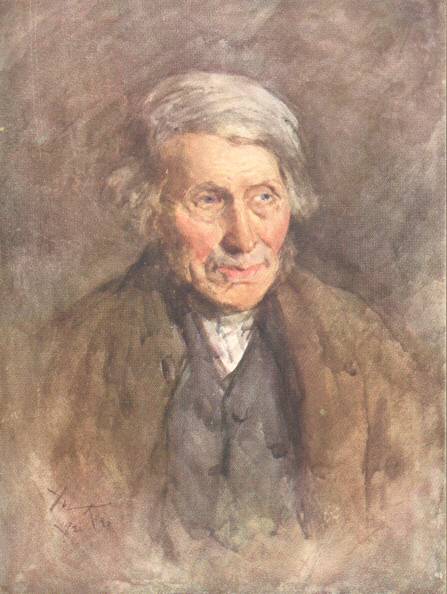
Thus ended the history of Mrs. Malcolm, as connected with ourParish Annals. Her house was sold, and is the same nowinhabited by the millwright, Mr. Periffery; and a neat house itstill is, for the possessor is an Englishman, and the Englishhave an uncommon taste for snod houses and trim gardens; but atthe time it was built, there was not a better in the town, thoughit’s now but of the second class. Yearly we hear bothfrom Mrs. Macadam and her sister, with a five-pound note fromeach to the poor of the parish, as a token of their remembrance;but they are far off, and, were any thing ailing me, I supposethe gift will not be continued. As for Captain Malcolm, hehas proved, in many ways, a friend to such of our young men ashave gone to sea. He has now left it off himself, andsettled at London, where he latterly sailed from, and, Iunderstand, is in a great way as a shipowner. These thingsI have thought it fitting to record, and will now resume myhistorical narration.
p.234CHAPTER XLI
YEAR 1800The same quietude and regularitythat marked the progress of the last year, continued throughoutthe whole of this. We sowed and reaped in tranquillity,though the sough of distant war came heavily from adistance. The cotton-mill did well for the company, andthere was a sobriety in the minds of the spinners and weavers,which showed that the crisis of their political distemperaturewas over;—there was something more of the old prudence inmen’s reflections; and it was plain to see that theelements of reconciliation were coming together throughout theworld. The conflagration of the French Revolution wasindeed not extinguished, but it was evidently burning out; andtheir old reverence for the Grand Monarque was beginning torevive among them, though they only called him a consul. Upon the king’s fast I preached on this subject; and whenthe peace was concluded, I got great credit for my foresight, butthere was no merit in’t. I had only lived longer thanthe most of those around me, and had been all my days a closeobserver of the signs of the times; so that what was lightlycalled prophecy and prediction, were but a probability thatexperience had taught me to discern.
In the affairs of the parish, the most remarkable generality(for we had no particular catastrophe) was a great death of oldpeople in the spring. Among others, Miss Sabrina, theschool mistress, paid the debt of nature, but we could now betterspare her than we did her predecessor; for at Cayenneville therewas a broken manufacturer’s wife, an excellent teacher, anda genteel and modernised woman, who took the better order ofchildren; and Miss Sabrina having been long frail (for she wasnever stout), a decent and discreet carlin, Mrs. M‘Caffie,the widow of a custom-house officer, that was a native of theparish, set up another for plainer work. Her oppositionMiss Sabrina did not mind, but she was sorely displeased at theinterloping of Mrs. Pirn at Cayenneville, and some said it helpedto kill her—of that, however, I am not so certain; for Dr.Tanzey had told me in the winter, that he thought the sharp windsin March would blow out her candle, as it was burnt to the snuff;accordingly, she took her departure from this life, on thetwenty-fifth day of that month, after there had, for some daysprior, been a most cold and piercing east wind.
Miss Sabrina, who was always an oddity and aping grandeur, itwas found, had made a will, leaving her gatherings to herfavourites, with all regular formality. To one shebequeathed a gown, to another this, and a third that, and to me apair of black silk stockings. I was amazed when I heardthis; but judge what I felt, when a pair of old marrowlessstockings, darned in the heel, and not whole enough in the legsto make a pair of mittens to Mrs. Balwhidder, were delivered tome by her executor, Mr. Caption, the lawyer. Saving,however, this kind of flummery, Miss Sabrina was a harmlesscreature, and could quote poetry in discourse more glibly thantexts of Scripture—her father having spared no pains on hermind: as for her body, it could not be mended; but that was nother fault.
After her death, the session held a consultation, and weagreed to give the same salary that Miss Sabrina enjoyed to Mrs.M‘Caffie, which angered Mr. Cayenne, who thought it shouldhave been given to the head mistress; and it made him give Mrs.Pirn, out of his own pocket, double the sum. But weconsidered that the parish funds were for the poor of the parish,and therefore it was our duty to provide for the instruction ofthe poor children. Saving, therefore, those few notations,I have nothing further to say concerning the topics and progressof this Ann. Dom.
p.237CHAPTER XLII
YEAR 1801It is often to me very curious foodfor meditation, that as the parish increased in population, thereshould have been less cause for matter to record. Thingsthat in former days would have occasioned great discourse andcogitation, are forgotten with the day in which they happen; andthere is no longer that searching into personalities which was somuch in vogue during the first epoch of my ministry, which Ireckon the period before the American war; nor has there been anysuch germinal changes among us, as those which took place in thesecond epoch, counting backward from the building of thecotton-mill that gave rise to the town of Cayenneville. Butstill we were not, even at this era, of which this Ann. Dom. isthe beginning, without occasional personality, or an event thatdeserved to be called a germinal.
Some years before, I had noted among the callans at Mr.Lorimore’s school a long soople laddie, who, like allbairns that grow fast and tall, had but little smeddum. Hecould not be called a dolt, for he was observant and thoughtful,and giving to asking sagacious questions; but there was asleepiness about him, especially in the kirk, and he gave, as themaster said, but little application to his lessons, so that folkthought he would turn out a sort of gaunt-at-the-door, moremindful of meat than work. He was, however, a good-naturedlad; and, when I was taking my solitary walks of meditation, Isometimes fell in with him sitting alone on the brae by thewater-side, and sometimes lying on the grass, with his handsunder his head, on the sunny green knolls where Mr. Cylinder, theEnglish engineer belonging to the cotton-work, has built thebonny house that he calls Diryhill Cottage. This was whenColin Mavis was a laddie at the school, and when I spoke to him,I was surprised at the discretion of his answers; so thatgradually I began to think and say, that there was more aboutColin than the neighbours knew. Nothing, however, for manya day, came out to his advantage; so that his mother, who was bythis time a widow woman, did not well know what to do with him,and folk pitied her heavy handful of such a droud.
By-and-by, however, it happened that one of the young clerksat the cotton-mill shattered his right-hand thumb by a gunbursting; and, being no longer able to write, was sent into thearmy to be an ensign, which caused a vacancy in the office; and,through the help of Mr. Cayenne, I got Colin Mavis into theplace, where, to the surprise of everybody, he proved a wonderfuleident and active lad, and, from less to more, has come at thehead of all the clerks, and deep in the confidentials of hisemployers. But although this was a great satisfaction tome, and to the widow woman his mother, it somehow was not so muchso to the rest of the parish, who seemed, as it were, angry thatpoor Colin had not proved himself such a dolt as they hadexpected and foretold.
Among other ways that Colin had of spending his leisure, wasthat of playing music on an instrument, in which it was said hemade a wonderful proficiency; but being long and thin, and of adelicate habit of body, he was obligated to refrain from thisrecreation; so he betook himself to books, and from reading hebegan to try writing; but, as this was done in a corner, nobodyjealoused what he was about, till one evening in this year hecame to the manse, and asked a word in private with me. Ithought that perhaps he had fallen in with a lass, and was cometo consult me anent matrimony; but when we were by ourselves, inmy study, he took out of his pocket a number of the ScotsMagazine, and said, “Sir, you have been long pleased tonotice me more than any other body, and when I got this, I couldnot refrain from bringing it, to let you see’t. Yemaun ken, sir, that I have been long in secret given to trying myhand at rhyme; and, wishing to ascertain what others thought ofmy power in that way, I sent by the post twa three verses to theScots Magazine, and they have not only inserted them, butplaced them in the body of the book, in such a way that I kennawhat to think.” So I looked at the Magazine, and readhis verses, which were certainly very well-made verses for onewho had no regular education. But I said to him, as theGreenock magistrates said to John Wilson, the author of“Clyde,” when they stipulated with him to give up theart, that poem-making was a profane and unprofitable trade, andhe would do well to turn his talent to something of moresolidity, which he promised to do; but he has since put out abook, whereby he has angered all those that had foretold he wouldbe a do-nae-gude. Thus has our parish walked sidy for sidywith all the national improvements, having an author of its own,and getting a literary character in the ancient and famousrepublic of letters.
p.241CHAPTER XLIII
YEAR 1802“Experience teachesfools,” was the first moral apothegm that I wrote in smalltext, when learning to write at the school, and I have ever sincethought it was a very sensible reflection. For assuredly,as year after year has flown away on the swift wings of time, Ihave found my experience mellowing, and my discernment improving;by which I have, in the afternoon of life, been enabled toforesee what kings and nations would do, by the symptomsmanifested within the bounds of the society around me. Therefore, at the beginning of the spring in this Ann. Dom., Ihad misgivings at the heart, a fluttering in my thoughts, andaltogether a strange uneasiness as to the stability of the peaceand harmony that was supposed to be founded upon a steadfastfoundation between us and the French people. What my fearsprincipally took their rise from, was a sort of compliancy, onthe part of those in power and authority, to cultivate the oldrelations and parts between them and the commonalty. It didnot appear to me that this proceeded from any known or decidedevent, for I read the papers at this period daily; but from somegeneral dread and fear, that was begotten, like a vapour out ofthe fermentation of all sorts of opinions; most people of anysagacity thinking that the state of things in France being somuch of an antic, poetical, and playactor-like guise, that itwould never obtain that respect, far less that reverence from theworld, which is necessary to the maintenance of all beneficialgovernment. The consequence of this was a great distrustbetween man and man, and an aching restlessness among those whohad their bread to bake in the world; persons possessing thepower to provide for their kindred, forcing them, as it were,down the throats of those who were dependent on them in business,a bitter morsel.
But the pith of these remarks chiefly applies to themanufacturing concerns of the new town of Cayenneville; for inthe clachan we lived in the lea of the dike, and were more takenup with our own natural rural affairs, and the markets forvictual, than the craft of merchandise. The only maninterested in business, who walked in a steady manner at his oldpace, though he sometimes was seen, being of a spunkie temper,grinding the teeth of vexation, was Mr. Cayenne himself.
One day, however, he came to me at the manse. “Doctor,” says he, for so he always called me,“I want your advice. I never choose to trouble otherswith my private affairs; but there are times when the word of anhonest man may do good. I need not tell you, that when Ideclared myself a Royalist in America, it was at a considerablesacrifice. I have, however, nothing to complain of againstgovernment on that score; but I think it damn’d hard thatthose personal connexions, whose interests I preserved to thedetriment of my own, should in my old age make such an ungratefulreturn. By the steps I took prior to quitting America, Isaved the property of a great mercantile concern in London. In return for that, they took a share with me, and for me, in thecotton-mill; and being here on the spot, as manager, I have bothmade and saved them money. I have, no doubt, bettered myown fortune in the mean time. Would you believe it, doctor,they have written a letter to me, saying that they wish toprovide for a relation, and requiring me to give up to him aportion of my share in the concern—a pretty sort ofproviding this, at another man’s expense! ButI’ll be damn’d if I do any such thing! If theywant to provide for their friend, let them do so from themselves,and not at my cost—What is your opinion?”
This appeared to me a very weighty concern, and, not beingversed in mercantile dealing, I did not well know what to say;but I reflected for some time, and then I replied, “As far,Mr. Cayenne, as my observation has gone in this world, I thinkthat the giffs and the gaffs nearly balance one another; and whenthey do not, there is a moral defect on the failing side. If a man long gives his labour to his employer, and is paid forthat labour, it might be said that both are equal; but I sayno. For it’s in human nature to be prompt to change;and the employer, having always more in his power than hisservant or agent, it seems to me a clear case, that in the courseof a number of years, the master of the old servant is theobligated of the two; and therefore I say, in the first place, inyour case there is no tie or claim, by which you may, in a moralsense, be called upon to submit to the dictates of your Londoncorrespondents; but there is a reason, in the nature of the thingand case, by which you may ask a favour from them—So, theadvice I would give you would be this: write an answer to theirletter, and tell them that you have no objection to the taking inof a new partner, but you think it would be proper to revise allthe copartnery, especially as you have, considering the manner inwhich you have advanced the business, been of opinion, that yourshare should be considerably enlarged.”
I thought Mr. Cayenne would have louped out of his skin withmirth at this notion; and, being a prompt man, he sat down at myscrutoire, and answered the letter which gave him so muchuneasiness. No notice was taken of it for some time; but inthe course of a month he was informed, that it was not consideredexpedient at that time to make any change in the company. Ithought the old man was gone by himself when he got thisletter. He came over instantly in his chariot, from thecotton-mill office to the manse, and swore an oath, by somedreadful name, that I was a Solomon. However, I onlymention this to show how experience had instructed me, and as asample of that sinister provisioning of friends that was going onin the world at this time—all owing, as I do verilybelieve, to the uncertain state of governments and nationalaffairs.
Besides these generalities, I observed another thing workingto effect—mankind read more, and the spirit of reflectionand reasoning was more awake than at any time within myremembrance. Not only was there a handsomebookseller’s shop in Cayenneville, with a London newspaperdaily, but magazines, and reviews, and other newpublications.
Till this year, when a chaise was wanted we had to send toIrville; but Mr. Toddy of the Cross-Keys being in at Glasgow, hebought an excellent one at the second-hand, a portion of theeffects of a broken merchant, by which, from that period, we hadone of our own, and it proved a great convenience; for I, whonever but twice in my life before hired that kind of commodity,had it thrice during the summer, for a bit jaunt with Mrs.Balwhidder to divers places and curiosities in the county that Ihad not seen before, by which our ideas were greatly enlarged;indeed, I have always had a partiality for travelling, as one ofthe best means of opening the faculty of the mind, and givingclear and correct notions of men and things.
p.247CHAPTER XLIV
YEAR 1803During the tempestuous times thatensued, from the death of the King of France by the hands of theexecutioner in 1793, there had been a political schism among mypeople that often made me very uneasy. The folk belongingto the cotton-mill, and the muslin-weavers in Cayenneville, wereafflicted with the itch of jacobinism, but those of the villagewere stanch and true to king and country; and some of theheritors were desirous to make volunteers of the young men ofthem, in case of anything like the French anarchy and confusionrising on the side of the manufacturers. I, however, setmyself, at that time, against this, for I foresaw that the Frenchbusiness was but a fever which would soon pass off; but no mancould tell the consequence of putting arms in the hands ofneighbour against neighbour, though it was but in the way ofpolicy.
But when Bonaparte gathered his host fornent the Englishcoast, and the government at London were in terror of their livesfor an invasion, all in the country saw that there was danger,and I was not backward in sounding the trumpet to battle. For a time, however, there was a diffidence among ussomewhere. The gentry had a distrust of the manufacturers,and the farming lads were wud with impatience, that those whoshould be their leaders would not come forth. I, knowingthis, prepared a sermon suitable to the occasion, giving out fromthe pulpit myself, the Sabbath before preaching it, that it wasmy intent, on the next Lord’s day, to deliver a religiousand political exhortation on the present posture of publicaffairs. This drew a vast congregation of all ranks.
I trow that the stoor had no peace in the stuffing of thepulpit in that day; and the effect was very great and speedy: fornext morning the weavers and cotton-mill folk held a meeting, andthey, being skilled in the ways of committees and associatingtogether, had certain resolutions prepared, by which a select fewwas appointed to take an enrolment of all willing in the parishto serve as volunteers in defence of their king and country, andto concert with certain gentlemen named therein, about theformation of a corps, of which, it was an understood thing, thesaid gentlemen were to be the officers. The whole of thisbusiness was managed with the height of discretion; and theweavers, and spinners, and farming lads, vied with one anotherwho should be first on the list. But that which the mostsurprised me, was the wonderful sagacity of the committee innaming the gentlemen that should be the officers. I couldnot have made a better choice myself; for they were the bestbuilt, the best bred, and the best natured, in the parish. In short, when I saw the bravery that was in my people, and thespirit of wisdom by which it was directed, I said in my heart,the Lord of Hosts is with us, and the adversary shall notprevail.
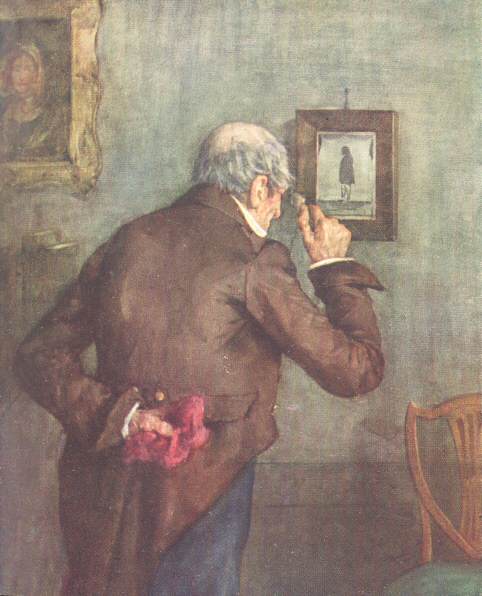
The number of valiant men which at that time placed themselvesaround the banners of their country was so great, that thegovernment would not accept of all who offered; so, like as inother parishes, we were obligated to make a selection, which waslikewise done in a most judicious manner, all men above a certainage being reserved for the defence of the parish, in the day whenthe young might be called to England to fight the enemy.
When the corps was formed, and the officers named, they mademe their chaplain, and Dr. Marigold their doctor. He was alittle man with a big belly, and was as crouse as a bantam cock;but it was not thought he could do so well in field exercises, onwhich account he was made the doctor, although he had no reputein that capacity in comparison with Dr. Tanzey, who was not,however, liked, being a stiff-mannered man, with a sharptemper.
All things having come to a proper head, the young ladies ofthe parish resolved to present the corps with a stand of colours,which they embroidered themselves, and a day was fixed for thepresentation of the same. Never was such a day seen inDalmailing. The sun shone brightly on that scene of braveryand grandeur, and far and near the country folk came flocking in;and we had the regimental band of music hired from the soldiersthat were in Ayr barracks. The very first sound o’tmade the hair on my old grey head to prickle up, and my blood torise and glow as if youth was coming again into my veins.
Sir Hugh Montgomerie was the commandant; and he came in allthe glory of war, on his best horse, and marched at the head ofthe men to the green-head. The doctor and me were therearguard: not being able, on account of my age and his fatness,to walk so fast as the quick-step of the corps. On thefield, we took our place in front, near Sir Hugh and the ladieswith the colours; and after some salutations, according to thefashion of the army, Sir Hugh made a speech to the men, and thenMiss Maria Montgomerie came forward, with her sister Miss Eliza,and the other ladies, and the banners were unfurled, allglittering with gold, and the king’s arms inneedlework. Miss Maria then made a speech, which she hadgot by heart; but she was so agitated that it was said she forgotthe best part of it: however, it was very well considering. When this was done, I then stepped forward, and laying my hat onthe ground, every man and boy taking off theirs, I said a prayer,which I had conned most carefully, and which I thought the mostsuitable I could devise, in unison with Christian principles,which are averse to the shedding of blood; and I particularlydwelt upon some of the specialities of our situation.
When I had concluded, the volunteers gave three great shouts,and the multitude answered them to the same tune, and all theinstruments of music sounded, making such a bruit as could not besurpassed for grandeur—a long, and very circumstantialaccount of all which, may be read in the newspapers of thattime.
The volunteers, at the word of command, then showed us the waythey were to fight with the French, in the doing of which a saddisaster happened; for when they were charging bayonets, theycame towards us like a flood, and all the spectators ran; and Iran, and the doctor ran; but being laden with his belly, he couldnot run fast enough, so he lay down, and being just before me atthe time, I tumbled over him, and such a shout of laughter shookthe field as was never heard.
When the fatigues of the day were at an end, we marched to thecotton-mill, where, in one of the ware-houses, a vast table wasspread, and a dinner, prepared at Mr. Cayenne’s ownexpense, sent in from the Cross-Keys, and the whole corps, withmany of the gentry of the neighbourhood, dined with greatjollity, the band of music playing beautiful airs all thetime. At night there was a universal dance, gentle andsemple mingled together. All which made it plain to me,that the Lord, by this unison of spirit, had decreed our nationalpreservation; but I kept this in my own breast, lest it mighthave the effect to relax the vigilance of the kingdom. AndI should note that Colin Mavis, the poetical lad, of whom I havespoken in another part, made a song for this occasion that wasvery mightily thought of, having in it a nerve of valiant genius,that kindled the very souls of those that heard it.
p.253CHAPTER XLV
YEAR 1804In conformity with the alteredfashions of the age, in this year the session came to anunderstanding with me, that we should not inflict the commonchurch censures for such as made themselves liable thereto; butwe did not formally promulge our resolution as to this, wishingas long as possible to keep the deterring rod over the heads ofthe young and thoughtless. Our motive, on the one hand, wasthe disregard of the manufacturers in Cayenneville, who were,without the breach of truth, an irreligious people; and, on theother, a desire to preserve the ancient and wholesome admonitoryand censorian jurisdiction of the minister and elders. Wetherefore laid it down as a rule to ourselves, that, in the caseof transgressions on the part of the inhabitants of the newdistrict of Cayenneville, we should subject them rigorously to afine; but that for the farming-lads, we would put it in theiroption to pay the fine, or stand in the kirk.
We conformed also in another matter to the times, byconsenting to baptize occasionally in private houses. Hitherto it had been a strict rule with me only to baptize fromthe pulpit. Other parishes, however, had long been in thepractice of this relaxation of ancient discipline.
But all this on my part, was not done without compunction ofspirit; for I was of opinion, that the principle of Presbyterianintegrity should have been maintained to the uttermost. Seeing, however, the elders set on an alteration, I distrusted myown judgment, and yielded myself to the considerations thatweighed with them; for they were true men, and of a godlyhonesty, and took the part of the poor in all contentions withthe heritors, often to the hazard and damage of their owntemporal welfare.
I have now to note a curious thing, not on account of itsimportance, but to show to what lengths a correspondence had beenopened in the parish with the farthest parts of the earth. Mr. Cayenne got a turtle-fish sent to him from a Glasgowmerchant, and it was living when it came to the Wheatrig House,and was one of the most remarkable beasts that had ever been seenin our country side. It weighed as much as a well-fed calf,and had three kinds of meat in its body, fish, flesh, and fowl,and it had four water-wings, for they could not be properlycalled fins; but what was little short of a miracle about thecreature, happened after the head was cutted off, when, if afinger was offered to it, it would open its mouth and snap at it,and all this after the carcass was divided for dressing.
Mr. Cayenne made a feast on the occasion to many of theneighbouring gentry, to the which I was invited; and we dranklime-punch as we ate the turtle, which, as I understand, is thefashion in practice among the Glasgow West Indy merchants, whoare famed as great hands with turtles and lime-punch. Butit is a sort of food that I should not like to fare longupon. I was not right the next day; and I have heard itsaid, that when eaten too often, it has a tendency to harden theheart and make it crave for greater luxuries.
But the story of the turtle is nothing to that of the Mass,which, with all its mummeries and abominations, was brought intoCayenneville by an Irish priest of the name of FatherO’Grady, who was confessor to some of the poor deludedIrish labourers about the new houses and the cotton-mill. How he had the impudence to set up that memento of Satan, thecrucifix, within my parish and jurisdiction, was what I nevercould get to the bottom of; but the soul was shaken within me,when, on the Monday after, one of the elders came to the manse,and told me that the old dragon of Popery, with its seven headsand ten horns, had been triumphing in Cayenneville on theforegoing Lord’s day! I lost no time in convening thesession to see what was to be done; much, however, to mysurprise, the elders recommended no step to be taken, but only azealous endeavour to greater Christian excellence on our part, bywhich we should put the beast and his worshippers to shame andflight. I am free to confess, that, at the time, I did notthink this the wisest counsel which they might have given; for,in the heat of my alarm, I was for attacking the enemy in hiscamp. But they prudently observed, that the days ofreligious persecution were past, and it was a comfort to seemankind cherishing any sense of religion at all, after thevehement infidelity that had been sent abroad by the FrenchRepublicans; and to this opinion, now that I have had years tosift its wisdom, I own myself a convert and proselyte.
Fortunately, however, for my peace of mind, there proved to bebut five Roman Catholics in Cayenneville; and FatherO’Grady not being able to make a living there, packed uphis Virgin Marys, saints, and painted Agneses in a portmanteau,and went off in the Ayr fly one morning for Glasgow, where I hearhe has since met with all the encouragement that might beexpected from the ignorant and idolatrous inhabitants of thatgreat city.
Scarcely were we well rid of Father O’Grady, whenanother interloper entered the parish. He was moredangerous, in the opinion of the session, than even the Pope ofRome himself; for he came to teach the flagrant heresy ofUniversal Redemption, a most consolatory doctrine to the sinnerthat is loth to repent, and who loves to troll his iniquity likea sweet morsel under his tongue. Mr. Martin Siftwell, whowas the last ta’en on elder, and who had received a liberaland judicious education, and was, moreover, naturally possessedof a quick penetration, observed, in speaking of this newdoctrine, that the grossest papist sinner might have some qualmsof fear after he had bought the Pope’s pardon, and mightthereby be led to a reformation of life; but that the doctrine ofuniversal redemption was a bribe to commit sin, the wickedestmortal, according to it, being only liable to a few thousandyears, more or less, of suffering, which, compared with eternity,was but a momentary pang, like having a tooth drawn for thetoothache. Mr. Siftwell is a shrewd and clear-seeing man inpoints of theology, and I would trust a great deal to what hesays, as I have not, at my advanced age, such a mind for thekittle crudities of polemical investigation that I had in myyounger years, especially when I was a student in the DivinityHall of Glasgow.
It will be seen from all I have herein recorded, that, in thecourse of this year, there was a general resuscitation ofreligious sentiments; for what happened in my parish was but atype and index to the rest of the world. We had, however,one memorable that must stand by itself; for although neitherdeath nor bloodshed happened, yet was it cause of the fear ofboth.
A rumour reached us from the Clyde, that a French man-of-warhad appeared in a Highland loch, and that all the Greenockvolunteers had embarked in merchant vessels to bring her in for aprize. Our volunteers were just jumping and yowling, likechained dogs, to be at her too; but the colonel, Sir Hugh, woulddo nothing without orders from his superiors. Mr. Cayenne,though an aged man above seventy, was as bold as a lion, and cameforth in the old garb of an American huntsman, like, as I wastold, a Robin Hood in the play is; and it was just a sport to seehim, feckless man, trying to march so crousely with his lean,shaking hands. But the whole affair proved a false alarm,and our men, when they heard it, were as well pleased that theyhad been constrained to sleep in their warm beds at home, insteadof lying on coils of cables, like the gallant Greenocksharp-shooters.
p.259CHAPTER XLVI
YEAR 1805For some time I had meditated areformation in the parish, and this year I carried the same intoeffect. I had often noticed with concern, that, out of amistaken notion of paying respect to the dead, my people werewont to go to great lengths at their burials, and dealt roundshort-bread and sugar-biscuit, with wine and other confections,as if there had been no ha’d in their hands; whichstraitened many a poor family, making the dispensation of theLord a heavier temporal calamity than it should naturally havebeen. Accordingly, on consulting with Mrs. Balwhidder, whohas a most judicious judgment, it was thought that myinterference would go a great way to lighten the evil. Itherefore advised with those whose friends were taken from them,not to make that amplitude of preparation which used to be thefashion, nor to continue handing about as long as the folk wouldtake, but only at the very most to go no more than three timesround with the service. Objections were made to this, as ifit would be thought mean; but I put on a stern visage, and toldthem, that if they did more I would rise up, and rebuke andforbid the extravagance. So three services became theuttermost modicum at all burials. This was doing much, butit was not all that I wished to do.
I considered that the best reformations are those whichproceed step by step, and stop at that point where the consent towhat has been established becomes general; and so I governedmyself, and therefore interfered no farther; but I was determinedto set an example. Accordingly, at the very next dregy,after I partook of one service, I made a bow to the servitors andthey passed on, but all before me had partaken of the secondservice; some, however, of those after me did as I did, so Iforesaw that in a quiet canny way I would bring in the fashion ofbeing satisfied with one service. I therefore, from thattime, always took my place as near as possible to the door, wherethe chief mourner sat, and made a point of nodding away thesecond service, which has now grown into a custom, to the greatadvantage of surviving relations.
But in this reforming business I was not altogether pleasedwith our poet; for he took a pawkie view of my endeavours, andindited a ballad on the subject, in the which he makes aclattering carlin describe what took place, so as to turn a verysolemn matter into a kind of derision. When he brought hisverse and read it to me, I told him that I thought it was overlynatural; for I could not find another term to designate the causeof the dissatisfaction that I had with it; but Mrs. Balwhiddersaid that it might help my plan if it were made public; so uponher advice we got some of Mr. Lorimore’s best writers tomake copies of it for distribution, which was not without fruitand influence. But a sore thing happened at the very nextburial. As soon as the nodding away of the second servicebegan, I could see that the gravity of the whole meeting wasdiscomposed; and some of the irreverent young chiels almost brokeout into even-down laughter, which vexed me exceedingly. Mrs. Balwhidder, howsoever, comforted me by saying, that customin time would make it familiar, and by-and-by the thing wouldpass as a matter of course, until one service would be all thatfolk would offer; and truly the thing is coming to that, for onlytwo services are now handed round, and the second is regularlynodded by.
p.262CHAPTER XLVII
YEAR 1806Mr. Cayenne of Wheatrig having forseveral years been in a declining way, partly brought on by theconsuming fire of his furious passion, and partly by the decay ofold age, sent for me on the evening of the first Sabbath of Marchin this year. I was surprised at the message, and went tothe Wheatrig House directly, where, by the lights in the windowsas I gaed up through the policy to the door, I saw somethingextraordinary was going on. Sambo, the blackamoor servant,opened the door, and, without speaking, shook his head; for itwas an affectionate creature, and as fond of his master as if hehad been his own father. By this sign I guessed that theold gentleman was thought to be drawing near his latter end; so Iwalked softly after Sambo up the stair, and was shown into thechamber where Mr. Cayenne, since he had been confined to thehouse, usually sat. His wife had been dead some yearsbefore.
Mr. Cayenne was sitting in his easy chair, with a white cottonnightcap on his head, and a pillow at his shoulders to keep himstraight. But his head had fallen down on his breast, andhe breathed like a panting baby. His legs were swelled, andhis feet rested on a footstool. His face, which was wont tobe the colour of a peony rose, was of a yellow hue, with a patchof red on each cheek like a wafer; and his nose was shirpit andsharp, and of an unnatural purple. Death was evidentlyfighting with nature for the possession of the body. “Heaven have mercy on his soul!” said I to myself, asI sat down beside him.
When I had been seated some time, the power was given him toraise his head as it were a-jee; and he looked at me with thetail of his eye, which I saw was glittering and glassy. “Doctor,” for he always called me doctor, though I amnot of that degree, “I am glad to see you,” were hiswords, uttered with some difficulty.
“How do you find yourself, sir?” I replied, in asympathising manner.
“Damned bad,” said he, as if I had been the causeof his suffering. I was daunted to the very heart to hearhim in such an unregenerate state; but after a short pause Iaddressed myself to him again, saying, that “I hoped hewould soon be more at ease; and he should bear in mind that theLord chasteneth whom he loveth.”
“The devil take such love!” was his awful answer,which was to me as a blow on the forehead with a mell. However, I was resolved to do my duty to the miserable sinner,let him say what he would. Accordingly, I stooped towardshim with my hands on my knees, and said in a compassionate voice,“It’s very true, sir, that you are in great agony;but the goodness of God is without bound.”
“Curse me if I think so, doctor!” replied thedying uncircumcised Philistine. But he added at whiles, hisbreathlessness being grievous, and often broken by a sore hiccup,“I am, however, no saint, as you know, doctor; so I wishyou to put in a word for me, doctor; for you know that in thesetimes, doctor, it is the duty of every good subject to die aChristian.”
This was a poor account of the state of his soul; but it wasplain I could make no better o’t, by entering into anyreligious discourse or controversy with him, he being then in thelast gasp; so I knelt down and prayed for him with greatsincerity, imploring the Lord, as an awakening sense of grace tothe dying man, that it would please him to lift up, though itwere but for the season of a minute, the chastening hand whichwas laid so heavily upon his aged servant; at which Mr. Cayenne,as if, indeed, the hand had been then lifted, cried out,“None of that stuff, doctor; you know that I cannot callmyself his servant.”
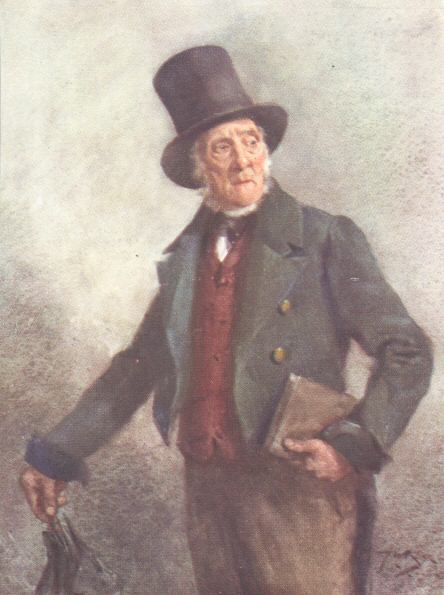
Was ever a minister in his prayer so broken in upon by aperishing sinner! However, I had the weight of a duty uponme, and made no reply, but continued, “Thou hearest, OLord, how he confesses his unworthiness! Let not thycompassion, therefore, be withheld, but verify to him the wordsthat I have spoken in faith, of the boundlessness of thygoodness, and the infinite multitude of thy tendermercies.” I then calmly, but sadly, sat down, andpresently, as if my prayer had been heard, relief was granted;for Mr. Cayenne raised his head, and giving me a queer look,said, “That last clause of your petition, doctor, was wellput, and I think, too, it has been granted, for I ameasier”—adding, “I have no doubt, doctor, givenmuch offence in the world, and oftenest when I meant to do good;but I have wilfully injured no man; and as God is my judge, andhis goodness, you say, is so great, he may, perhaps, take my soulinto his holy keeping.” In saying which words, Mr.Cayenne dropped his head upon his breast, his breathing ceased,and he was wafted away out of this world with as little troubleas a blameless baby.
This event soon led to a change among us. In thesettling of Mr. Cayenne’s affairs in the Cotton-millCompany, it was found that he had left such a power of money,that it was needful to the concern, in order that they mightsettle with the doers under his testament, to take in otherpartners. By this Mr. Speckle came to be a resident in theparish, he having taken up a portion of Mr. Cayenne’sshare. He likewise took a tack of the house and policy ofWheatrig. But although Mr. Speckle was a far moreconversible man than his predecessor, and had a wonderfulplausibility in business, the affairs of the company did notthrive in his hands. Some said this was owing to his havingowre many irons in the fire; others, to the circumstances of thetimes: in my judgment, however, both helped; but the issuebelongs to the events of another year. In the meanwhile, Ishould here note, that in the course of this current Ann. Dom. itpleased Heaven to visit me with a severe trial; the nature ofwhich I will here record at length—the upshot I will makeknown hereafter.
From the planting of inhabitants in the cotton-mill town ofCayenneville, or as the country folk, not used to used to suchlang-nebbit words, now call it, Canaille, there had come in uponthe parish various sectarians among the weavers, some of whomwere not satisfied with the gospel as I preached it, andendeavoured to practise it in my walk and conversation; and theybegan to speak of building a kirk for themselves, and of gettinga minster that would give them the gospel more to their ownignorant fancies. I was exceedingly wroth and disturbedwhen the thing was first mentioned to me; and I very earnestly,from the pulpit, next Lord’s day, lectured on the growth ofnewfangled doctrines; which, however, instead of having thewonted effect of my discourses, set up the theological weavers ina bleeze, and the very Monday following they named a committee,to raise money by subscription to build a meeting-house. This was the first overt act of insubordination, collectivelymanifested, in the parish; and it was conducted with all thatcrafty dexterity with which the infidel and jacobin spirit of theFrench Revolution had corrupted the honest simplicity of our goodold hameward fashions. In the course of a very short time,the Canaille folk had raised a large sum, and seduced not a fewof my people into their schism, by which they were enabled to setabout building their kirk; the foundations thereof were not,however, laid till the following year, but their proceedings gaveme a het heart, for they were like an open rebellion to myauthority, and a contemptuous disregard of that religiousallegiance which is due from the flock to the pastor.
On Christmas-day the wind broke off the main arm of our Adamand Eve pear-tree; and I grieved for it more as a type and signof the threatened partition, than on account of the damage,though the fruit was the juiciest in all the country side.
p.268CHAPTER XLVIII
YEAR 1807This was a year to me ofsatisfaction in many points; for a greater number of my youngerflock married in it, than had done for any one of ten yearsprior. They were chiefly the offspring of the marriagesthat took place at the close of the American war; and I waspleased to see the duplification of well-doing, as I thinkmarrying is, having always considered the command to increase andmultiply, a holy ordinance, which the circumstances of this worldbut too often interfere to prevent.
It was also made manifest to me, that in this year there was avery general renewal in the hearts of men, of a sense of theutility, even in earthly affairs, of a religious life: in some, Itrust it was more than prudence, and really a birth ofgrace. Whether this was owing to the upshot of the FrenchRevolution, all men being pretty well satisfied in their minds,that uproar and rebellion make but an ill way of righting wrongs,or that the swarm of unruly youth the offspring, as I have said,of the marriages after the American war, had grown sobered fromtheir follies, and saw things in a better light, I cannot takeupon me to say. But it was very edifying to me, theirminister, to see several lads who had been both wild and free intheir principles, marrying with sobriety, and taking their wivesto the kirk with the comely decorum of heads of families.
But I was now growing old, and could go seldomer out among mypeople than in former days; so that I was less a partaker oftheir ploys and banquets, either at birth, bridal, orburial. I heard, however, all that went on at them, and Imade it a rule, after giving the blessing at the end of theceremony, to admonish the bride and bridegroom to ca’canny, and join trembling with their mirth. It behoved meon one occasion, however, to break through a rule that age andfrailty had imposed upon me, and to go to the wedding of TibbyBanes, the daughter of the betheral, because she had once been aservant in the manse, besides the obligation upon me, from herfather’s part both in the kirk and kirkyard. Mrs.Balwhidder went with me, for she liked to countenance thepleasantries of my people; and, over and above all, it was apay-wedding, in order to set up the bridegroom in a shop.
There was, to be sure, a great multitude, gentle and semple,of all denominations, with two fiddles and a bass, and thevolunteers’ fife and drum; and the jollity that went on wasa perfect feast of itself, though the wedding-supper was aprodigy of abundance. The auld carles kecklet with fainnessas they saw the young dancers; and the carlins sat on forms, asmim as May puddocks, with their shawls pinned apart, to showtheir muslin napkins. But, after supper, when they had gota glass of the punch, their heels showed their mettle, andgrannies danced with their oyes, holding out their hands as ifthey had been spinning with two rocks. I told Colin Mavis,the poet, than an Infarewas a fine subject for his muse;and soon after he indited an excellent ballad under that title,which he projects to publish, with other ditties, bysubscription; and I have no doubt a liberal and discerning publicwill give him all manner of encouragement, for that is the foodof talent of every kind; and without cheering, no one can saywhat an author’s faculty naturally is.
p.271CHAPTER XLIX
YEAR 1808Through all the wars that haveraged from the time of the King’s accession to the throne,there has been a gradually coming nearer and nearer to our gates,which is a very alarming thing to think of. In the first,at the time he came to the crown, we suffered nothing. Notone belonging to the parish was engaged in the battles thereof;and the news of victories, before they reached us, which wasgenerally by word of mouth, were old tales. In the Americanwar, as I have related at length, we had an immediateparticipation; but those that suffered were only a fewindividuals, and the evil was done at a distance, and reached usnot until the worst of its effects were spent. And duringthe first term of the present just and necessary contest for allthat is dear to us as a people, although, by the offswarming ofsome of our restless youth, we had our part and portion in commonwith the rest of the Christian world; yet still there was at homea great augmentation of prosperity, and every thing had thrivenin a surprising manner; somewhat, however, to the detriment ofour country simplicity. By the building of the cotton-mill,and the rising up of the new town of Cayenneville, we hadintromitted so much with concerns of trade, that we were become apart of the great web of commercial reciprocities, and felt inour corner and extremity, every touch or stir that was made onany part of the texture. The consequence of this I have nowto relate.
Various rumours had been floating about the business of thecotton manufacturers not being so lucrative as it had been; andBonaparte, as it is well known, was a perfect limb of Satanagainst our prosperity, having recourse to the most wicked meansand purposes to bring ruin upon us as a nation. Hiscantrips, in this year, began to have a dreadful effect.
For some time it had been observed in the parish, that Mr.Specle of the cotton-mill, went very often to Glasgow, and wassometimes off at a few minutes’ warning to London; and theneighbours began to guess and wonder at what could be the causeof all this running here, and riding there, as if the little-gudewas at his heels. Sober folk augured ill o’t; and itwas remarked, likewise, that there was a haste and confusion inhis mind, which betokened a foretaste of some change offortune. At last, in the fulness of time, the babe wasborn.
On a Saturday night, Mr. Speckle came out late from Glasgow;on the Sabbath he was with all his family at the kirk, looking asa man that had changed his way of life; and on the Monday, whenthe spinners went to the mill, they were told that the companyhad stopped payment. Never did a thunder-clap daunt theheart like this news; for the bread in a moment was snatched frommore than a thousand mouths. It was a scene not to bedescribed, to see the cotton-spinners and the weavers, with theirwives and children, standing in bands along the road, all lookingand speaking as if they had lost a dear friend or parent. For my part, I could not bear the sight, but hid myself in mycloset, and prayed to the Lord to mitigate a calamity whichseemed to me past the capacity of man to remedy; for what couldour parish fund do in the way of helping a whole town, thussuddenly thrown out of bread?
In the evening, however, I was strengthened, and convened theelders at the manse to consult with them on what was best to bedone; for it was well known that the sufferers had made noprovision for a sore foot. But all our gathered judgmentscould determine nothing; and therefore we resolved to wait theissue, not doubting but that He who sends the night, would bringthe day in His good and gracious time, which so fell out. Some of them who had the largest experience of such vicissitudes,immediately began to pack up their ends and their awls, and tohie them into Glasgow and Paisley in quest of employ; but thosewho trusted to the hopes that Mr. Speckle himself stillcherished, lingered long, and were obligated to submit to soredistress. After a time, however, it was found that thecompany was ruined; and the mill being sold for the benefit ofthe creditors, it was bought by another Glasgow company, who, bygetting a good bargain, and managing well, have it still, andhave made it again a blessing to the country. At the timeof the stoppage, however, we saw that commercial prosperity,flush as it might be, was but a perishable commodity, and fromthence, both by public discourse and private exhortation, I haverecommended to the workmen to lay up something for a reverse; andshowed that, by doing with their bawbees and pennies what thegreat do with their pounds, they might in time get a pose to helpthem in the day of need. This advice they have followed,and made up a Savings Bank, which is a pillow of comfort to manyan industrious head of a family.
But I should not close this account of the disaster thatbefell Mr. Speckle, and the cotton-mill company, without relatinga very melancholy case that was the consequence. Among theoverseers there was a Mr. Dwining, an Englishman from Manchester,where he had seen better days, having had himself there of hisown property, once as large a mill, according to report, as theCayenneville mill. He was certainly a man above the common,and his wife was a lady in every point; but they held themselvesby themselves, and shunned all manner of civility, giving uptheir whole attention to their two little boys, who were reallylike creatures of a better race than the callans of ourclachan.
On the failure of the company, Mr. Dwining was observed bythose who were present to be particularly distressed: his salarybeing his all; but he said little, and went thoughtfullyhome. Some days after he was seen walking by himself with apale face, a heavy eye, and slow step—all tokens of asorrowful heart. Soon after, he was missed altogether;nobody saw him. The door of his house was however open, andhis two pretty boys were as lively as usual, on the green beforethe door. I happened to pass when they were there, and Iasked them how their father and mother were. They said theywere still in bed, and would not waken, and the innocent lambstook me by the hand, to make me waken their parents. I knownot what was in it, but I trembled from head to foot, and I wasled in by the babies, as if I had not the power to resist. Never shall I forget what I saw in that bed.
* * * *
*I found a letter on the table; and I came away, locking thedoor behind me, and took the lovely prattling orphans home. I could but shake my head and weep, as I gave them to the care ofMrs. Balwhidder, and she was terrified but said nothing. Ithen read the letter. It was to send the bairns to agentleman, their uncle, in London. Oh! it is a terribletale; but the winding-sheet and the earth is over it. Isent for two of my elders. I related what I had seen. Two coffins were got, and the bodies laid in them; and the nextday, with one of the fatherless bairns in each hand, I followedthem to the grave, which was dug in that part of the kirkyardwhere unchristened babies are laid. We durst not take itupon us to do more; but few knew the reason, and some thought itwas because the deceased were strangers, and had no regularlair.
I dressed the two bonny orphans in the best mourning at my owncost, and kept them in the manse till we could get an answer fromtheir uncle, to whom I sent their father’s letter. Itstung him to the quick, and he came down all the way from London,and took the children away himself. Oh! he was a vexed manwhen the beautiful bairns, on being told he was their uncle, raninto his arms, and complained that their papa and mamma had sleptso long, that they would never waken.
p.277CHAPTER L
YEAR 1809As I come towards the events ofthese latter days, I am surprised to find myself not at all sodistinct in my recollection of them as in those of the first ofmy ministry; being apt to confound the things of one occasionwith those of another, which Mrs. Balwhidder says is anadmonishment to me to leave off my writing. But, pleaseGod, I will endeavour to fulfil this as I have through lifetried, to the best of my capacity, to do every other duty; and,with the help of Mrs. Balwhidder, who has a very clearunderstanding, I think I may get through my task in a creditablemanner, which is all I aspire after; not writing for a vainworld, but only to testify to posterity anent the great changesthat have happened in my day and generation—a period whichall the best-informed writers say, has not had its match in thehistory of the world since the beginning of time.
By the failure of the cotton-mill company, whose affairs werenot settled till the spring of this year, there was greatsuffering during the winter; but my people, those that stilladhered to the establishment, bore their share of thedispensation with meekness and patience, nor was there wantingedifying monuments of resignation even among the stravaigers.
On the day that the Canaille Meeting-house was opened, whichwas in the summer, I was smitten to the heart to see the emptyseats that were in my kirk; for all the thoughtless, and somethat I had a better opinion of, went to hear the openingdiscourse. Satan that day had power given to him to buffetme as he did Job of old; and when I looked around and saw theempty seats, my corruption rose, and I forgot myself in theremembering prayer; for when I prayed for all denominations ofChristians, and worshippers, and infidels, I could not speak ofthe schismatics with patience, but entreated the Lord to do withthe hobleshow at Cayenneville, as he saw meet in his displeasure,the which, when I came afterwards to think upon, I grieved atwith a sore contrition.
In the course of the week following, the elders, in a body,came to me in the manse, and after much commendation of my godlyministry, they said, that seeing I was now growing old, theythought they could not testify their respect for me in a bettermanner than by agreeing to get me a helper. But I would notat that time listen to such a proposal, for I felt no falling offin my powers of preaching; on the contrary, I found myselfgrowing better at it, as I was enabled to hold forth, in an easymanner, often a whole half hour longer, than I could do a dozenyears before. Therefore nothing was done in this year anentmy resignation; but during the winter, Mrs. Balwhidder was oftengrieved, in the bad weather, that I should preach, and, in short,so worked upon my affections, that I began to think it wasfitting for me to comply with the advice of my friends. Accordingly, in the course of the winter, the elders began tocast about for a helper; and during the bleak weather in theensuing spring, several young men spared me from the necessity ofpreaching. But this relates to the concerns of the next andlast year of my ministry. So I will now proceed to give anaccount of it, very thankful that I have been permitted, inunmolested tranquillity, to bring my history to such a point.
p.280CHAPTER LI
YEAR 1810My tasks are all near a close; andin writing this final record of my ministry, the very sound of mypen admonishes me that my life is a burden on the back of flyingTime, that he will soon be obliged to lay down in his greatstorehouse—the grave. Old age has, indeed, longwarned me to prepare for rest; and the darkened windows of mysight show that the night is coming on, while deafness, like adoor fast barred, has shut out all the pleasant sounds of thisworld, and inclosed me, as it were, in a prison, even from thevoices of my friends.
I have lived longer than the common lot of man, and I haveseen, in my time, many mutations and turnings, and ups and downs,notwithstanding the great spread that has been in our nationalprosperity. I have beheld them that were flourishing likethe green bay-trees, made desolate, and their branchesscattered. But, in my own estate, I have had a large andliberal experience of goodness.
At the beginning of my ministry I was reviled and rejected;but my honest endeavours to prove a faithful shepherd wereblessed from on high, and rewarded with the affection of myflock. Perhaps, in the vanity of doting old age, I thoughtin this there was a merit due to myself, which made the Lord tosend the chastisement of the Canaille schism among my people; forI was then wroth without judgment, and by my heat hastened intoan open division the flaw that a more considerate manner mighthave healed. But I confess my fault, and submit my cheek tothe smiter; and now I see that the finger of Wisdom was in thatprobation, and it was far better that the weavers meddled withthe things of God, which they could not change, than with thoseof the King, which they could only harm. In that matter,however, I was like our gracious monarch in the American war; forthough I thereby lost the pastoral allegiance of a portion of mypeople, in like manner as he did of his American subjects, yet,after the separation, I was enabled so to deport myself, thatthey showed me many voluntary testimonies of affectionaterespect, and which it would be a vain glory in me to rehearsehere. One thing I must record, because it is as much totheir honour as it is to mine.
When it was known that I was to preach my last sermon, everyone of those who had been my hearers, and who had seceded to theCanaille meeting, made it a point that day to be in the parishkirk, and to stand in the crowd, that made a lane of reverencefor me to pass from the kirk-door to the back-yett of themanse. And shortly after, a deputation of all theirbrethren, with their minister at their head, came to me onemorning, and presented to me a server of silver, in token, asthey were pleased to say, of their esteem for my blameless life,and the charity that I had practised towards the poor of allsects in the neighbourhood; which is set forth in a well-pennedinscription, written by a weaver lad that works for his dailybread. Such a thing would have been a prodigy at thebeginning of my ministry; but the progress of book-learning andeducation has been wonderful since, and with it has come a spiritof greater liberality than the world knew before, bringing men ofadverse principles and doctrines into a more humane communionwith each other; showing that it’s by the mollifyinginfluence of knowledge the time will come to pass, when the tigerof papistry shall lie down with the lamb of reformation, and thevultures of prelacy be as harmless as the presbyterian doves;when the independent, the anabaptist, and every other order anddenomination of Christians, not forgetting even those poor weewrens of the Lord, the burghers and anti-burghers, who will pickfrom the hand of patronage, and dread no snare.
On the next Sunday, after my farewell discourse, I took thearm of Mrs. Balwhidder, and with my cane in my hand, walked toour own pew, where I sat some time; but, owing to my deafness,not being able to hear, I have not since gone back to thechurch. But my people are fond of having their weans stillchristened by me, and the young folk, such as are of a seriousturn, come to be married at my hands, believing, as they say,that there is something good in the blessing of an aged gospelminister. But even this remnant of my gown I must layaside; for Mrs. Balwhidder is now and then obliged to stop me inmy prayers, as I sometimes wander—pronouncing the baptismalblessing upon a bride and bridegroom, talking as if they werealready parents. I am thankful, however, that I have beenspared with a sound mind to write this book to the end; but it ismy last task, and, indeed, really I have no more to say, savingonly to wish a blessing on all people from on high, where I soonhope to be, and to meet there all the old and long-departed sheepof my flock, especially the first and second Mrs.Balwhidders.
FOOTNOTES.
[1] Dreghorn, Ayrshire, two miles fromIrvine.
[9] Irvine, Ayrshire.
[17] Cognac.
- Recently updated
-
-
2026-07-29 21:17:29The Project Gutenberg eBook of The Real Cyberpunk Fakebook, by St. Jude et al.
-
2026-07-29 21:17:29Memoirs of Carwin the Biloquist, by Charles Brockden Brown
-
2026-07-29 21:17:29The Importance of Being Earnest
-
2026-07-29 21:17:29Memoirs of Carwin the Biloquist, by Charles Brockden Brown
-
2026-07-29 21:17:29The Project Gutenberg eBook of Apology, by Plato
-
2026-07-29 21:17:29The Importance of Being Earnest
-
2026-07-29 21:17:29The Importance of Being Earnest
-
2026-07-29 21:17:29Poems of Henry Timrod,
-
- Hot ranking
-
-
2026-07-29 21:17:29The Project Gutenberg eBook of The Chignecto Isthmus and Its First Settlers, by Howard Trueman
-
2026-07-29 21:17:29The Importance of Being Earnest
-
2026-07-29 21:17:29Poems of Henry Timrod,
-
2026-07-29 21:17:29Poems of Henry Timrod,
-
2026-07-29 21:17:29Sarrasine, by Honore de Balzac
-
2026-07-29 21:17:29Poems of Henry Timrod,
-
2026-07-29 21:17:29The Importance of Being Earnest
-
2026-07-29 21:17:29Poems of Henry Timrod,
-
- Friendly links
-
- gift ideas with pretend play capes for the whole family best kids costumes for 8 year olds under 30 dollars best scratch art kits for 8 year olds under 50 dollars educational push and pull toys for 18 months best montessori toys for 6 year olds under 30 dollars best snow toys for 5 year olds under 20 dollars best magnetic tiles for 4 year olds under 30 dollars best magnetic construction sets for 2 year olds under 50 dollars best kids keyboards for 10 year olds under 25 dollars educational kids soccer goals for 9 year olds
- George Silverman's Explanation, by Charles Dickens
- The Man Between, by Amelia E. Barr
- Ballads and Lyrics of Old France, by Andrew Lang
- The Project Gutenberg eBook of The Story of the Amulet, by E. Nesbit
- The Travels of Sir John Mandeville, by John Mandeville
- The Project Gutenberg eBook of Le tour du monde en quatre
- The Death of the Lion, by Henry James
- Memoir of Fleeming Jenkin, by Robert Louis Stevenson
- The Project Gutenberg eBook of James Otis, the Pre
- Henry James, Jr., by William Dean Howells